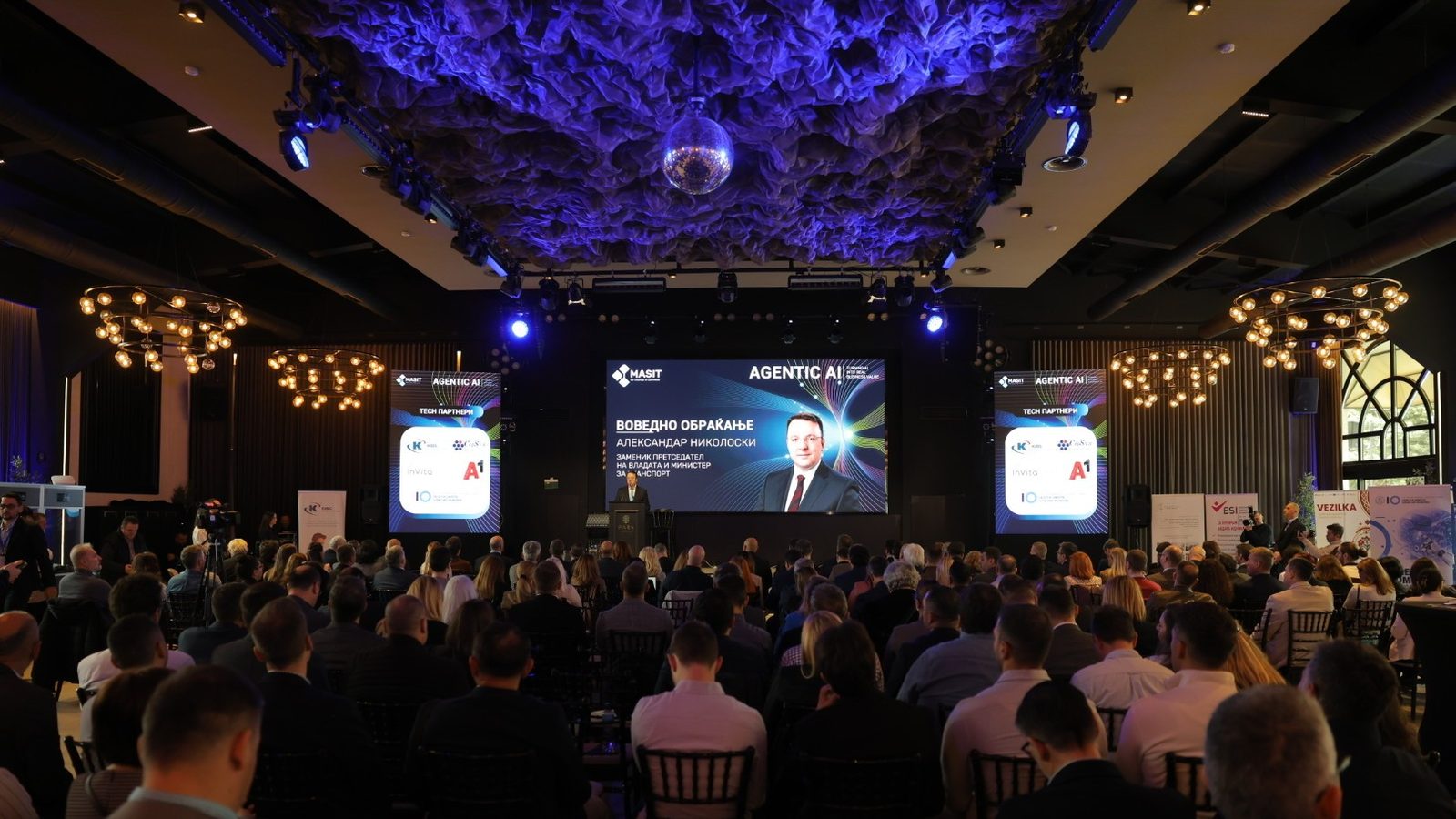
Stefan Andonovski: Those who use artificial intelligence will progress faster, others will stagnate
The minister presented the Vezilka project and urged investment in data centres and training to enable AI adoption across business and the public sector.

Stefan Andonovski, North Macedonia's Minister of Digital Transformation, warned that the adoption of artificial intelligence will be the dividing line between faster growth and stagnation for both businesses and the state.
Speaking before the start of the MASIT conference titled "Use of Artificial Intelligence as an Agent", Andonovski said: "The question for both the business sector and the state will be: those who use artificial intelligence can expect accelerated progress, and those who do not know how and cannot use artificial intelligence will be stuck with no progress or in stagnation."
Government projects and support for ICT
Andonovski said the Government continues to back the domestic ICT industry through two large initiatives, Digit Mak and Inofejt EDIH, which are intended to provide direct support to small and medium-sized enterprises by driving digital transformation. He said the focus will be on training, on practical use of AI tools and on projects that bring digital change to businesses.
On AI use inside state institutions, Andonovski described the phenomenon as new for administrations across the region and Europe, and outlined a flagship programme: "That's why we started 'Vezilka', a project of over 5.5 million euros, with which we are working in five sectors that also cover the public administration. That means building a large language model in the Macedonian language and then implementing it in the public sector. First, through trainings to prepare public sector employees for using these tools, and then through practical examples using AI tools and building certain systems on them. The first such memorandum we already signed in the Assembly, also in the Ministry of Education, we have one project in our ministry that will start, we also signed a memorandum, which means that it will slowly start to be used."
He stressed that the country lacks large data centres able to process AI workloads and that the government wants to attract investment and build a National Data Center to bring infrastructure closer to EU standards. "For too long we have deceived ourselves that by using foreign data centres, foreign systems and foreign agents we will be able to develop Macedonian progress. And that does not happen because the Macedonian language is small, we do not have a large language model in Macedonian because there is nowhere to build it. And here will be the key difference we are trying to make: attracting investment in data centres, construction of the National Data Center and thus infrastructurally approaching the European Union," he said.
Regarding protection of personal data in the "m-Services" mobile application, the minister said the personal data stored in the electronic versions of ID cards and driving licences are already held in the systems of the Ministry of Internal Affairs and are not being moved to a new location; the state's task is to guarantee their security and to finalize the procedural documentation. He added he expects that issue to be closed by the end of the year.
Jordan Dimitrovski, president of MASIT, highlighted that AI is already a present reality and pointed to research indicating heavy use of AI tools in the ICT sector. "According to Stack Overflow research, more than 85 percent of IT professionals already use IT tools and artificial intelligence," he said, arguing that wider adoption across other industries will boost competitiveness. Dimitrovski also noted shortages in cyber security and data science specialists and said that AI will shift tasks and require reskilling rather than simply eliminating jobs.
Photo: press material from the event