Francis Halzen awarded Nobel Prize in Physics
Halzen was honored for IceCube and the discovery of high‑energy neutrinos from astrophysical sources.
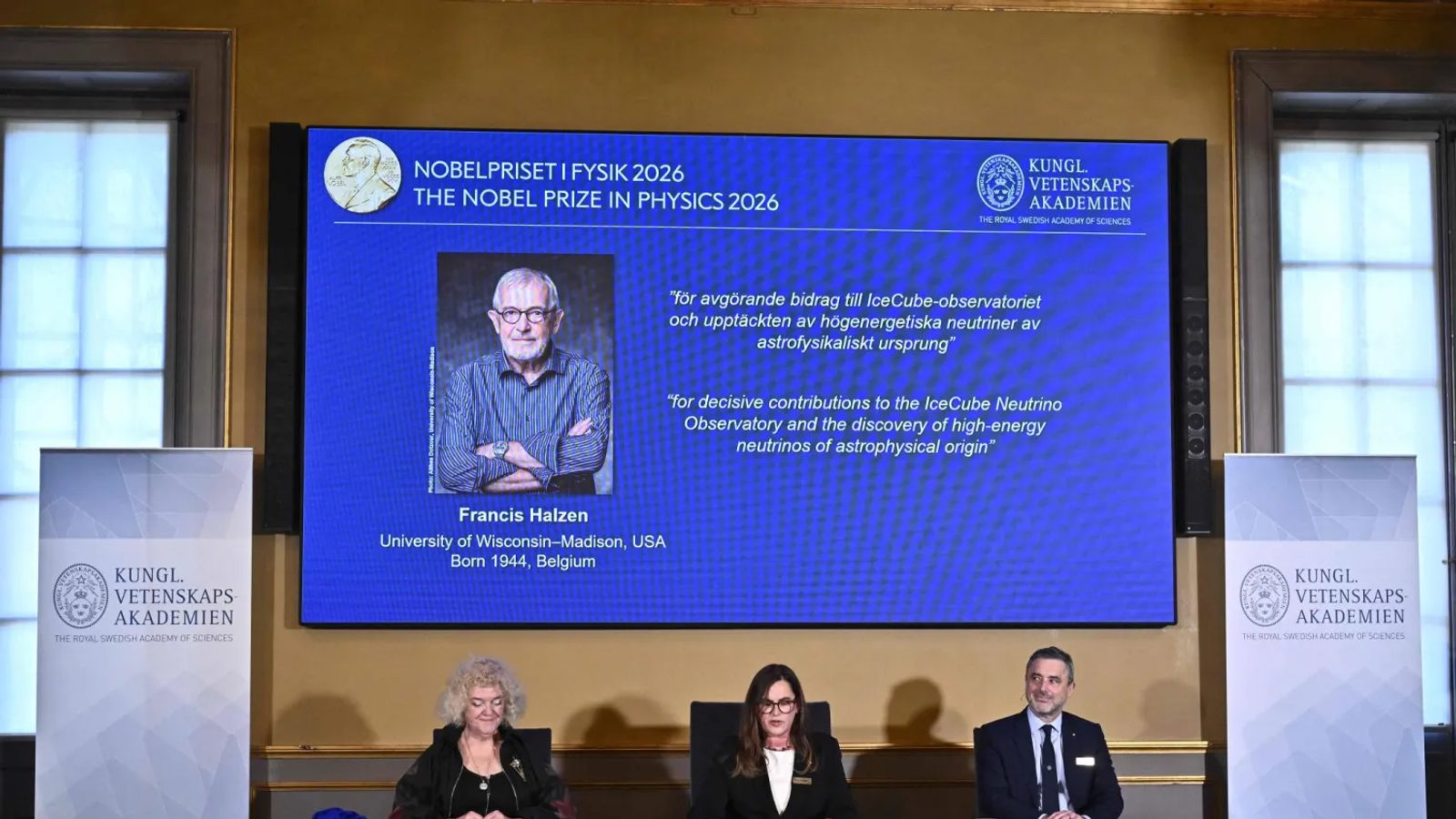
Belgian scientist Francis Halzen, 82, has been awarded the 2026 Nobel Prize in Physics for his leadership in the IceCube neutrino observatory and for the discovery of high-energy neutrinos of astrophysical origin.
"Francis Halzen led an international team of researchers and engineers who gave us a fantastic instrument. His persistence and scientific vision opened the way for a new kind of astronomy," said Mark Pirs, president of the Nobel Committee for Physics.
What Halzen and IceCube achieved
Halzen's work on detecting neutrinos at the South Pole began in the 1980s and eventually led to the construction of IceCube, a research facility embedded in the Antarctic ice. The project, whose leading institution is the University of Wisconsin–Madison, uses thousands of light sensors frozen into the ice to register faint flashes produced when neutrinos interact with material in the detector.
The prize recognizes both the technical achievement of building a detector capable of registering extremely rare, high-energy neutrinos and the discovery that some of these particles arrive from distant astrophysical sources. Detecting such neutrinos provides a new, complementary way to observe the universe, allowing scientists to study processes in places that are otherwise opaque to electromagnetic radiation.
Colleagues and collaborators have highlighted that the success of IceCube rests on decades of engineering, international cooperation and continuous upgrades to instrumentation and data analysis. Halzen's career and the observatory's results have opened new avenues for multimessenger astronomy, linking neutrino detections with observations across the electromagnetic spectrum and with gravitational-wave events.
The Nobel committee's decision underscores the growing importance of particle astrophysics in answering fundamental questions about the origin of cosmic rays and the mechanisms that power the universe's most energetic phenomena.
Photo: TT)