Power struggle at Poland's Constitutional Court accelerates after government‑backed judges take control
Judges selected by the Tusk coalition assumed leadership on 30 October 2026, deepening a constitutional crisis marked by protests, police action and competing claims to authority.
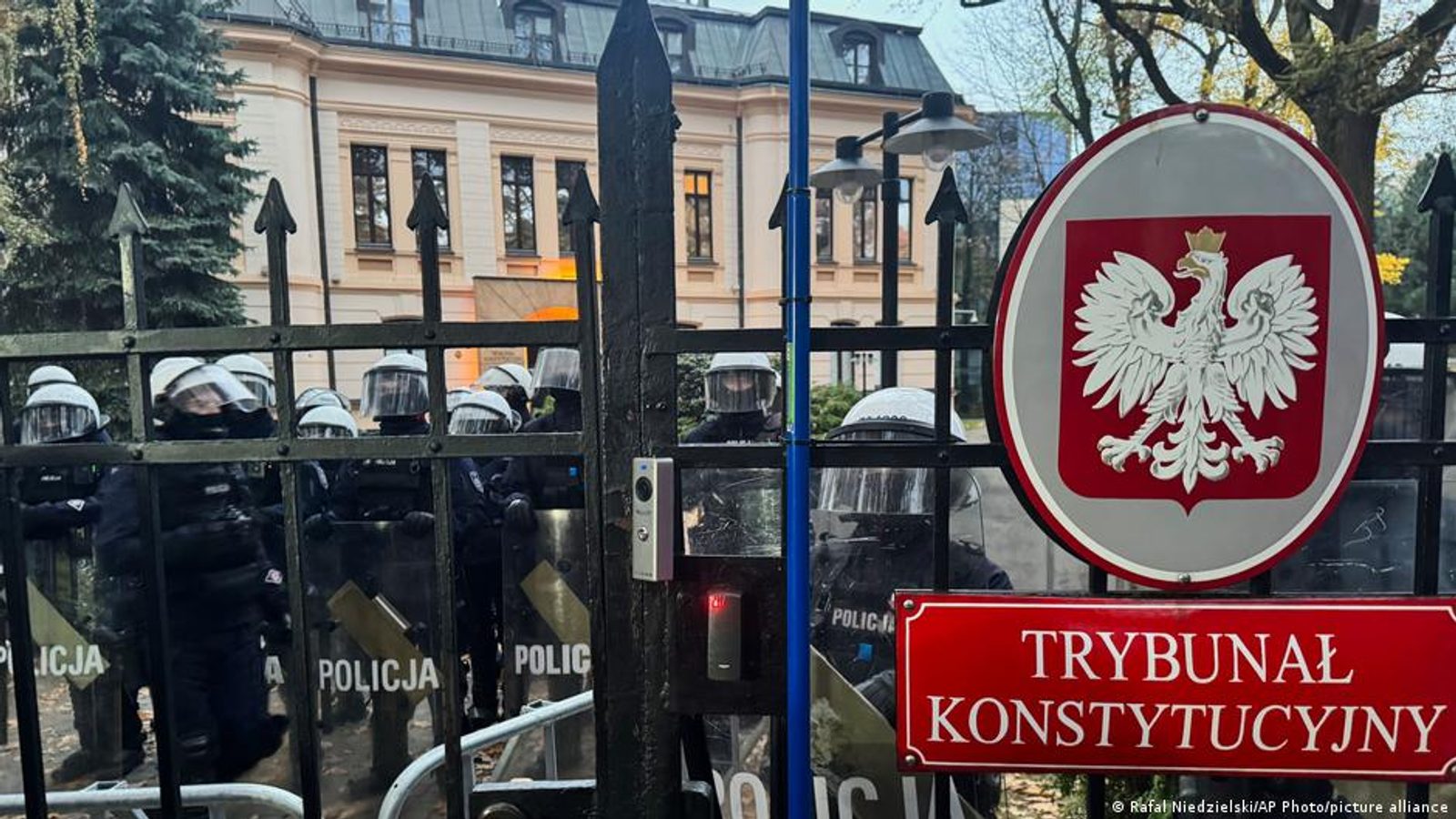
Poland's Constitutional Court has become the focal point of a sharp power struggle between Prime Minister Donald Tusk's pro‑European, centre‑left government and the right‑wing conservative opposition aligned with President Karol Nawrocki. Judges appointed by the Tusk coalition moved to assume leadership of the Court on Friday, 30 October 2026, deepening an already acute institutional crisis.
Backlog, dysfunction and a contested takeover
The Court has accumulated almost 1,000 unresolved cases, some pending for more than a decade, and this year failed even to approve its own budget for 2027. The European Court of Justice found in 2025 that the Polish Constitutional Court "is neither independent nor impartial," a finding that has shadowed the current confrontation.
The 15‑member bench is split between seven judges appointed during Law and Justice (PiS) rule from 2015 to 2023 and eight selected by the parliament after the December 2023 change of government. Bogdan Święczkowski, the Court's president and a former PiS politician, has refused to allow five of the newly appointed judges to take office, arguing they swore an oath before the speaker of parliament rather than before President Karol Nawrocki.
After months of waiting without duties or pay, the five new judges moved into action on the evening of 30 October. The most senior among them, Anna Korwin‑Piotrowska, declared herself head of the Court and ordered the immediate suspension of Święczkowski and his deputy Bartłomiej Sohanański for one month, also barring both from entering the Court's building.
Święczkowski rejected his suspension and said he remains the Court's president. Backed by PiS supporters camped for weeks outside the Court, he tried to cross a security cordon around the building but was stopped by police. Right‑wing and far‑right politicians, including Law and Justice leader Jarosław Kaczyński, used the standoff for political rallies; demonstrators chanted "Topple Tusk." Kaczyński wrote on X that "From today Poland becomes a police state" and warned the government's course led "directly to authoritarianism and totalitarianism."
President Nawrocki cut short a trip to Africa and returned to Warsaw. Pawel Schefernaker from the presidential office said: "Tonight the constitutional order of Poland was violated and a violent takeover of a state institution was carried out." Marcin Przydacz, the president's foreign policy adviser and state secretary, told reporters: "We are facing a very serious constitutional crisis in Poland. It is a direct consequence of the unlawful and violent actions of Tusk's government." He added: "The president is obliged to react whenever the Constitution and laws of Poland are violated."
PiS vice‑chair Tobiasz Bocheński went further, calling the moves "This is a coup." He compared the situation on television to the imposition of martial law by General Wojciech Jaruzelski in December 1981. A disputed physical incident also arose when Korwin‑Piotrowska and other judges said Nawrocki pushed them as he entered the Court; the president's spokesperson Rafał Leśkiewicz accused the judges of endangering the president's physical integrity and announced a planned criminal complaint.
Prime Minister Donald Tusk defended the judges on Saturday evening and justified police action to protect the Court. "A democratic state must be strong," he said in a televised address, adding: "The attack on the Court and its judges is another chapter in the process of destroying the rule of law in Poland by PiS and Presidents Duda and Nawrocki." Justice Minister Waldemar Żurek said he expected progress soon: "In a few weeks the first hearings and the review of the first cases will take place."
Korwin‑Piotrowska called a plenary session of the Constitutional Court for Tuesday, 3 November 2026, aiming to approve the Court's budget; a quorum of two‑thirds of judges is required. Legal opinion inside Poland is split: four former presidents of the Court — Marek Safjan, Jerzy Stępień, Bohdan Zdzienicki and Andrzej Zoll — backed the newly acting judges as having taken necessary steps to make the Court functional again, while the Polish Helsinki Foundation for Human Rights criticised the suspension of Święczkowski as legally "dubious" and warned of a dangerous precedent.
After the escalation on the night of 30–31 October, President Nawrocki invited party representatives to talks. Adrian Zandberg, leader of the Left Together party, discussed a possible "reset" that would see all current constitutional judges resign and new members chosen by a three‑fifths parliamentary majority — a compromise that would nonetheless require cooperation between the governing coalition and the opposition, now looking unlikely. The standoff leaves the Court's capacity to act uncertain and Poland's political class, as one editorial put it, under a deep strain: "Come to your senses," the editor urged, calling for a roundtable of senior jurists to seek an exit from the crisis.
Photo: press material from the event