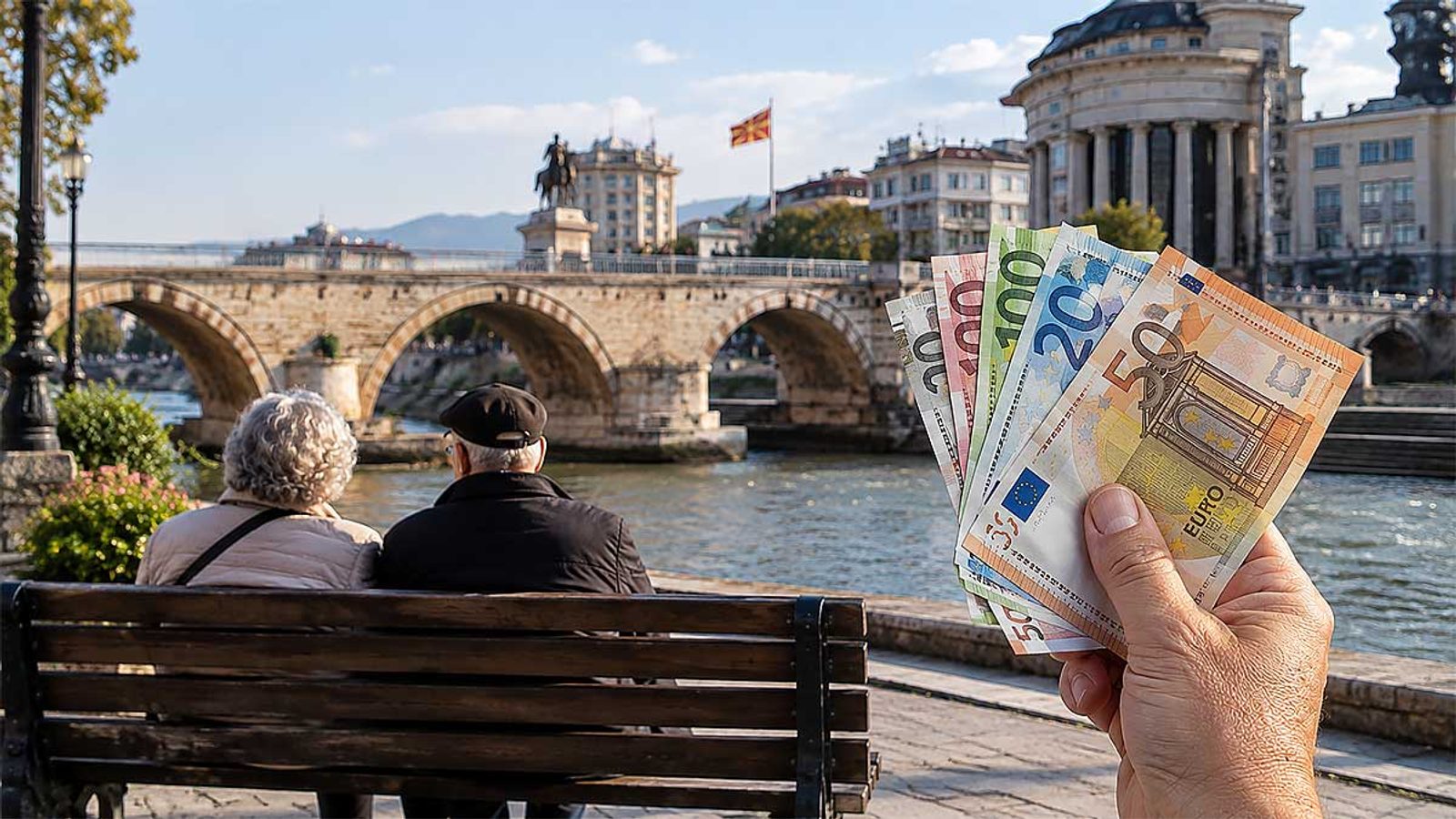
Pensions in North Macedonia likely to rise by around 3%
Initial calculations point to a 3–3.5% indexation for September; final figure will be announced after August inflation and wage data are finalised.

Pensioners in North Macedonia are counting the days until the final calculation for the September indexation is finished and the payment expected to land in accounts on October 1. After a phase of uniform (linear) increases, the next disbursement will return to the statutory percentage formula.
Minister of Social Policy, Demography and Youth Gjoko Velkovski said the latest statistical inputs for August inflation and wage growth will be finalised at the beginning of next week, after which the exact percentage will be announced. Initial estimates point to an increase between 3% and 3.5% for September pensions.
Unlike the recent flat top-up that granted the same fixed amount to all pensioners, a percentage adjustment raises higher pensions by a larger nominal sum while smaller pensions receive a smaller increase in denars. If the final indexation rate is 3%, the impact on monthly payments would be (examples):
- 20,000 denars → +600 denars
- 25,000 denars → +750 denars
- 30,000 denars → +900 denars
- 40,000 denars → +1,200 denars
- 50,000 denars → +1,500 denars
Article 37 of the Law on Pension and Disability Insurance mandates indexation twice a year, on March 1 and September 1. The statutory formula combines 50% of consumer price growth (inflation) and 50% of the change in the average paid net wage over the preceding half-year.
University professor and pension-system expert Jadranka Mršić warned that the process needs greater transparency. She said: "Adjustment is not a gift or social assistance. In a system of automatic statutory indexation, all statistical data must be published on time and officially, without political guesses or discretion," and called for timely, official release of the underlying statistics.
VMRO-DPMNE highlighted in a party statement that economic indicators show the average old-age pension rose in the past 23 months from 22,850 to over 29,700 denars, which they described as an average increase of about 300 denars per month.
European context: rising retirement ages
While local pensioners await the exact percentage, pension systems across Europe are moving toward stricter retirement ages because of longer lifespans and demographic shifts. OECD-based figures put the current EU average retirement age at about 64.7 years for men and 63.8 years for women.
Denmark has legislated a rise to age 70 by 2040, with projections suggesting a possible increase to 74 by 2060. Italy and Estonia plan to move toward 71, and the Netherlands, Sweden and Cyprus are shifting toward 70. Today the highest statutory retirement ages are in Denmark, Norway and Iceland at 67, while countries such as Germany, the Netherlands, the United Kingdom, Ireland and Portugal already have retirement ages above 65.
The OECD also projects that by 2060 the gender gap in retirement ages will largely disappear in most countries. At the same time, the average replacement rate in the EU stands at about 60% of pre-retirement earnings, with many countries below 50%, raising questions about the long-term sustainability of pension incomes across the continent.
Photo: press material from the event