Half of online shoppers in North Macedonia pay cash on delivery
Study shows strong gap between account and card ownership and actual use of digital payments; older, rural and lower‑income buyers rely most on cash.
The new report "Analysis of Cash-on-Delivery and Digital Payments in E‑commerce in North Macedonia, 2026", prepared by the Association for E‑commerce of North Macedonia (AETSM) with support from Visa and presented at the ninth Regional Conference on e‑commerce in Skopje, finds a large gap between financial access and the actual use of digital payment methods.
Access does not equal usage
Although 84.3% of adults in North Macedonia hold an account with a financial institution and 75.2% own a debit card, everyday use of digital channels remains limited. Only 27.4% of adults used a mobile phone or the internet to pay bills (compared with 61.8% in higher‑middle‑income economies), and just 28% used those channels to purchase goods and services versus 60.4% in the comparator group.
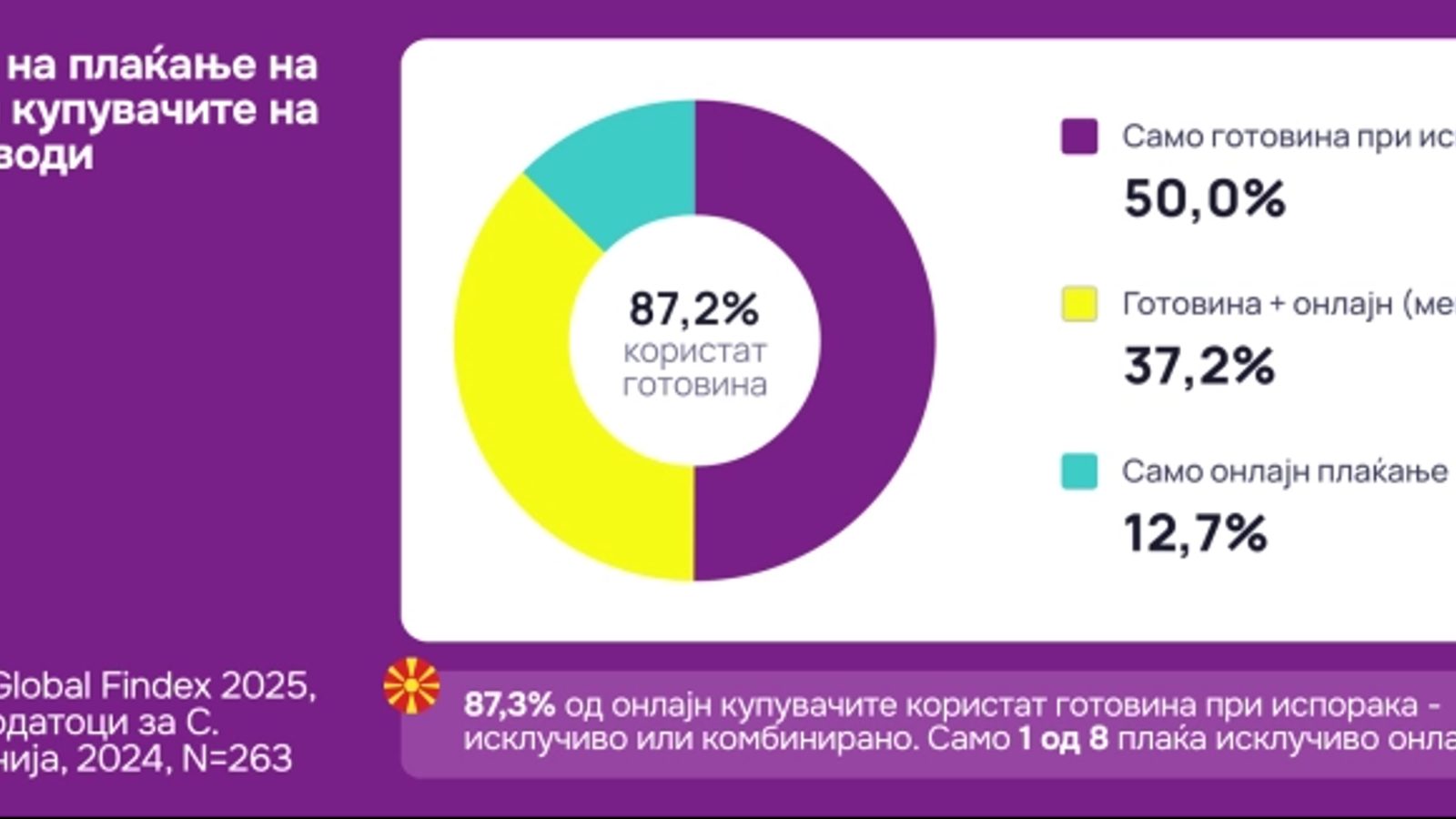
The Global Findex microdata (2025), collected in 2024 and analyzed for the report, show that about half of online shoppers in North Macedonia reported using digital payments (50%), similar to Serbia (49.3%), while the share reaches 90.9% in the higher‑middle‑income peer group. A detailed look at 263 respondents who bought physical goods online reveals that 50% pay exclusively in cash on delivery, 37.2% use both cash and online payments, and only 12.7% pay exclusively online — meaning 87.3% use cash on delivery at least sometimes.
Age is the strongest dividing line. Among online buyers aged 15–34, 40.3% pay only in cash on delivery; for those 35–54 the share is 49.4%; and it rises to 81.8% for shoppers aged 55 and over. The analysis shows that age remains strongly associated with cash use even after controlling for other demographic and socioeconomic variables.
There are also differences by location and income: in rural areas 60% of online buyers pay exclusively in cash, versus 41.4% in urban areas. Buyers in the two lowest income quintiles are cash‑only in 66.5% of cases, compared with 43.2% among the two highest quintiles. Gender makes almost no difference: 50.5% of female online buyers and 49.6% of male online buyers pay exclusively in cash.
"It is no longer enough to talk only about how many people buy online. We need to look at how they complete the purchase. The data show an interesting paradox — we have wide availability of bank accounts and payment cards, but half of online buyers still pay exclusively in cash on delivery. That means digitalization of shopping does not automatically mean digitalization of payment. If we want real progress, we must work on trust, digital literacy and on making online payment a simple, secure and attractive choice for all generations," said Dr. Nina Angelovska Stovank, president of the Association for E‑commerce of North Macedonia.
The report concludes that increasing digital payments requires more than technology: consumer trust, education, improved user experience and incentives are needed. The goal is not to abolish cash‑on‑delivery — which remains important for domestic e‑commerce — but to create conditions that make digital payment progressively more convenient and appealing.
Photo: press material from the event