Rumen Radev receives the mortal remains of Tsar Samuil in Thessaloniki
The handing-over took place at the Museum of Byzantine Culture; Greece will also return 48 liturgical objects seized during World War I.
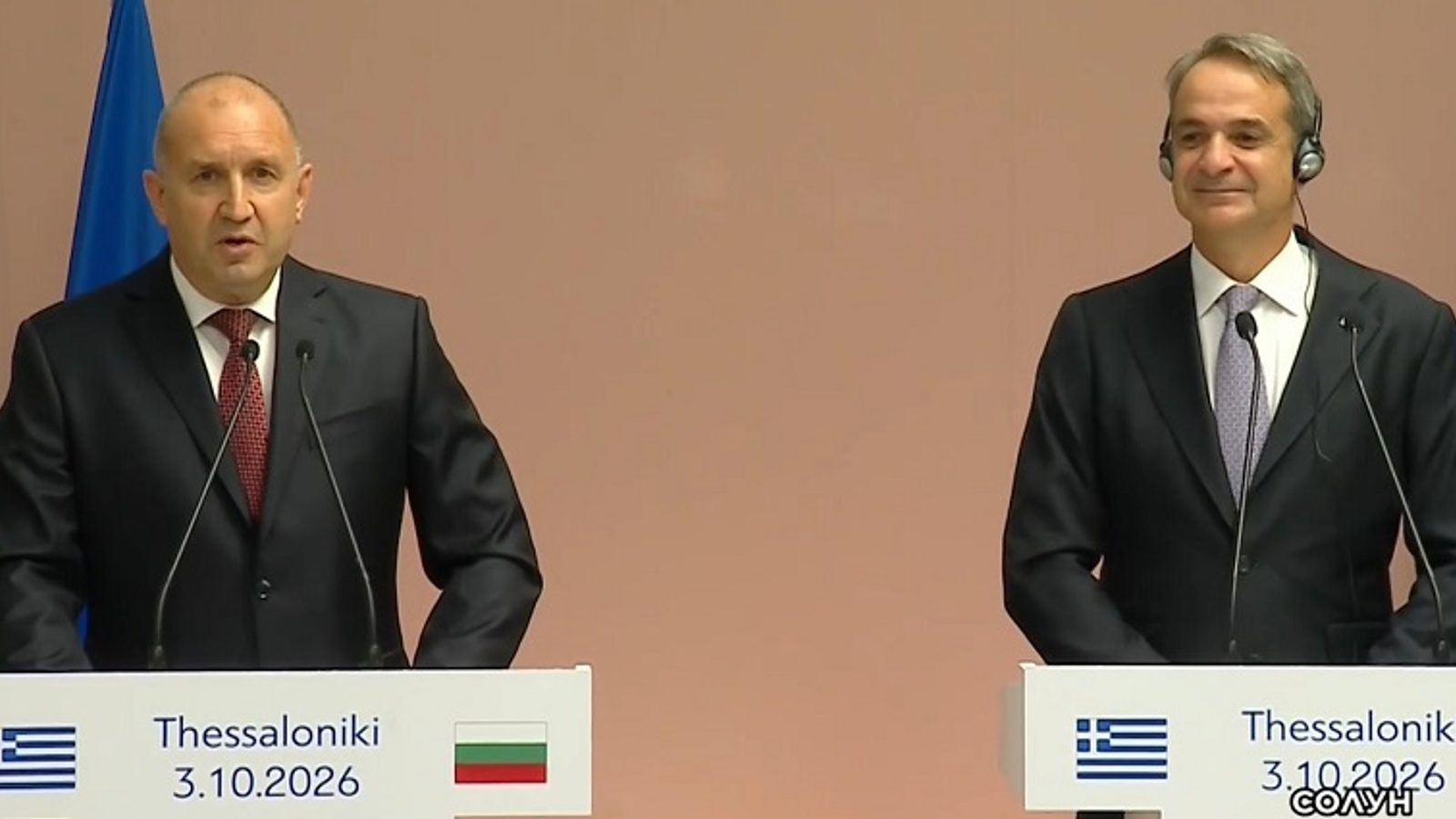
Bulgarian Prime Minister Rumen Radev arrived at the Museum of Byzantine Culture in Thessaloniki to receive the mortal remains attributed to the medieval ruler Tsar Samuil. He was welcomed by his Greek counterpart Kyriakos Mitsotakis; in the presence of the two prime ministers the culture ministers signed a protocol formalizing the handover.
Bulgaria is also returning 48 items to Greece — mainly liturgical vessels from several monasteries in Aegean Macedonia that Bulgarian scholars rescued during the First World War. The objects include, Mitsotakis said, an episcopal throne and other church furnishings taken in 1917 from the metropolises of Serres and Negrita.
“Today we establish a much deeper bond with Bulgaria, which is not only cultural. The return of an important ecclesiastical vessel creates new bridges of communication,” Mitsotakis said, thanking Rumen Radev for the agreement. He added that Athens was fulfilling a long-standing obligation by handing over the remains of Tsar Samuil, which had been kept by the Greek state for decades.
Historic context and earlier talks
Mitsotakis recalled that negotiations to return the remains began in the 1970s during the leadership of Konstantinos Karamanlis and Todor Zhivkov. “It took time to overcome the challenges of the past. Our cooperation starts now. This is the first phase for the return of other relics from Bulgaria,” he said.
According to the Greek announcements, the authorities in Athens will hand the remains over to Bulgaria on Saturday. Radev described the moment in Thessaloniki as a personal honour and reminded listeners that the Bulgarian state's aspiration to repatriate the remains dates back to the 1960s, when they were discovered in the church of Saint Achillios.
“The aspiration of the Bulgarian state to repatriate the remains dates from the 1960s, when these remains were discovered in the church ‘Saint Achillios’. I am glad that today we fulfil the testament of their discoverer, Prof. Mutsopulos, to return them. I would like to thank Mitsotakis for achieving this historic agreement for our two countries, for your political leadership,” Radev said.
Radev stressed that decades of effort led to the transfer. “If in the past Tsar Samuil divided us, today he unites us. Our joint EU membership allows our two countries to better feel each other’s concerns. After thousands of years of confrontation, sharing a turbulent Balkan past — marked by wars — today we mark the next phase in the development and deepening of our relations. It is a miracle that after more than 1,000 years of clashes we enjoy a high level of neighbourly relations. The last decades contributed to this, we managed to leave behind the shadows of the past and to build trust and friendship. I am pleased that our two peoples have left this rivalry behind,” he added.
After the transfer in Thessaloniki the remains will be taken to Sofia, where a ceremony is expected on Prince Alexander I Battenberg Square followed by a procession to the Church of Saint Sophia, which will become their final resting place.
The remains were uncovered in 1969 by Professor Nikolaos Mutsopulos in the basilica of Saint Achillios. He found four sarcophagi; only one contained an undisturbed skeleton. Anthropological analysis identified an older man of about 70 years, with characteristic traces of a blow to the left arm. Remains of rich textiles and fine armour were also found. The archaeological context, anthropological data and historical information form the basis for the identification as Tsar Samuil.
Photo: press material from the event