Sikorski at UN Security Council: Tell Putin ‘Enough’
At the UN Security Council on 24 September 2026 Sikorski accused the Kremlin of panic, listed cross‑border incidents and demanded an end to the war.
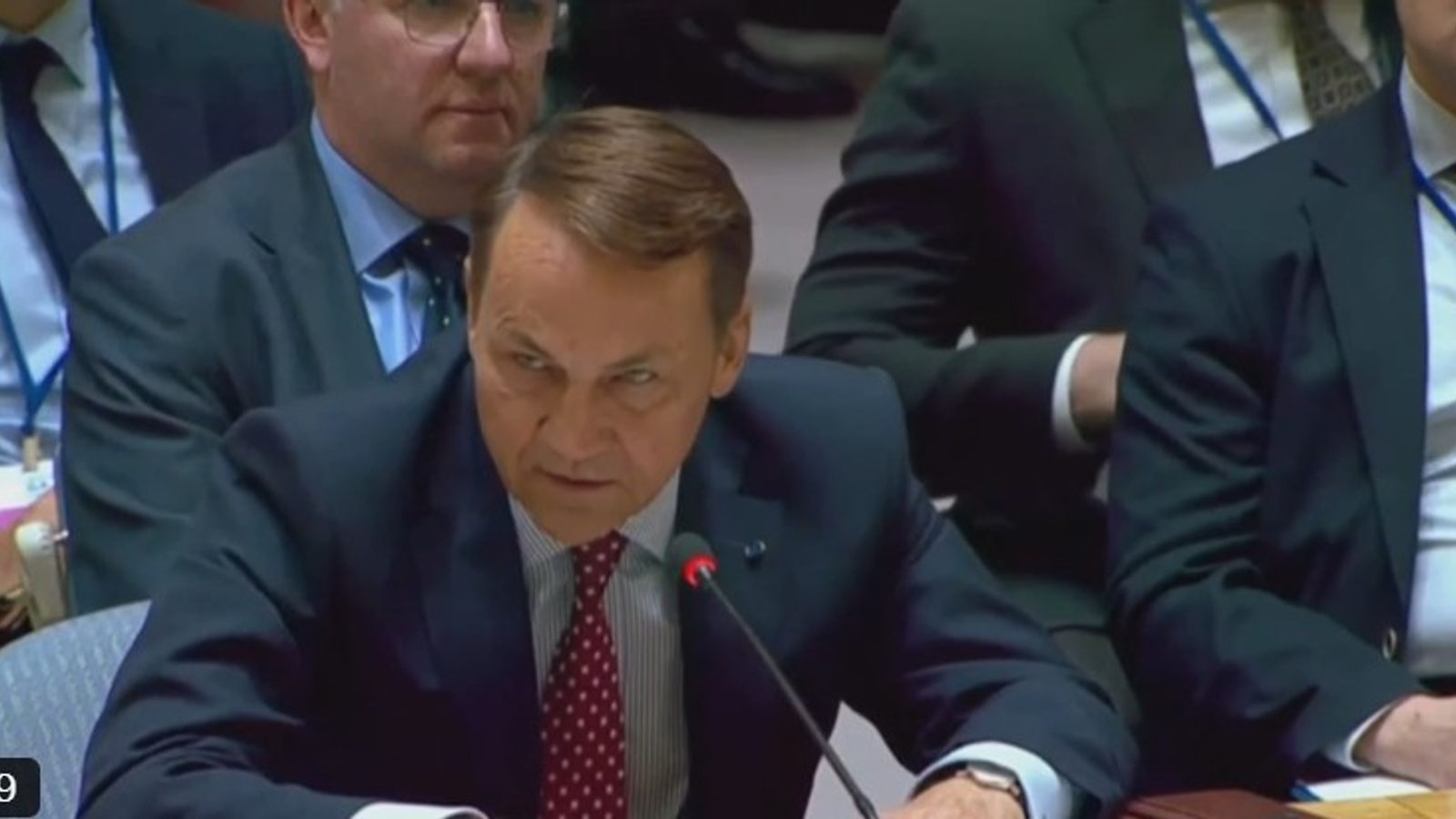
Poland's foreign minister Radosław Sikorski used his speech at the United Nations Security Council on 24 September 2026 to strongly rebut Russian claims about Ukraine and to warn that Moscow's campaign is spilling beyond the battlefield. Addressing his Russian counterpart Sergey Lavrov directly at the end of the session, Sikorski urged him to pass a single message to President Vladimir Putin: “Tell your boss: Enough.”
Sikorski accuses Kremlin of panic and widening operations across Europe
Speaking after Lavrov described the 2014 ouster of Viktor Yanukovych as a “bloody coup,” Sikorski rejected that characterization and said he had been present in Kyiv with the foreign ministers of Germany and France. “There was no coup,” he said, recalling that Ukraine’s democratically elected parliament voted to remove Yanukovych and that even his own Party of Regions supported the measure after what Sikorski described as a massacre in which “one hundred or more Ukrainian civilians” died.
Sikorski also dismissed Lavrov's claim that the Russian language has been banned in Ukraine. “Mr Lavrov also claims — I quote from the transcript — that the Russian language is entirely banned in all spheres of Ukrainian territory. I was in Kyiv ten days ago, while Russian bombs were falling, and I can assure you that Russian is spoken there widely,” he said.
The minister argued that Moscow’s recent escalation reflects Kremlin desperation after more than four years of full-scale invasion. “Russia is escalating the situation because its leadership is in panic. After more than four years of a senseless colonial war, Vladimir Putin has achieved nothing. He is running out of soldiers and resources, so he needs a pretext for mobilisation. One and a half million Russians have been killed or wounded in his unnecessary war. Millions of Ukrainians and other Europeans are exposed to increased danger,” Sikorski said.
He listed a string of incidents he said showed Russian operations spreading across Europe: on 13 September a jet-powered Russian drone struck a Ukrainian train two kilometres from the crossing with Poland, with a second attack on 17 September; drones and missiles were reportedly aimed at border crossings with Moldova and Romania; an armed drone was placed at Leipzig airport in Germany; Russian drones and aircraft violated the airspace of Lithuania, Estonia, Norway and Finland; and Russian “elimination teams” allegedly killed people in Spain, the United Kingdom, Poland and Germany.
Sikorski also referred to US legal actions. “On 15 September, the Office of the US Attorney for the Southern District of New York filed charges against members of a Russian intelligence network for — and I quote — conspiracy to finance terrorism and carry out contract killings in the United States,” he said, framing such cases as part of “a pattern of behaviour.”
Turning to the economic balance, Sikorski contrasted military aggression with the collective economic weight of states supporting Kyiv: “You have been trying to conquer Donbas for over twelve years and Kyiv for over four. You have been stopped by heroic Ukraine — a country with a GDP ten times smaller than yours. Poland’s GDP is nearly half of yours. Europe’s GDP is ten times bigger than yours. NATO’s GDP is 25 times bigger than yours. You may kill many more people, but you cannot win,” he said before concluding with his appeal to Lavrov: “You can stop this imperial war, which you chose, at any moment. Stop jeopardising Europe and the world. Stop destroying the future of Russia. Sergei, I know you are listening. Tell your boss: Enough.”
Photo: Printskrin/Iks