Siljanovska‑Davkova: France a key partner on North Macedonia’s EU path
In a meeting with a French Senate delegation she urged continued political dialogue and warned against protocol‑driven identity demands.
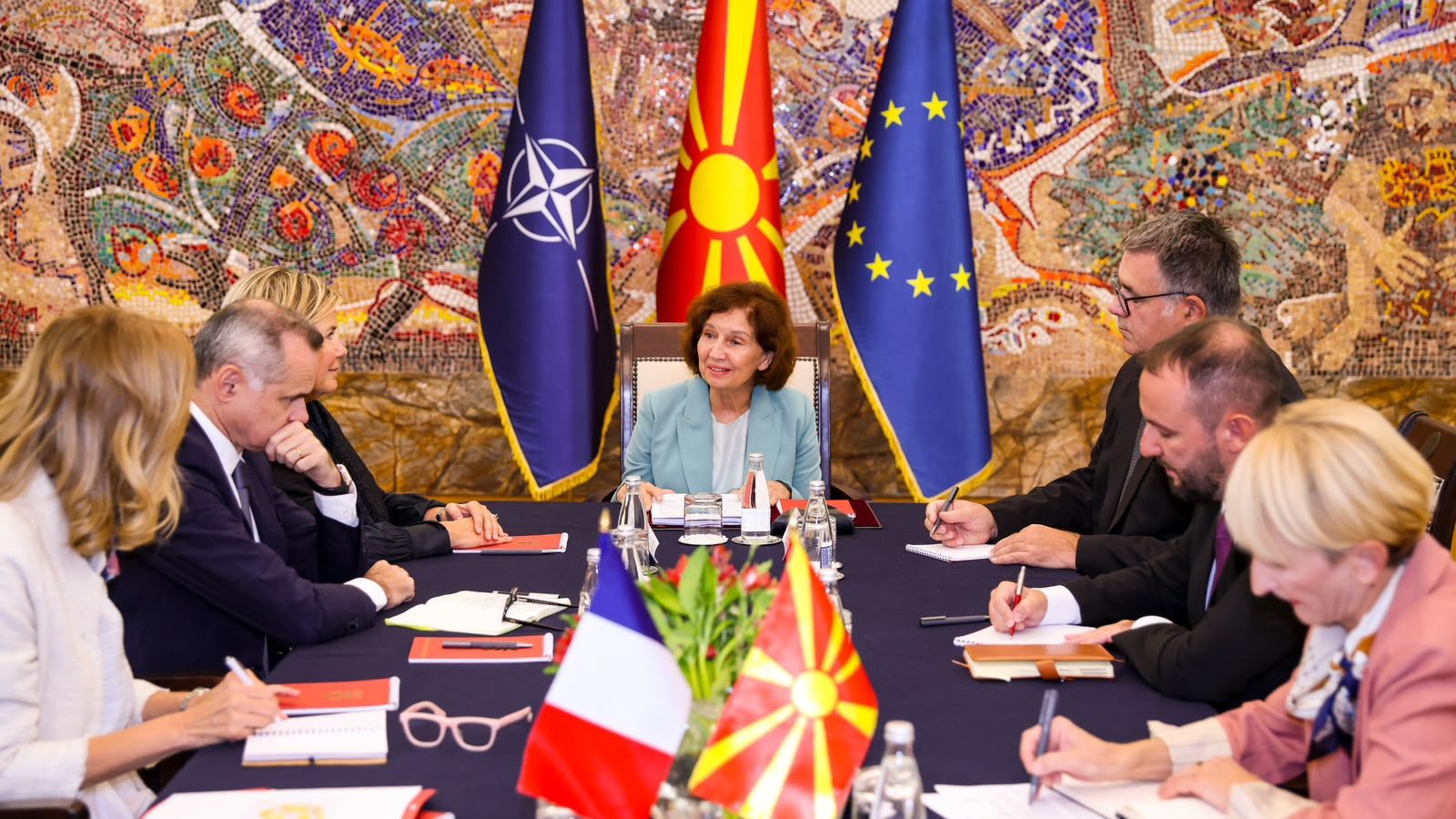
President Gordana Siljanovska‑Davkova told a visiting French Senate delegation that France remains an important partner for North Macedonia on its path to the European Union, while warning that recent developments have shifted some accession debates from reform themes to identity questions.
The delegation was led by Marta de Sidrak, chair of the France–Western Balkans friendship group in the French Senate. Siljanovska‑Davkova welcomed the senators’ visit and praised the parliamentary friendship group for its active engagement in supporting the region’s EU perspective.
Historical legal safeguards and a contemporary paradox
Siljanovska‑Davkova reminded the guests that the Badinter Commission in 1992 had positively assessed the country’s constitutional alignment with the European Convention on Human Rights and the Framework Convention for the Protection of National Minorities, and that in 2022 the Venice Commission, in its opinion on the Law on the Use of Languages, had noted higher standards of minority protection than the European baseline.
At the same time, she drew attention to what she called a Euro‑integration paradox: despite years of positive reports on community rights, a 2023 report by Bulgarian MP Ilhan Kyuchuk raised the need to introduce Bulgarians into North Macedonia’s constitution on the basis of a second protocol of the Macedonian–Bulgarian commission on historical and educational issues — a protocol signed by ministers Osmani and Genchovska, although no such provision exists in the Friendship and Good‑Neighbourliness Agreement with Bulgaria.
Addressing the issue directly, Siljanovska‑Davkova asked: "She asks: can two ministers 'amend' a bilateral treaty by a protocol/record; can a condition from a protocol become part of the Conclusions of the Council without being problematized and disputed; can one state demand from another a change of constitution, while forgetting the philosophy of the EU Treaty, that is, the provisions on respect for: the national and cultural identity of states and nations, the constitutional and political structures, the integrity and dignity of citizens; can anyone in a democratic state guarantee constitutional changes, when MPs represent citizens and vote according to their own conviction?"
She also raised concerns about Bulgaria’s stance toward judgments of the European Court of Human Rights in Strasbourg, noting that the court includes a Bulgarian judge.
Marta de Sidrak expressed understanding for North Macedonia’s situation and reiterated France’s support for the country’s European perspective, saying Western Balkan states deserve EU membership based on merit. She also underlined the delegation’s commitment to nurturing dialogue, European values and the legacy of Robert Badinter.
The French Senate delegation — which included senators Arno Bazen, Alen Milon and Lorans Aribe, adviser Gijom Rendino and French Ambassador Kristof Le Rigoler — also met today with the National Council for European Integrations in Skopje.
Photo: Kabinet na pretsedatelkata Gordana Siljanovska-Davkova