Vertical Aerospace unveils eVTOL prototype as Valo project moves toward certification
The company demonstrated full‑scale test flights at Cotswold Airport and says the production Valo aims for six seats, ~100 miles range and certification by 2029.
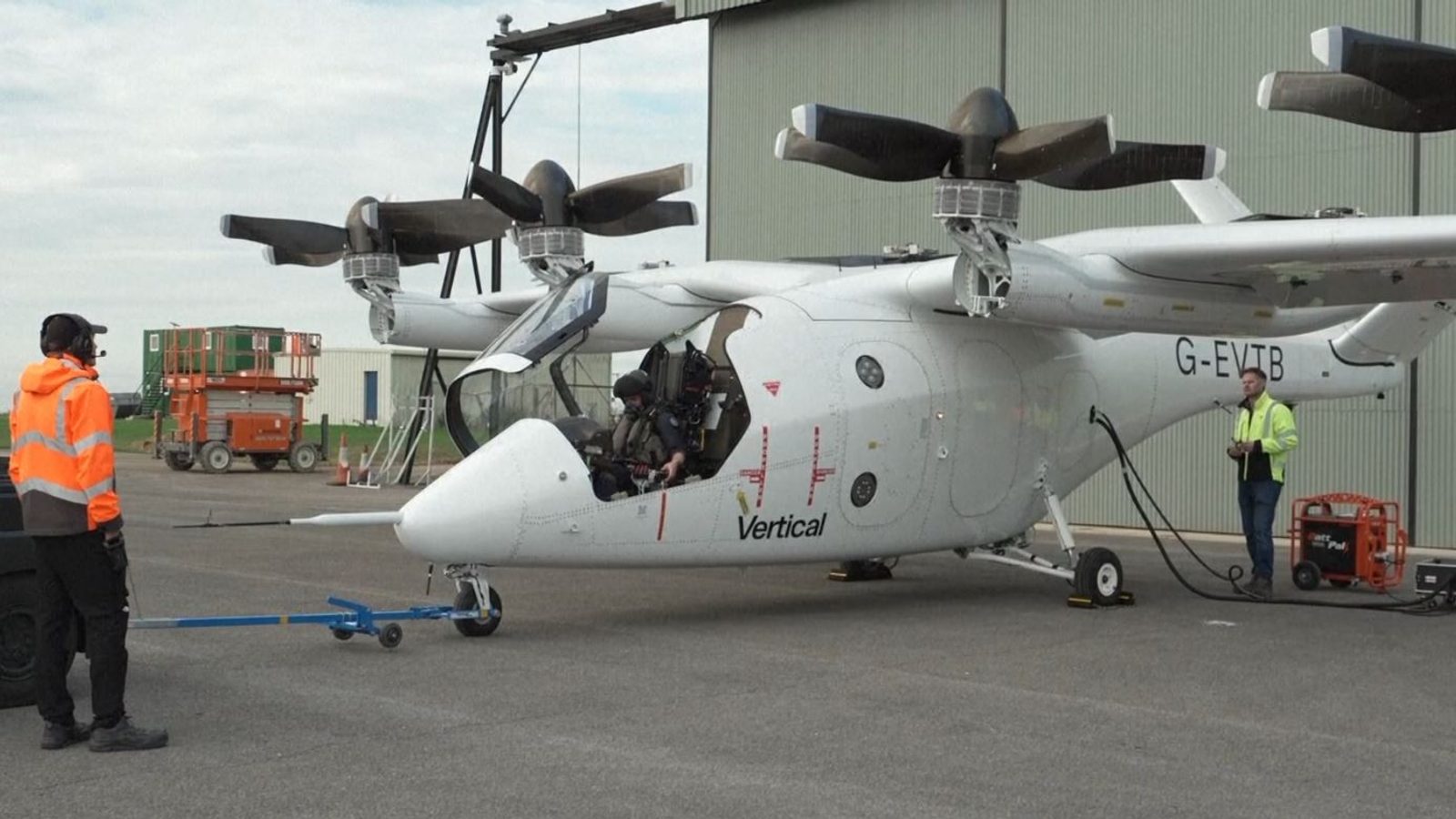
British developer Vertical Aerospace has unveiled a full‑scale eVTOL prototype and says it is close to producing an electrically powered aircraft that could meet certification requirements. The company carried out test flights with the prototype at Cotswold Airport in England as part of a programme aimed at one day carrying passengers on short routes without a conventional runway.
The design combines two flight modes: rotors that point upward to lift and hover like a helicopter, then tilt rearwards to allow the wings to produce lift for forward flight like a conventional airplane. Vertical says the demonstrator has completed controlled test flights while engineers monitor its electric systems, propulsion, flight controls and safety equipment before each sortie.
“Five years ago, 200 companies were trying to achieve this. Today, we are one of only two companies in the world that have managed to perform a fully electric vertical take‑off, to fly like an airplane, to stop a four‑ton aircraft in the air and land vertically,” said Stuart Simpson, chief executive of Vertical Aerospace.
Technical setup and handling
Vertical describes the demonstrator as a fully electric machine powered by eight independent batteries feeding eight independent groups of motors. It is fitted with a sophisticated Honeywell flight‑control computer which the company calls the aircraft’s “brain.”
“It is a fully electric aircraft. It has eight independent batteries that feed the eight independent groups of motors. It is equipped with a very sophisticated Honeywell flight computer for flight control — that is, in fact, the ‘brain’ of the aircraft. So when the pilot flies the aircraft, he is actually only issuing commands like: ‘I want to go up, down, left, right, faster or slower’. There are three independent computers that interpret those commands and the data from all the aircraft sensors, then adjust the speed and angle of the rotors, as well as the conventional control surfaces; the entire process runs automatically, both in normal flight and in the event of a failure,” said Michael Chervenka, chief technology officer at Vertical Aerospace.
“From a pilot’s perspective, you simply tell the aircraft where to go. You pull the stick back and it rises; when you release the controls, the aircraft hovers by itself. The system is highly automated and assisted, so despite the relative complexity brought by moving rotors, multiple motors and all those elements, the handling is really incredibly simple,” added Simon Davis, lead test pilot for Vertical Aerospace. The programme has already demonstrated transition flights — the shift from rotor‑borne vertical flight to wing‑borne forward flight and back — a key milestone for safety and handling.
Market aims and regulatory hurdles
Vertical has said the production version, named Valo, would be designed to carry up to six people, target a range of around 100 miles and a cruising speed near 150 miles per hour. The demonstrator has validated aerodynamic design, propulsion and flight‑control concepts ahead of building an aircraft intended for certification testing.
In August 2026 the company announced additional funding commitments of $100 million and reported around 1,500 aircraft in its order book. Vertical notes those orders are conditional and not legally binding until final purchase contracts are signed. The company previously targeted certification in 2028, a date that remained in its filings through April 2026, but later revised the schedule and now expects certification activities to extend into 2029.
Regulatory approval remains one of the biggest obstacles. The UK Civil Aviation Authority (CAA) has said the rules necessary for broader commercial operations of eVTOL aircraft are not yet fully in place. Approval from EASA and other regional regulators will be required for sales on international markets, and in the United States each design must satisfy FAA certification requirements even though the FAA has established a category and some rules for powered‑lift eVTOL aircraft.
Photo: press material from the event