Shtip wind park to be commissioned within three years
Alcazar Energy secured financing for the first phase (131 MW / 21 turbines); the full project totals up to 400 MW and over $500M.
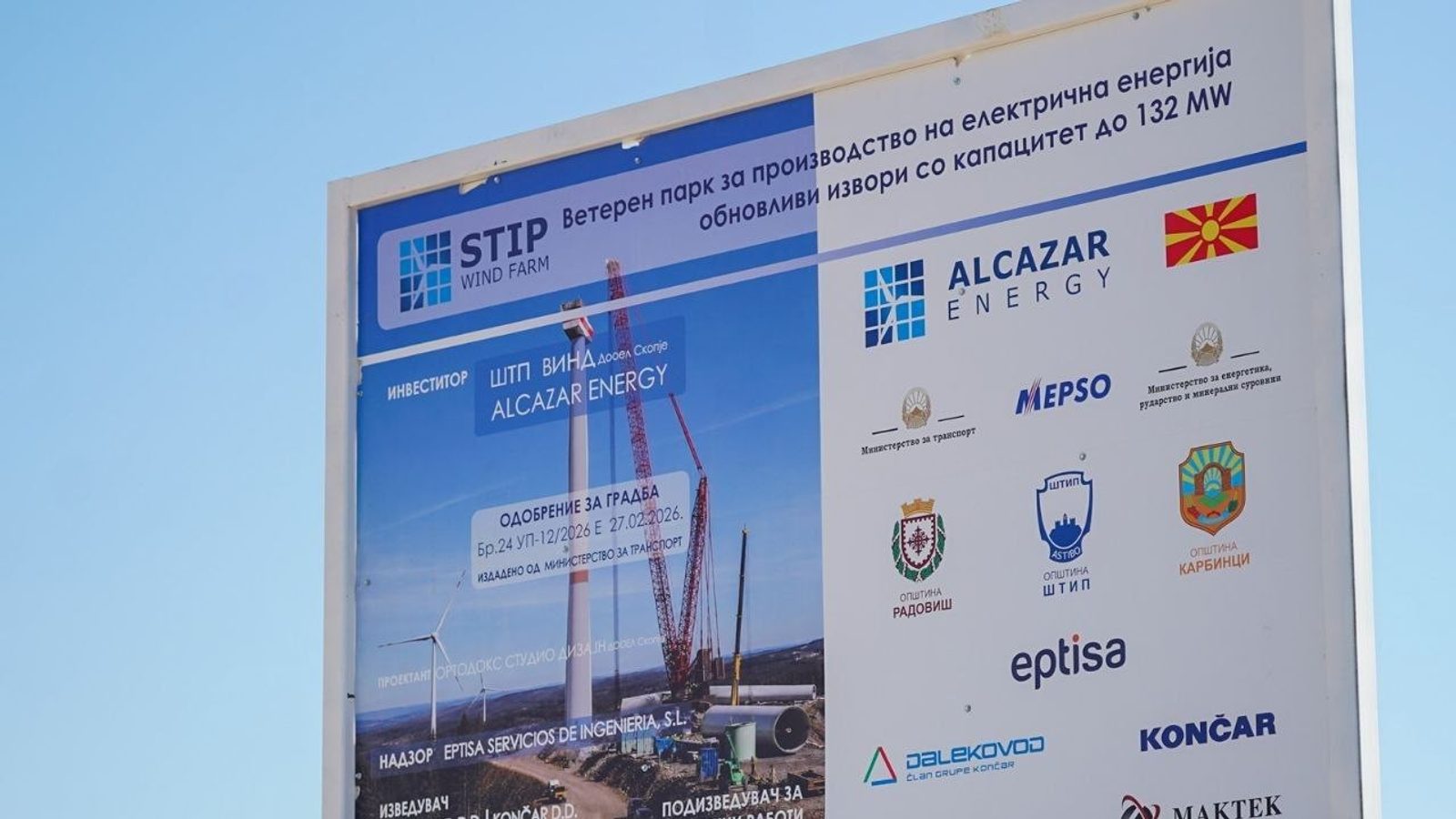
The wind farm being built near Shtip by Alcazar Energy is expected to be commissioned within three years, project officials announced at an event marking financial close for the project's first phase.
Planned to include 54 wind turbines with a total capacity of up to 400 megawatts, the development is presented by its backers as the largest wind park in the Western Balkans. The overall investment is projected to exceed 500 million US dollars and, when complete, the park should supply electricity to about 148,000 households, cut roughly 570,000 tonnes of CO2 emissions and generate around 300 jobs.
Alcazar Energy said the financing package that closed today covers 131 megawatts and 21 turbines. Daniel Calderon, co‑founder and CEO of Alcazar Energy, said €180 million for that phase was secured from the European Bank for Reconstruction and Development (EBRD), the International Finance Corporation (IFC), Erste Bank together with Sparkasse Bank.
Calderon added: "I cannot disclose the name of the contractor, but I can say that such a company shows confidence in a country like North Macedonia." He described the milestone as "the crown of two years of work here; Alcazar is and will remain an important partner of the Government," and said further financing rounds for the Karbinci and Radovish wind parks should follow soon.
Government frames project as strategic for energy security
Sanja Bozhinovska, Minister of Energy, Mining and Minerals, said the Shtip wind park goes beyond a single investment and must be linked to broader goals: stronger supply security, a more resilient economy and less exposure to external energy shocks. She said the country should build its energy future with capacities developed domestically: "Our task is to connect such capacities to a broader purpose, greater supply security, a stronger economy and lower exposure to external energy shocks. We must not leave North Macedonia's energy future to conditions created by others; we must build it with capacities we create here."
Vice Prime Minister and Minister of Transport Aleksandar Nikoloski stressed the project as evidence of progress: "We will continue to advance the project; we have invested a lot in the past period. The fact that we are here today, and that in three years we will commission this wind park, is the best proof of our work."
Prime Minister Hristijan Mickoski highlighted the investment’s wider economic potential and cited regional and European energy trends, recalling a 2025 remark by European Commission President Ursula von der Leyen that the Balkans could become a hub for renewable energy exports to Europe. He warned of growing demand driven by artificial intelligence and framed national capacity building as an economic opportunity: "Considering the development of artificial intelligence, which is an irreversible process, in the next 14-15 years Europe will need an additional 1,000 terawatt-hours of electricity. Therefore, the potential that we as a country can have to invest in production capacities and then produce is equal to 24 terawatt-hours. When that is multiplied by the price of electricity, we're talking about a two billion euro annual business that should increase North Macedonia's GDP and positively contribute to the Macedonian economy." Mickoski also recalled that the project concept dates back to 2008 and that a contract for the initiative was signed in June 2024 after the new government took office.
Photo: press material from the event