25 years since the Ohrid Framework Agreement: achievements and open questions
On the 25th anniversary the focus returned to questions of representation, decentralization and municipal financing.
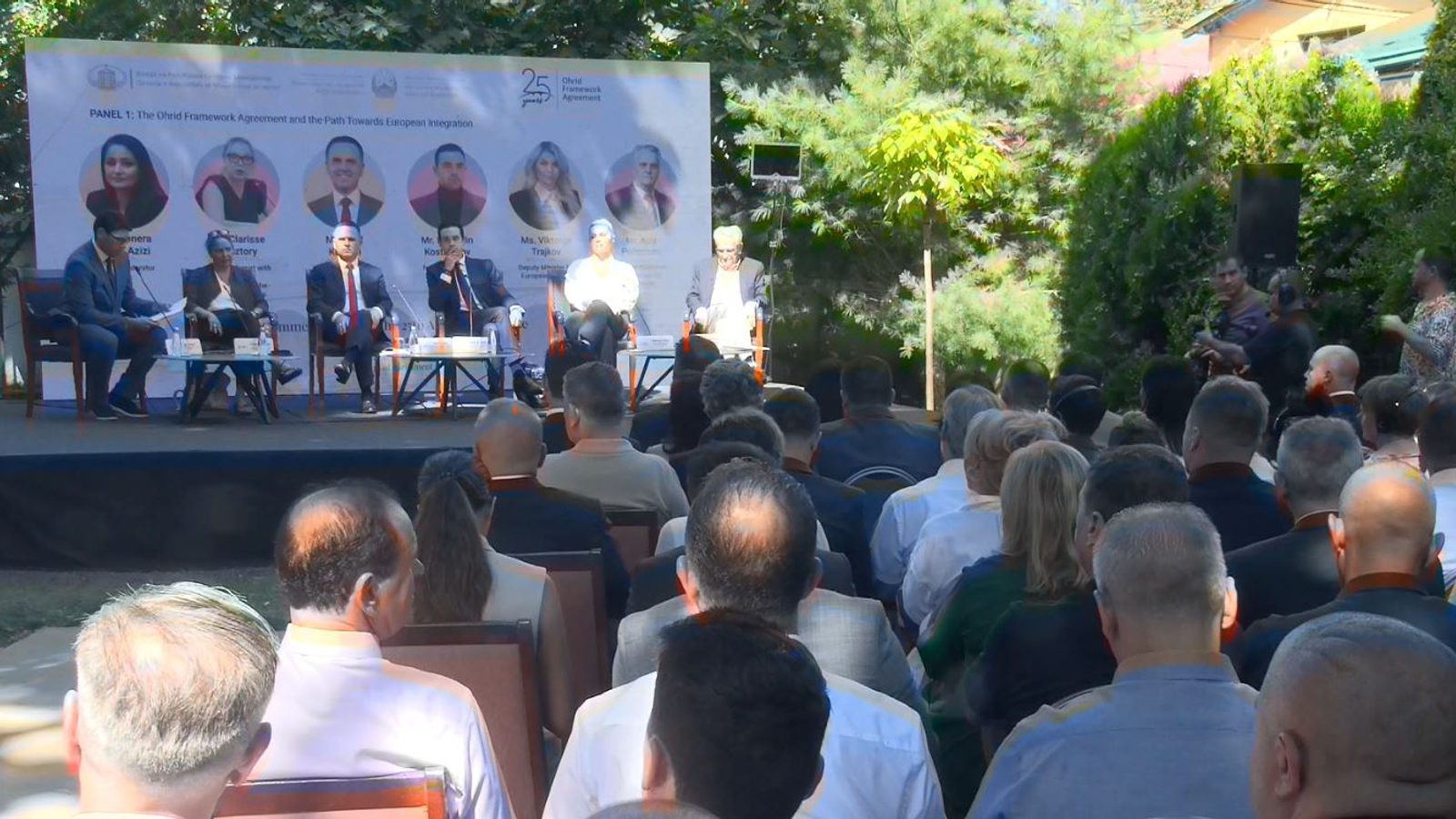
Twenty-five years after its signing, the Ohrid Framework Agreement remains the foundation of interethnic relations in the country, although decision-makers and local authorities debate what has been achieved and which problems remain unresolved. The anniversary refocused attention on issues such as fair representation, decentralization and municipal financing.
At the commemoration it was reiterated that the agreement is not just a memory of the past, but an obligation for the future: the gains must be nurtured, and ethnic divisions must be overcome in favor of a more cohesive civic society.
Key achievements and open questions
Timcho Mucunski, Minister of Foreign Affairs and Foreign Trade, assessed that the state has matured politically. "I personally believe that we as a state have matured to the point where we have the capacity to overcome ethnic lines and build a genuine civic society oriented toward the challenges of the 21st century and the time in which we live" – Timcho Mucunski – Minister of Foreign Affairs and Foreign Trade.
Agon Ferati, Minister for Relations between Communities, called for a focus on the future and institutional strengthening: "Let us direct our attention to the future, to strengthening the rule of law, the development of society, inclusiveness and building cohesion and trust among all citizens who make up our state" – Agon Ferati – Minister for Relations between Communities.
The OSCE diplomat Klaris Pastori, who was involved in the negotiations and implementation of the agreement, described the document as more than a peace agreement: "It is an inclusive agreement that ensured we all work in the same institutions. It is an agreement that protects basic individual and collective human rights, includes the communities and makes North Macedonia a country for all communities, with equal rights and obligations" – Klaris Pastori – OSCE diplomat with long experience in the Western Balkans.
At the same time, local representatives point to open questions related to decentralization and the distribution of funds. "A municipality with more capacities can move forward, while a smaller or poorer municipality remains behind regardless of the fact that the same citizens enjoy the same rights. There is also a stalemate in equitable regional development" – Bilal Kasami – Mayor of the Municipality of Tetovo. Former Mayor of Strumica, Kostadin Kostadinov, warned that true decentralization depends on legal and financial authorizations: "It is unlikely that there exists a power that wants to devolve. Decentralization by itself is not the power to transfer funds to me as a mayor or to the municipality to invest in projects, but through legal solutions to enable me to manage my own resources" – Kostadin Kostadinov – Former Mayor of the Municipality of Strumica.
The formal commemoration continues tomorrow, with activities organized by the Ministry for Relations between Communities. Participants say the message from the anniversary is clear: to protect and consolidate achievements while simultaneously resolving the open issues that affect everyday life in the municipalities.
Photo: press material from the event