Bundeswehr helps build Poland's 'Eastern Shield' near Budry
Around 40 German engineers have been deploying anti-tank obstacles and other installations near Budry since June as part of Poland's 'Eastern Shield'.
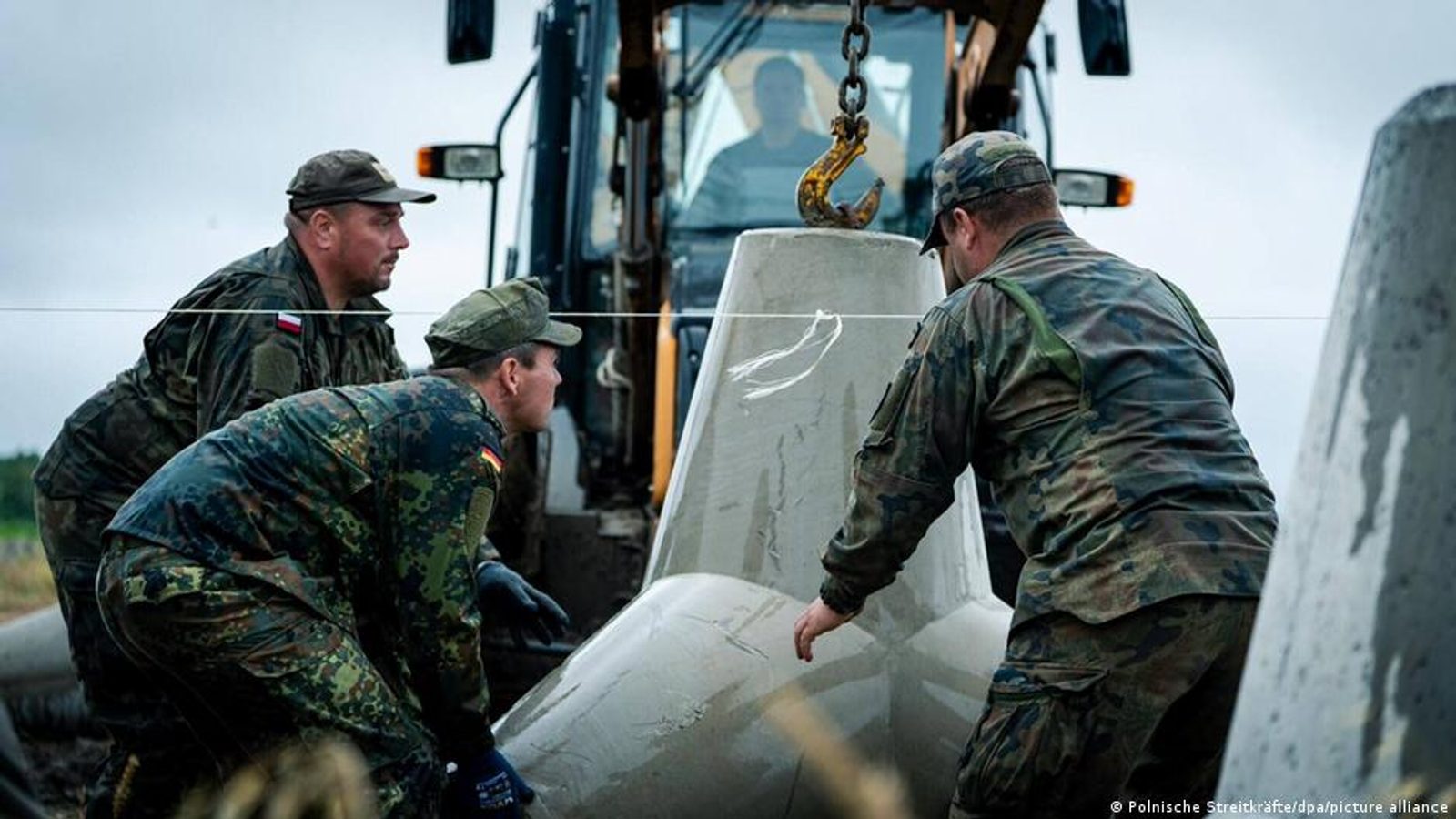
German engineers from the Bundeswehr are assisting the Polish army in building a protective belt along Poland's eastern border, working since June to install obstacles and other defensive installations near the village of Budry in the Masuria region.
The Polish project, known as the "Eastern Shield," has grown into an extensive programme along the borders with the Russian Kaliningrad exclave and Belarus. The overall system, planned to be about 800 kilometres long, has been under construction for roughly two years with the aim of deterring a possible attack from the east. During a field visit in November 2024, Prime Minister Donald Tusk said: "It is a real investment in peace."
On the ground near Budry, about 200 metres from the state border, around 40 German engineers are working together with Polish units. They lower the so‑called concrete "hedgehogs" weighing several tons from a truck with a yellow excavator, and erect an advanced installation made up of three rows of concrete blocks. Right next to the border there is a deep ditch and another row of obstacles; the space between the two rows can, at short notice and if necessary, be mined.
Polish General Stanisław Czosnek, who visited the site on Thursday, 20 August 2026, praised the Germans: "The German engineers have done an excellent job," and added that he was "very impressed by their performance." The German contingent has already installed more than one kilometre of obstacles in the month and a half since it arrived.
Political and symbolic message
German commanders stress the dual purpose of the deployment. "We are prepared to fight for democracy and freedom," said German General Tilo Gante while working shoulder to shoulder with his Polish colleagues. The Bundeswehr declared its support for the "Eastern Shield" an official mission: "We want to keep the peace with a credible means of deterrence," the German general explained, and stressed that "We are working shoulder to shoulder."
Observers point out that Berlin's involvement carries political weight. Łukasz Jasinski of the Polish Institute of International Affairs assessed that the German presence sends a signal to NATO and the EU that Poland's eastern border should be regarded as a shared external border. Warsaw and Berlin established close military ties after the end of the Cold War — including in 2003 when Germany handed over MiG‑29 combat aircraft to Poland at a symbolic price — which culminated in the German‑Polish defence agreement signed on 17 June 2026.
However, not all politicians in Poland welcome the presence of German soldiers. The leader of the Law and Justice party, Jarosław Kaczyński, has long said: "It will take at least seven generations before that becomes acceptable." Poland has increased its defence budget — for 2026 the amount was raised to 200 billion zlotys (46 billion euros), roughly five percent of gross domestic product — and sees the main guarantor of its security in the United States. Around 10,000 American troops are currently stationed at various locations in the country. On Polish Armed Forces Day, 15 August 2026, three German aircraft — two Eurofighters and one A400M — took part in the ceremonies, but German infantry units did not march in the parade.
German planners said the current engineering unit was supposed to remain until October, but the engineers working near Budry will be redeployed to other parts of the shield once their tasks at this site are completed next week.
Photo: press material from the event