Two years after crash, a rusting temporary railing still stands on Mother Teresa Bridge
After the August 2024 crash the damaged section was fitted with a temporary iron lattice; the City says it will replace it when identical material is available but gives no timetable.
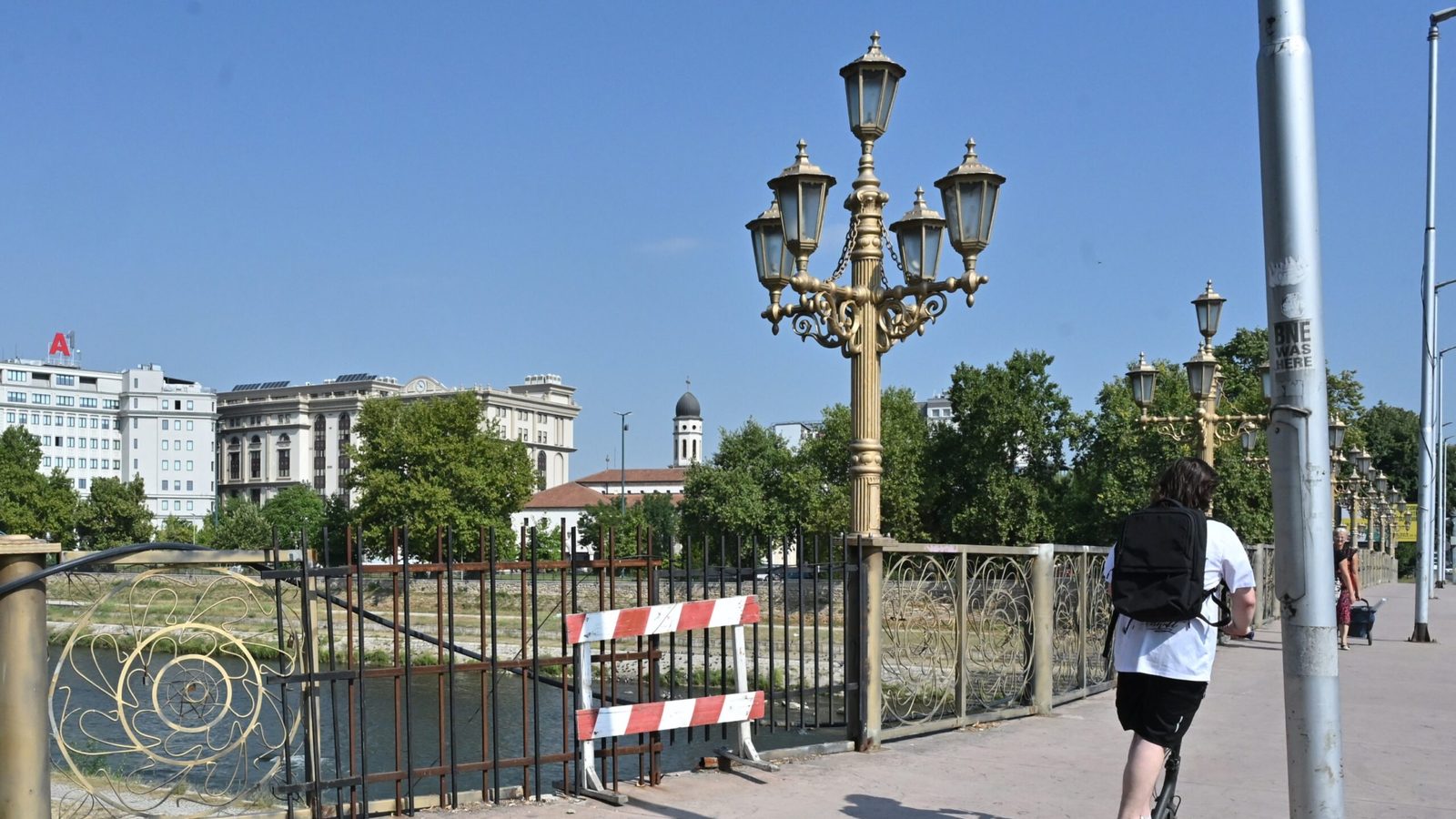
Two years after a car tore through the railing and fell into the Vardar River, a temporary iron grid remains in place on the bridge known today as the Mother Teresa Bridge, close to the National Bank. The makeshift barrier — originally fitted after the August 2024 crash — is visibly corroded and has prompted complaints from residents who say the City of Skopje has not carried out a permanent repair.
City calls the fix temporary, gives no date for replacement
The damaged section was initially replaced with an iron lattice and a wooden warning sign to protect pedestrians while authorities prepared a long-term solution. At the time the public enterprise that maintains streets said the temporary repair had been made in coordination with the Ministry of Interior to preserve safety for pedestrians and drivers.
Local commuters describe the temporary installation as unacceptable. A Skopje resident who contacted our newsroom said: "An accident happened, the railing broke, so replace it! Not like this, patch it and leave it standing for years as if it's forgotten!"
The City of Skopje reiterates that the current arrangement is provisional. Officials say the damaged segment will be permanently restored once the appropriate, matching material is procured and the conditions for work are met, and that public safety and the bridge's architectural appearance are priorities. They also stated that the public will be informed about the repair schedule, but provided no estimate when that will happen or whether the search for material has already begun.
Mother Teresa Bridge connects Kocho Racin and Krste Misirkov boulevards near the Macedonian Academy of Sciences and Arts (MANU). The structure was built in 1963 and underwent a full reconstruction about 15 years ago as part of the "Skopje 2014" programme. The refurbishment included new forged-iron railings painted gold and decorative candelabra; documents published at the time show the work cost about 43 million denars (roughly 700,000 euros). In 2016 the city spent an additional 100,000 euros to replace the original candelabra.
After significant investment in past years, residents and observers say the city must not allow a temporary, rusting lattice to become a permanent fixture on a central bridge. They call for a clear timetable and faster procurement so the railing's original appearance and safety can be restored.
Photo: press material from the event