Humanoid robots in China are not yet smart enough to replace human workers
A Liuzhou training centre is producing data for embodied AI, but robots remain slow, projects rely on subsidies and commercial demand lags behind capacity.
Inside a training complex in southern China more than 100 humanoid robots stand in neat rows while around ten human trainers guide some machines through simple, repetitive tasks such as sorting crates, packing noodles and making coffee. The robots remain slow and awkward: a novice trainer may coax one usable motion after roughly 300 attempts, while an experienced trainer can achieve the same in about 50 attempts.
The manufacturer UBTech won an $18 million contract from the Guangxi regional government last October to equip the facility with humanoids and related hardware. The stated aim is to generate large sets of training data for so‑called embodied artificial intelligence — systems that can perceive, decide and act in the physical world. Trainers wear headsets that let them see from the robots’ point of view and use handheld controllers with sensors to translate their own movements into the robots’ actions.
Commercial promise collides with technical limits
The Liuzhou centre — visited in April — is intended to sell robot training data to factories. Yet three employees admitted the project depends on subsidies and currently lacks a clear path to profitability, citing high operating costs and low prices for such data in emerging markets.
China’s demographic shift, with an ageing and shrinking workforce, helps explain the push toward industrial robotics. At the same time, military researchers in China are exploring robotics and AI for future weapon systems, increasing strategic interest in humanoid development.
“The intelligence quotient of the robots is too low,” said Tang Wenbin, co‑founder and chief executive of the AI robotics firm Yuanli Lingji. “A lot of what we see is dancing disguised as working.”
The industry shipped roughly 20,000 humanoids globally last year, with Chinese makers accounting for about 95%, according to BofA Global Research. Gan Xiaobin, an official at China’s Ministry of Industry and Information Technology, said in July the country expects to build more than 100,000 humanoids this year. BofA projects global annual shipments could reach 1.2 million by 2030. The scale of China’s manufacturing presence has raised international concerns: in July the Trump administration banned imports of new Chinese humanoids, citing risks to the U.S. AI industry from disruption and cyber threats.
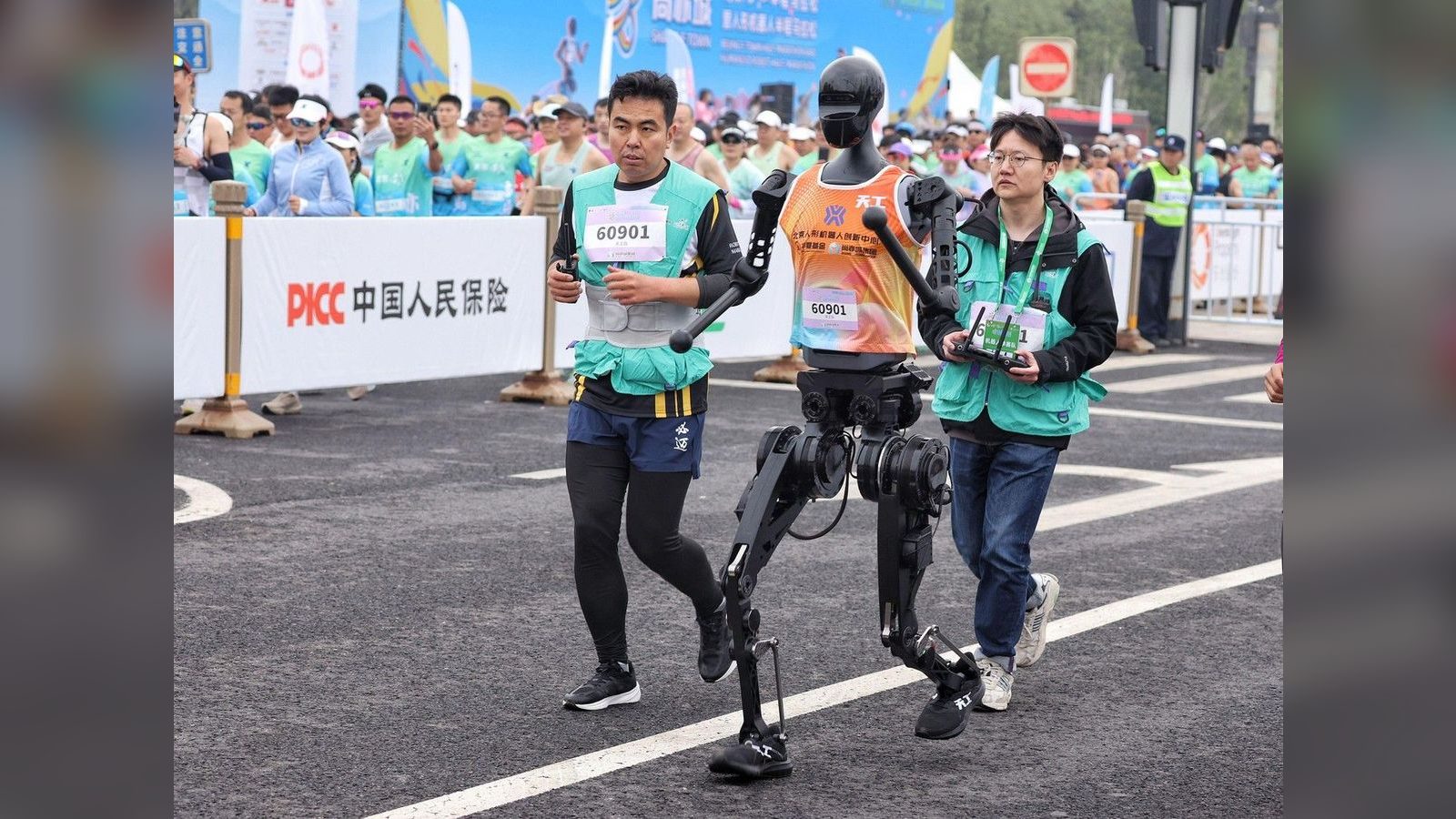
Photo: press material from the event