Skopje’s tourist maps unreadable for years; city promises overhaul for 'Skopje 2028'
Three‑dimensional tourist maps placed in 2011 at 17 sites are vandalised and covered; the City of Skopje says renewal will be part of the Skopje — European Capital of Culture 2028 programme.
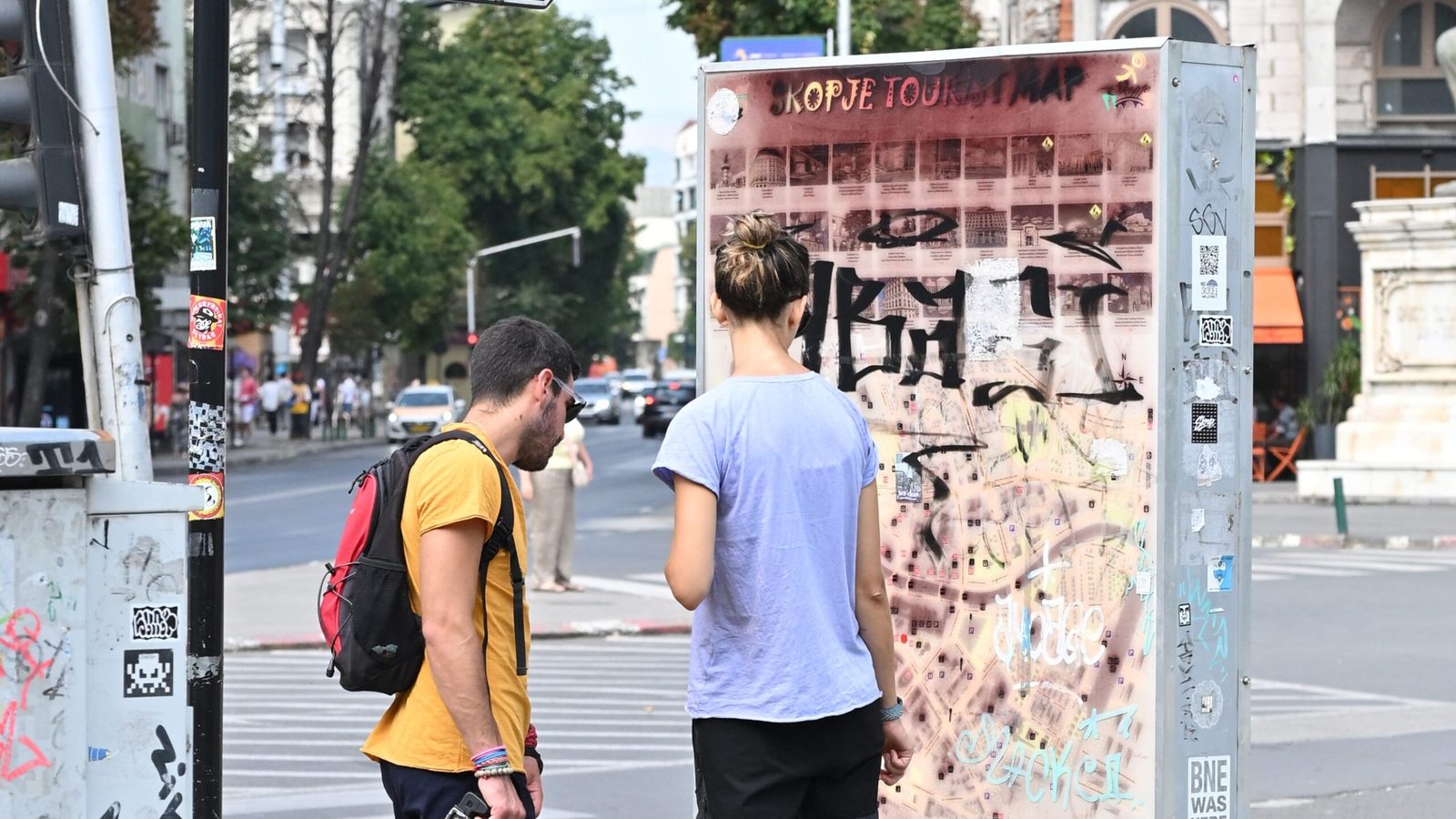
Skopje receives an increasing number of visitors every year, but much of the city’s basic tourist infrastructure is visibly neglected — most strikingly the three‑dimensional city maps that are supposed to help visitors find landmarks on their own. The problem is not the number of hotels, which are adequate, but the day‑to‑day practical obstacles tourists face when they try to explore the capital without a guide.
Guided groups move through the centre more easily: a guide leads the route and the group usually departs from the central area — where, locals note wryly, a cluster of roughly ten large dogs that have long lived on the city square often accompanies them. Independent visitors, by contrast, must improvise more to reach the sites on their list.
Old maps, new damage
The three‑dimensional maps were installed in 2011 at 17 locations across the central area, in the Old Bazaar and at the Millennium Cross on Vodno. At the time of the launch they were presented as made on high‑standard, weather‑resistant material and included a red dot showing “you are here” plus the city’s main institutions and attractions.
Today many of the map cases are covered with posters, defaced by spray paint and marker, and in several places the glass has been removed. Although the maps were printed in three languages, the graffiti and stickers make them unreadable. Passersby have been seen trying to make sense of the scribbles and torn posters instead of clear directions.
The City of Skopje says it is aware of the condition of a number of the tourist maps, some of which have been non‑functional for years. "We plan, in addition to renewing the existing tourist maps, to install new positions for tourist maps at appropriate and frequent locations. We believe Skopje must not have tourist infrastructure that is non‑functional and neglected. On the contrary, we want to leave a permanently improved and orderly urban space that will continue to serve both citizens and tourists, and the entire economic sector (tourism, hospitality, trade, etc.)," the City said, and added that the renewal work will be part of the activities linked to the Skopje — European Capital of Culture 2028 project.
Maps are not the only obstacle. Many statues and sculptures on the pedestrian bridges over the Vardar lack identification plates: on one of the two main pedestrian bridges none of the 32 sculptures has a plaque, while on the other — which stretches from the riverbank to the Prosecutor’s Office building — only a few of the 29 installed pieces still carry nameplates. Bus travel is also confusing for foreign visitors: tickets on board are cash‑only and there is no option to buy or pay by card, and bus stops often lack simple route maps showing where each line goes. Visitors who try to reach the scenic Matka canyon face a further set of problems — the line 60 bus from the Transporten terminal to Matka runs infrequently, so missing one service can mean waiting more than two hours for the next. Access to the aqueduct is limited as well: there is no proper entrance or regular public transport serving it, and restoration work there has been ongoing for years.
City officials say that the planned interventions for Skopje 2028 should address at least some of these shortcomings — from replacing and adding map panels, to better signage and improvements in public‑transport information — while residents and business owners hope the effort will include repairs to missing plaques and better upkeep of popular sites.
Photo: ”Sloboden pechat” – Dragan Mitreski