Education Ministry restores sexuality programme under new name; 'gender' and 'contraception' deleted
The elective CSE programme was restored under the title 'Health and Protection of Health' after a ministerial review, but several terms were deleted.
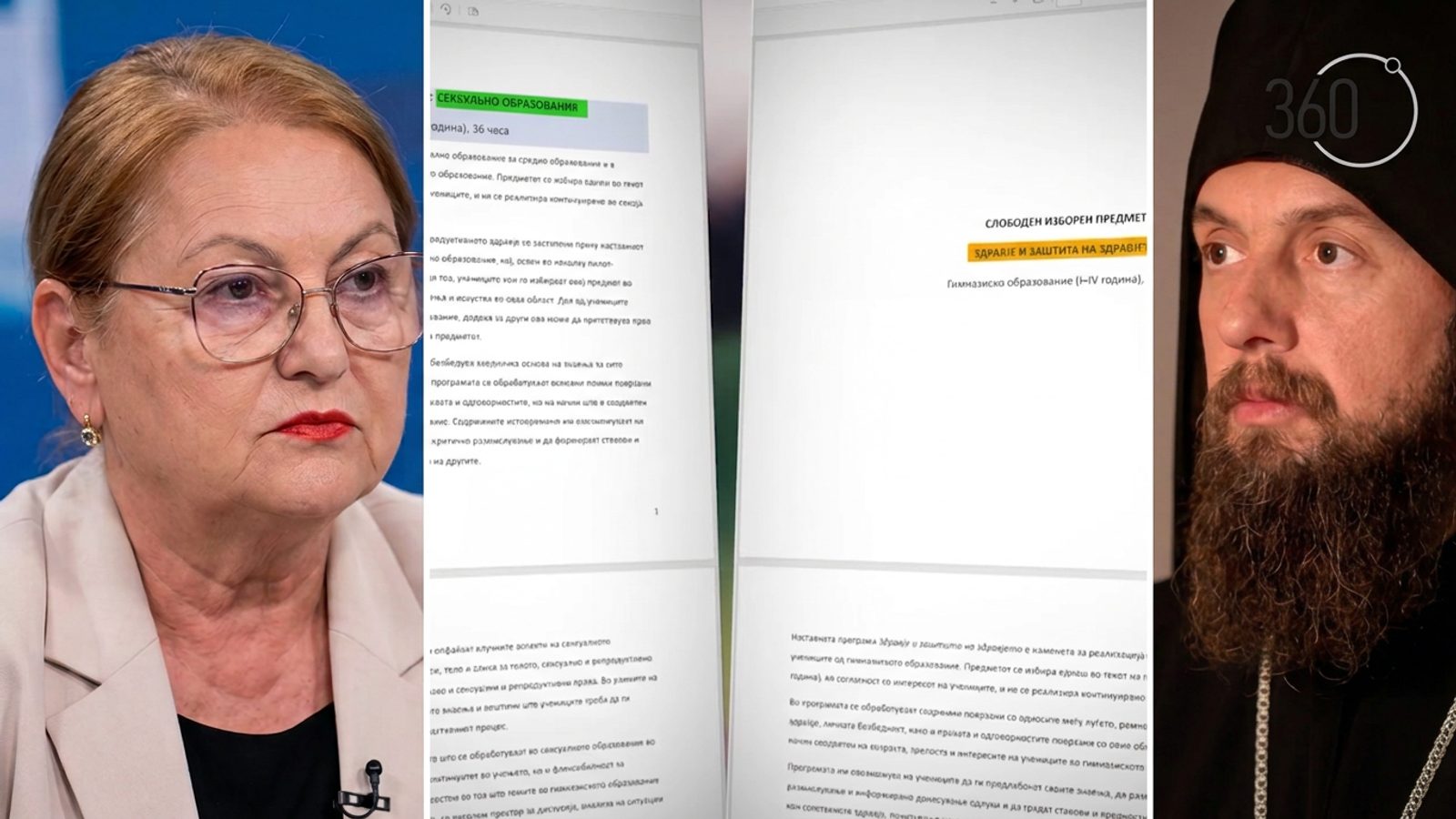
The Ministry of Education has restored the elective school programme formerly known as Comprehensive Sexuality Education (CSE), but under a new title and with some terminology removed.
The Bureau for Development of Education reissued the curriculum with the title "Health and Protection of Health". The overall number of classes and topics remains the same, but several words were deleted from the text, among them "gender" and "contraception".
Politics, church pressure and a summer "drill camp"
The CSE programme was withdrawn in early September after Bishop Jakov Stobiski published an open letter criticizing Minister Vesna Janevska for what he described as a prior opposition stance against so‑called "gender ideology" and calling for the programme's removal. Minister Janevska pulled the programme for what she called a thorough review; on 17.9.2026 she told MRT1: "I personally read it. I don't see anything controversial. But I asked the bureau to make a professional review, together with professional bodies and experts from Macedonia, to look at the programme again and give their opinion. I asked for this to be done quickly so we can restore the programme again."
Although the minister said she found nothing problematic in the text, the Bureau carried out revisions and changed the name. Officials told journalists the edits followed recommendations from experts and not orders from religious communities.
The controversy over the curriculum is part of a broader pattern of cooperation or overlap recently visible between conservative civic groups, religious actors and state institutions. Footage and promotional material show a summer "drill camp" held in Mavrovo where young people, some minors, trained in self‑defence, boxing, cardio and other exercises.
Organisers presented the camp as supported by the Rapid Deployment Unit, which belongs to the Ministry of Internal Affairs, and by a monastery that is part of the Macedonian Orthodox Church – Ohrid Archbishopric. The event was organised by a group calling itself "Patriotic Society", which has social media profiles and a website but does not appear as a registered legal entity in the Central Register; its web domain is registered via a company in Delaware, USA. The organisers describe themselves as patriots who focus on state, faith and family values.
The Ministry of Internal Affairs replied to inquiries with a statement: "The Rapid Deployment Unit does not support, does not organize and does not participate in activities of this kind, organized by external organizations, nor does it give consent for the use of its name, logo or institutional reputation for their promotion without prior approval. Any possible unauthorized use of the Unit's name, logo or reputation will be considered within the competences of the Ministry of Internal Affairs, in accordance with applicable regulations and established procedures." The ministry also said police officers on patrol near the St. Nikola monastery noticed persons and, after a conversation, were told they were holding sports activities with a boxing instructor; "the individuals were in sportswear without insignia."
The Macedonian Orthodox Church – Ohrid Archbishopric told reporters that "The Holy Synod has not adopted a decision, nor has it given a recommendation to direct any priest or monk to participate in events organized by the said association, to hold meetings with its representatives or to give them advice regarding their activities." It added that the presence of certain clerics at such events "needs further investigation to clarify whether this was with a possible blessing of the competent diocesan authorities or, alternatively, whether it was their independent decision."
Observers say the episode illustrates how state bodies, informal conservative movements and religious communities can become entangled around youth programmes and public policy, raising questions about secular neutrality and the oversight of activities that involve minors.
Photo: press material from the event