Network places Panche Toshkovski on 'Wall of Shame' and demands deadlines for eight law amendments
NGOs say eight planned amendments to strengthen protection of women remain unadopted after seven femicides; they want the main draft adopted by 10 December.
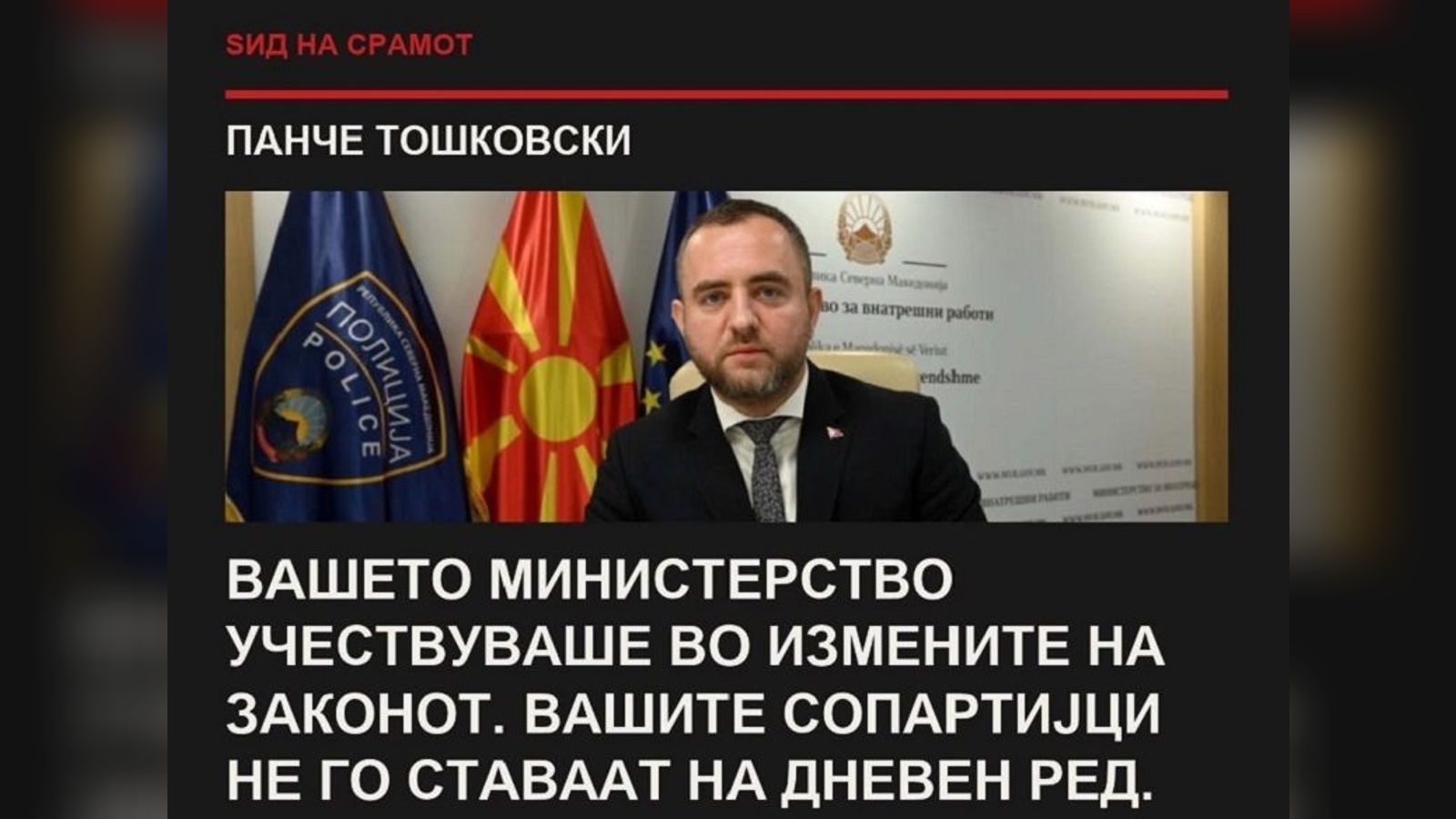
A coalition of NGOs called the Network for Protection from Discrimination has publicly added Interior Minister Panche Toshkovski to its so‑called "Wall of Shame" and is pressing him to set concrete deadlines for legislative changes aimed at preventing and protecting women from violence.
The group says that, after seven femicides this year, proposed amendments to eight laws related to gender‑based and domestic violence have not been adopted.
Deadlines demanded
"Seven femicides. Eight laws earmarked for amendments. Not a single one has been changed so far. We continue with our 'Wall of Shame', addressing public questions to Panche Toshkovski, Minister of Interior," the Network said, calling on the minister to secure adoption of the draft amendment to the Law on Prevention and Protection from Violence against Women and Domestic Violence by 10 December and to publish public timelines for preparing and submitting the remaining seven draft amendments to the Assembly.
The NGO recalled the case in Karpoš in which Ivana Jovanovska and her daughter Katja died after falling from a balcony, and the perpetrator, their husband and father Stojanche Jovanovski, was sentenced to 12 years in prison. Following that case a working group was formed to prepare amendments to eight laws to strengthen prevention and protection mechanisms.
The Network noted that eight months later only a single legislative proposal has been submitted to parliament — and even that proposal has not yet been adopted — and it asked what concrete results Toshkovski has produced, and what steps he has taken toward adopting the amendments in which, the NGO says, he participated.
"How will you ensure effective protection of women and girls if all forms of gender‑based violence are not recognized and named? Forming working groups is not a result in itself," the Network said. "We demand deadlines and accountability, not new promises!"
In a television appearance Toshkovski announced two projects intended to help prevention and protection: enabling potential victims to make video calls to the Ministry of Interior and to the Center for Crisis Management, and equipping police officers with body cameras by mid‑2027 so they can stream video directly to command centers.
Earlier in the campaign marking "16 Days of Activism against Gender‑Based Violence", three NGO networks warned that some MPs influenced by anti‑gender movements are blocking the process in order to force withdrawal of the current draft and open a new proposal that would omit the terms "gender", "gender‑based violence" and "gender identity" — mirroring recent changes in the education law.
Assembly President Afrim Gashi has already been placed on the Network's public list after civic groups said the draft amendments, submitted in August this year, have still not been put on the parliamentary agenda. Asked by journalists, Gashi said the texts have been sent to the Government for an opinion and will be scheduled for debate once that opinion arrives.
Government spokesperson Marija Miteva confirmed the drafts are with the Government and expressed confidence the procedure will be completed soon so the Government's opinion can be forwarded to the Assembly; she said the materials must pass through several institutions that will each deliver opinions to be synthesized into a single government position.
Photo: press material from the event