MVR food tender: ministry paying more for snacks than supermarkets
A sampling of tender line items for police canteens shows many products bought at tens of percent above retail prices.
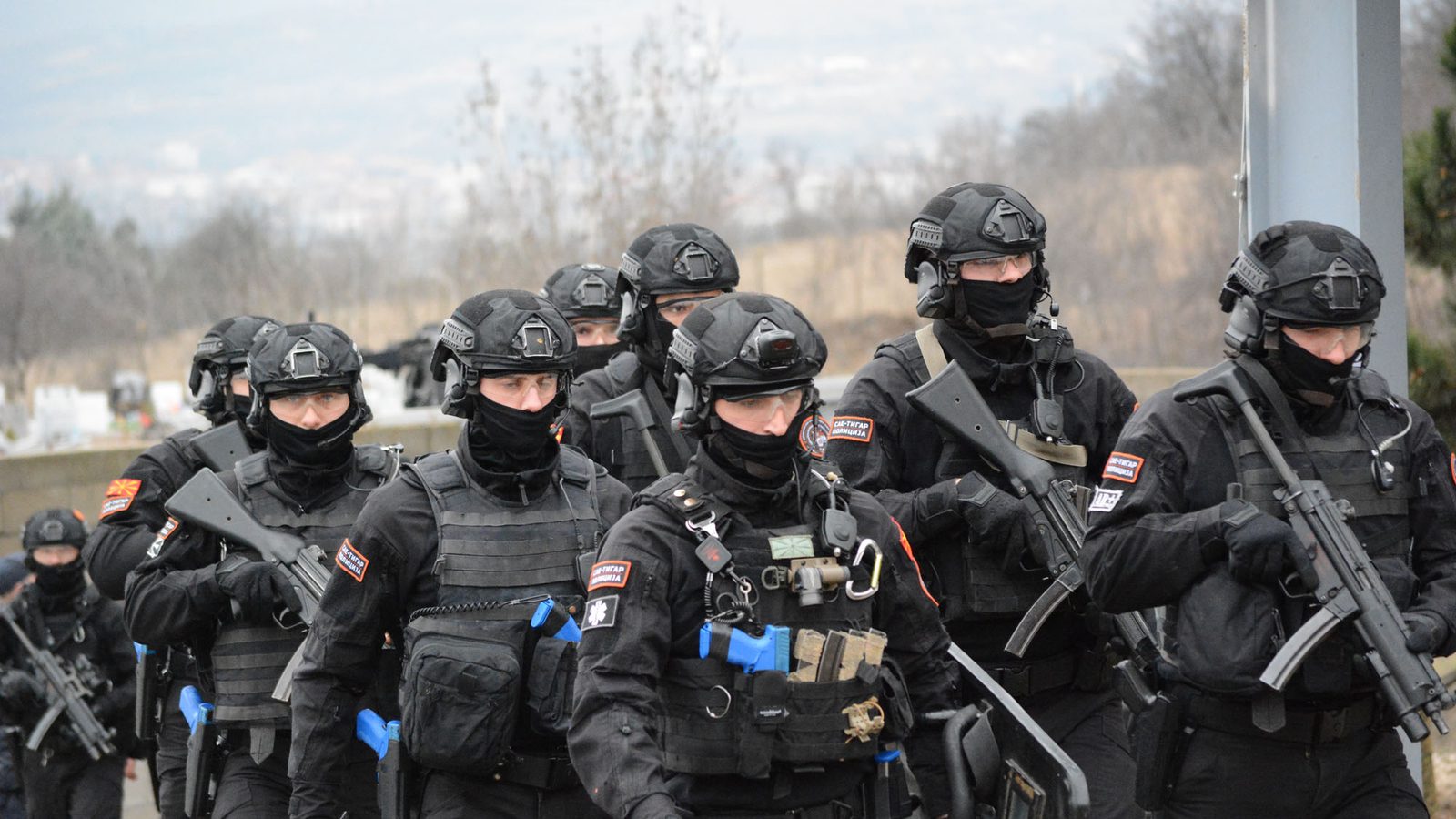
The Ministry of Interior (MVR) will pay markedly higher prices for packaged snacks and drinks for police units than those available in supermarkets, according to a price comparison of items named in the ministry's food services tender.
What the tender says and what shops sell
The contract covers three separate framework agreements for food supply to the Ilinden barracks (home of the special unit "Tigar"), the Gjorche Petrov barracks (Rapid Deployment Unit) and the MVR training centre in Idrizovo. The Bureau for Public Procurement published at the end of July that the ministry signed the three agreements with a total value of 17.5 million euros (1 078 000 denari).
For a simple point comparison, reporters looked for the same branded and descriptively identical products in five supermarket chains and on retail websites, then compared those retail prices with the MVR tender price list for supplies to Gjorche Petrov barracks.
The differences are stark. Examples from the tender and the retail market include:
- Carbonated soft drinks in 0.45 l plastic (cola and Fanta): MVR price 55 denars; retail prices found 37–43 denars.
- Cevitana powdered drink, 200 g: MVR price 88 denars; retail 59–79 denars.
- Bitolska Mlekara milk 0.5 l, 2.8% fat: MVR price 60.5 denars; retail 46–55 denars.
- 100% orange juice (1 l) from the same producer: MVR price 121 denars; retail 109–135 denars (the only item sometimes sold more expensively in shops).
- 100% apple juice (1 l): MVR price 99 denars; retail 65–82 denars.
- "Brownis" cherry flavour (Vincini): MVR price 99 denars; retail 82 denars where available.
- Red Bull energy drink, 0.25 l can: MVR price 110 denars; retail 59–95 denars.
- Mixed nuts and kernels from domestic brand Nutini (Cheza Com): MVR prices are significantly higher, especially for cashews, almonds and pistachios.
Summarising the sample, most items in the MVR list are purchased at tens of percent higher than the retail prices for essentially standard, ready-to-consume products.
The ministry did not respond to written questions. Reporters waited three working days for an explanation of the price differences but received no reply before publication.
On the procurement procedure itself, three companies submitted offers for each of the three parts: Industri servis DOO Skopje, Specijal-Produkt DOOEL and FF Balkan Group DOOEL. One basic eligibility condition required firms to show at least 200 million denars of revenue for each of the past three years.
According to Central Register figures for 2025 cited in the tender documents, Industri servis reported roughly 622 million denars in revenue, Specijal-Produkt around 480 million denars, while FF Balkan Group showed 5.2 million denars—about forty times below the stated minimum.
The MVR evaluation committee eliminated Specijal-Produkt on the grounds that some of the delivery vehicles they cited were not their property. In its complaint, the firm said the vehicles were used under technical cooperation agreements and that the vehicles met the requested criteria. The State Commission for Complaints in Public Procurement addressed these arguments in Decision on complaint no. 08-892/6:
"In such a case the same (Specijal-Produkt) would only fail to meet the requirements for one part of the procurement procedure, and not for all three parts as stated in the Notice," the decision states.
The complainant also pointed to alleged shortcomings in the documentation of the company that remained in the tender, arguing that cooks' and technical staff diplomas were incomplete. The commission answered in the decision:
"Visible from the submitted evidence — the diplomas could clearly be determined not to be complete because they did not contain a stamp, signature or seal of the institution that issued them," the decision says. It later adds that:
"On the diplomas themselves for the persons in question one can clearly see the name of the issuing institution and the registration number in the main book in which the file is kept at the issuing institution. The State Commission considers that if the complainant disputes the validity of the issued diplomas, it should have provided evidence for that, which follows from the provision of ... the Law on Public Procurement."
Regarding the vehicles, the commission noted that when a bidder relies on the capacities of another entity, it must submit documents proving there are no grounds for exclusion of that entity — documents that could not be provided after the tender was opened. The decision further explains:
"The bidder itself has not specified which vehicles it submits as proof of meeting the requirements for which part of the procedure, so the contracting authority cannot independently determine whether the economic operator meets the conditions for certain parts of the procurement; rather in such a case it evaluates the offer in terms of whether it fully meets the requirements."
Although the public records present the contest as competitive, in practical terms the selected offer was the only one that survived the elimination rounds. At the time the contract was signed and currently, the head of MVR is Panche Toshkovski, a member of VMRO-DPMNE; the party was in opposition in 2023 when the previous food procurement took place.
Procurement rules and competition are meant to ensure public funds are spent prudently. The price gaps exposed by this comparison raise questions about whether the food services contracts for police facilities delivered value for money.
Photo: MIA