Draft Spatial Plan to 2040: depopulation will continue, rail projects target Bitola, Ohrid and Strumica
Analyses presented in Bitola show continued population decline, a housing surplus and rail projects aimed at shortening journeys to Skopje.
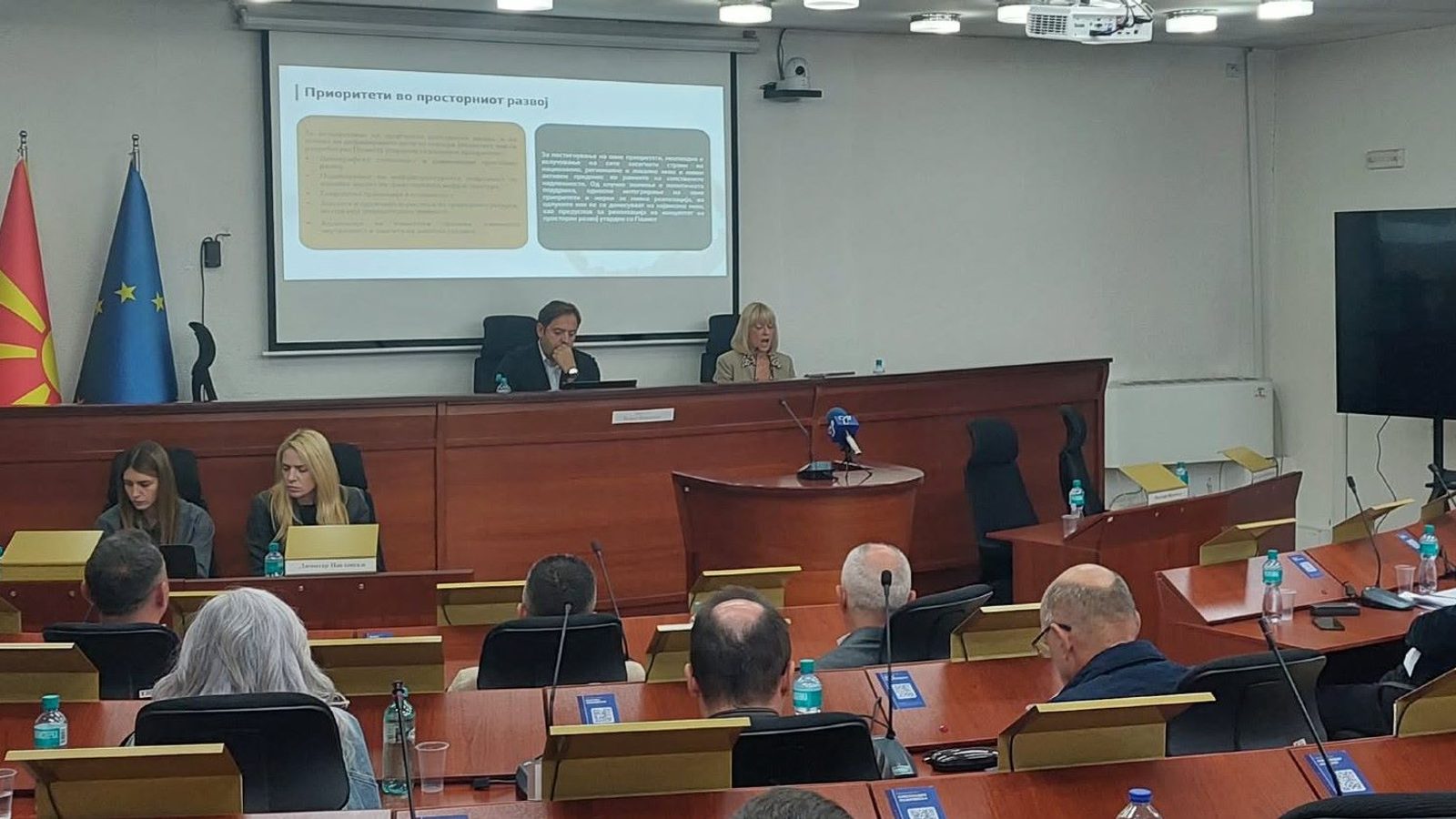
The draft Spatial Plan of North Macedonia to 2040 presented in Bitola projects continued depopulation across the country, with only the Skopje and Polog regions showing higher population concentration that will not reverse the overall decline.
Experts at the presentation warned of negative natural growth in every planning region, an ageing population, intense migration flows and an increasing concentration of people in the Skopje region, trends that deepen demographic and economic polarization.
"To change this situation, above all a consistent demographic policy with a varied set of measures is important, among them easier resolution of the housing issue, especially for younger generations, better employment opportunities, health care and everything that can influence keeping people in their place of origin and reducing migration. Measures are also needed to reduce the demographic gap between the Skopje and other regions," said Dusica Trpcevska-Angelkovikj of the Agency for Spatial Planning.
Analyses presented with the plan show that nearly half of North Macedonia's settlements have up to 100 inhabitants, yet these villages are home to only about one percent of the total population. Urban municipalities hold a strong population concentration while technical and social infrastructure and the environment often suffer neglect.
"There is a large concentration of the population in urban municipalities, and neglect of technical and social infrastructure and the environment is also noticeable. Technical infrastructure, especially transport, is the main factor for balanced spatial integration. Solutions are achievable only if all stakeholders contribute and we secure political support," Trpcevska-Angelkovikj added.
Rural decline, housing surplus and rail promises
Rural areas face pronounced emigration, declining interest in agriculture, loss of arable land, erosion and conversion of farmland to construction land. Despite favourable conditions for organic farming, organic production represents under one percent of total agricultural output. Experts warned that the greatest long-term threat to agriculture is falling interest among young people.
Housing statistics presented with the plan show an intensive building period has produced a surplus: the number of flats exceeds previous spatial plan projections by about 114,000 units, and nearly one third of apartments are unoccupied. The housing market is largely left to the private sector, with only a small number of state-owned units.
Criticism from the floor focused on regional infrastructure. "You have written off Western Macedonia. You only develop Eastern Macedonia. If you look at road infrastructure, there is nothing for Western Macedonia. The axis of development that you have on the map goes to the eastern and southern part, and to the west there is no development. The minister promoted the urban train Bitola-Prilep, which still does not exist. From Bitola to Skopje by train we travel 6 hours, an unheard horror, and from Bitola to Prilep on the current road being built, there are traffic accidents every month, it takes us 4 hours to reach Skopje," said Ljupcho Stojanovski, an environmental expert with 40 years of experience.
Authorities behind the draft plan said it envisages improved rail links so that Bitola, Strumica and Ohrid, the larger cities farthest from Skopje, could be connected to the capital with journeys of around 90 minutes.
"For that, a fast line on Corridor 10-d needs to be built, and from Gradsko a deviation should be made towards Rosoman and Raec and with a tunnel under Pletvar reach Prilep in about one hour. From Prilep to Bitola it is necessary to reconstruct the track, with a speed of 120 to 140 kilometres per hour and electrification. That way, Bitola would be about 80 minutes from the Skopje airport," said Professor Zoran Karakutovski of the Faculty of Civil Engineering. The plan also foresees longer-term rail links from Bitola to Resen and to Ohrid airport.
Photo: SDK.MK)