Panel at MakeDox says depoliticisation and cross‑sector work needed to revive Skopje cinema culture
Participants at a MakeDox panel on 24 August urged depoliticised, cross-sector work to rebuild cinema infrastructure before and after Skopje’s 2028 European Capital of Culture year.
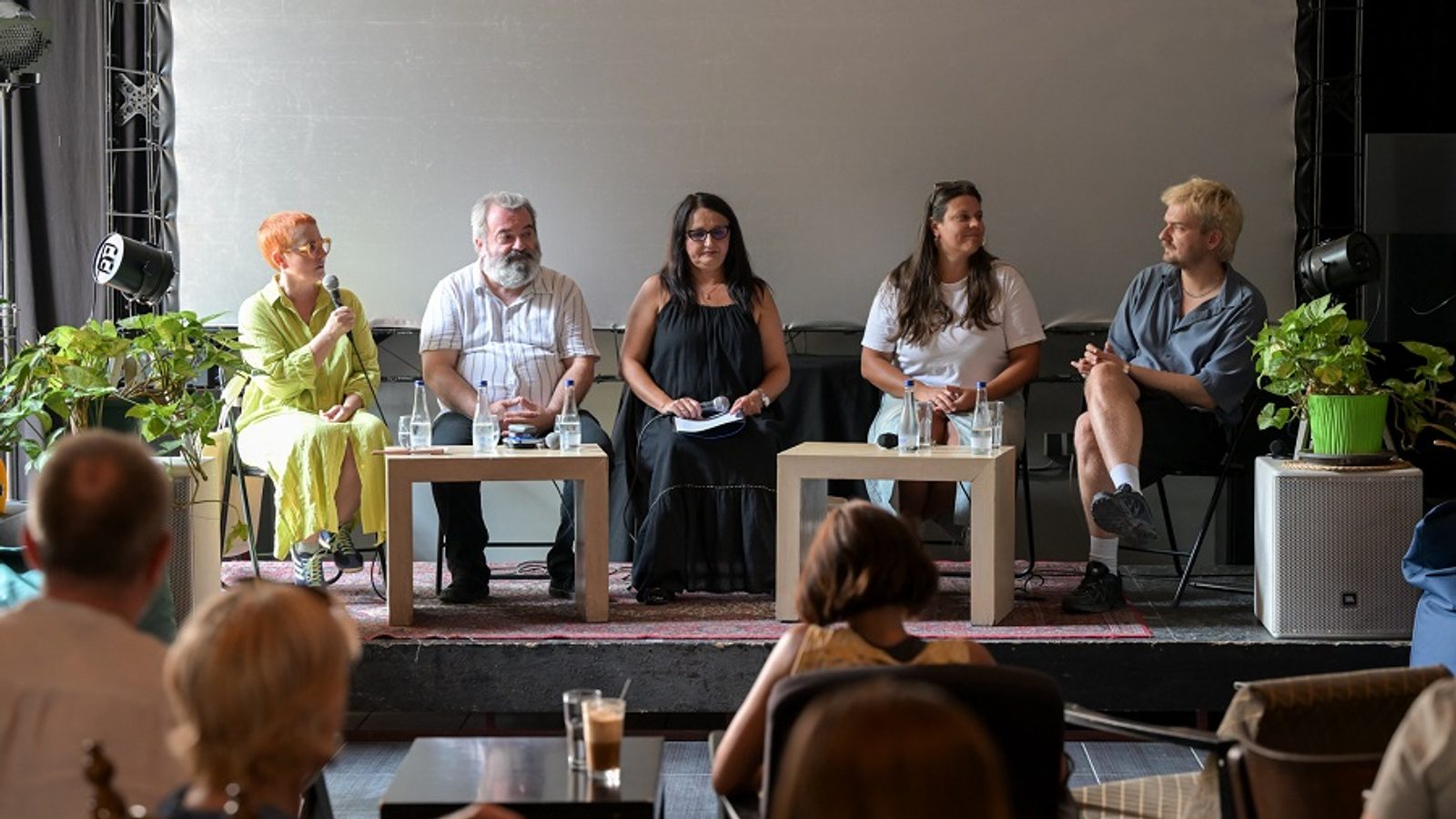
A panel titled "Cultural infrastructure ahead of the European Capital of Culture 2028" took place on 24 August at the Laboratorium venue during the 17th MakeDox festival and focused on one central question: where did the city's cinemas go?
Discussion at MakeDox
The panel gathered Zvonko Naumoski (Head of Operations, Foundation "Skopje 2028 – European Capital of Culture"), Biljana Lunga Filipovska (Advisor for international cooperation, records and strategic planning at the Agency for Film of the Republic of North Macedonia), Margarita Arsova (film-program curator at the Youth Cultural Center, MKC), and Darko Nabakov (executive director of MakeDox). The discussion was moderated by film critic Marina Kostova, vice-president of the international FIPRESCI organization.
In her opening remarks Kostova emphasised how cinema-going used to be an integral part of urban life: "Unfortunately, over time that joy began to fade. We witnessed, and still witness, that our capital, with over 600,000 inhabitants, until the early 1990s had 16 cinema halls, even a specialized cinema for children and youth, and 35 years later we have only one multiplex, a commercial cinema where our authors' auteur films must be shown. There are also two cinema halls, in Kisela Voda and in Drachevo, where films are shown occasionally," she said.
Margarita Arsova described how MKC adapted its film programme during the pandemic and argued that the closure of certain cinema spaces reflected political choices: "It is hard for me even to recall all those events because of the emotion and attachment to everything that happened before. We consciously moved ‘Cinedays’ into a summer, open-air format because we wanted a physical edition in the period when all indoor spaces could not be used during the COVID pandemic. We wanted the audience present live and not to lose the festival’s continuity. The loss of film spaces, like ‘Millenium’ in GTC and ‘Frosina’ at MKC, I cannot say is anything other than a political decision to eliminate MKC as a space. As you can see, not only regarding MKC, but culture in Macedonia in general is regressing; there are attempts to abolish spaces, concepts, and collective agreements so that other parts not connected to critical thought and the public can operate more easily. The closing of cinema halls brings a great loss for the city, for film workers, for the implementation of programmes we wanted to roll out as public policies to resemble a city that was given the title ‘European Capital of Culture.’ The title was awarded in 2023 so we could strengthen capacities and culminate in 2028, however many opportunities were missed. As long as things depend on politics and party affiliation, it is hard to move forward," Arsova argued.
Darko Nabakov spoke about MakeDox’s use of outdoor locations — Kurshumli An, Suli An and the plateau in front of the Museum of Macedonia — and warned about the fragile condition of the historic spaces: "Our goal is for MakeDox to expand into more spaces in the Old Bazaar. Kurshumli An is a magical place and a symbol for the festival, but we all have to be realistic that the space is indeed in a poor condition and one day will need restoration. It is a cultural monument that has not been restored for years and that has to happen. It would be a loss for the festival to be left without the space and exposed to the whims of politics without understanding from the authorities. After 17 years I think we left a mark in the city regarding the screening of documentary films and we should all think together how things could change in the future. We know the situation is difficult. Dialogue with local and state authorities is very hard. Our idea is to gather in one place and start saying things out loud. For example, the City of Skopje has not supported MakeDox for five years. A festival that has a large young audience and is slowly becoming a city symbol does not receive support from the city itself. That is the absurdity in our existence. Hence our entire ‘creative stubbornness’ in organising the festival, because we spend most energy negotiating with state institutions. It is much easier to agree with partners from abroad and to bring a hundred foreign authors every year than to agree with domestic institutions," Nabakov commented.
Zvonko Naumoski noted the Foundation’s mandate and limits but suggested open calls for creative solutions: "Film and film exhibition should be among the core threads in implementing the programme, however ‘ECoC Skopje 2028’ does not have the institutional mandate to solve cinema exhibition problems that have accumulated over the past 30 years. What we can do is invite all interested parties through public calls to apply and propose certain creative solutions," he explained. Naumoski also clarified that the Foundation was specifically formed for the implementation of ECoC Skopje 2028 in July 2026 and that a Declaration has already defined the obligations of the Government and the City of Skopje to the Foundation; the project budget is expected to be around €40 million, of which €30 million is for the programme and €10 million for logistical needs in delivering the programme.
Biljana Lunga Filipovska confirmed the bleak picture of exhibition infrastructure and highlighted existing capacities: the largest concentrated cinema capacity is the commercial cinema "Sinepleks", the Cinematheque plays an important role, and a model that has been developing in the last two years is the cinema network "Kinoverzum." She added that re-establishing a local neighbourhood cinema culture is feasible if a multi-stakeholder working group maps the situation and includes the Ministry of Culture, the Ministry of Education and other partners: "When we talk about establishing a cinema network, it is important to remember that this is not a model we must invent from scratch. We are not talking about an idea that never existed. Skopje already had a culture of neighbourhood cinemas — a cinema you could reach on foot, a cinema in the neighbourhood, a cinema that was part of everyday life. The question today is not whether we can imagine that, but whether we can, given today’s conditions and models, once again create a modern cinema network and bring audiences back to local cinemas. Therefore, I think the next step should be to form a working group that will map the entire situation in Skopje and the country. Of course, part of the working group should mandatorily include the Ministry of Culture, the Ministry of Education, and with the Bureau for Development of Education the Agency already has a memorandum of cooperation," she said.
As a closing point panelists underlined that the Skopje 2028 European Capital of Culture project offers a chance to plan legacy measures: the aim should not be only temporary festivals or pop-up screenings but a functioning cinema network that remains after 2028, created through cooperation among state, local and independent cultural producers.
Photo: press material from the event