Second phase of Skopje–Blace highway begins: many government officials present
At the ceremonial groundbreaking for the 10.5‑km Skopje–Blace section a large part of the state leadership attended; only the president was absent.
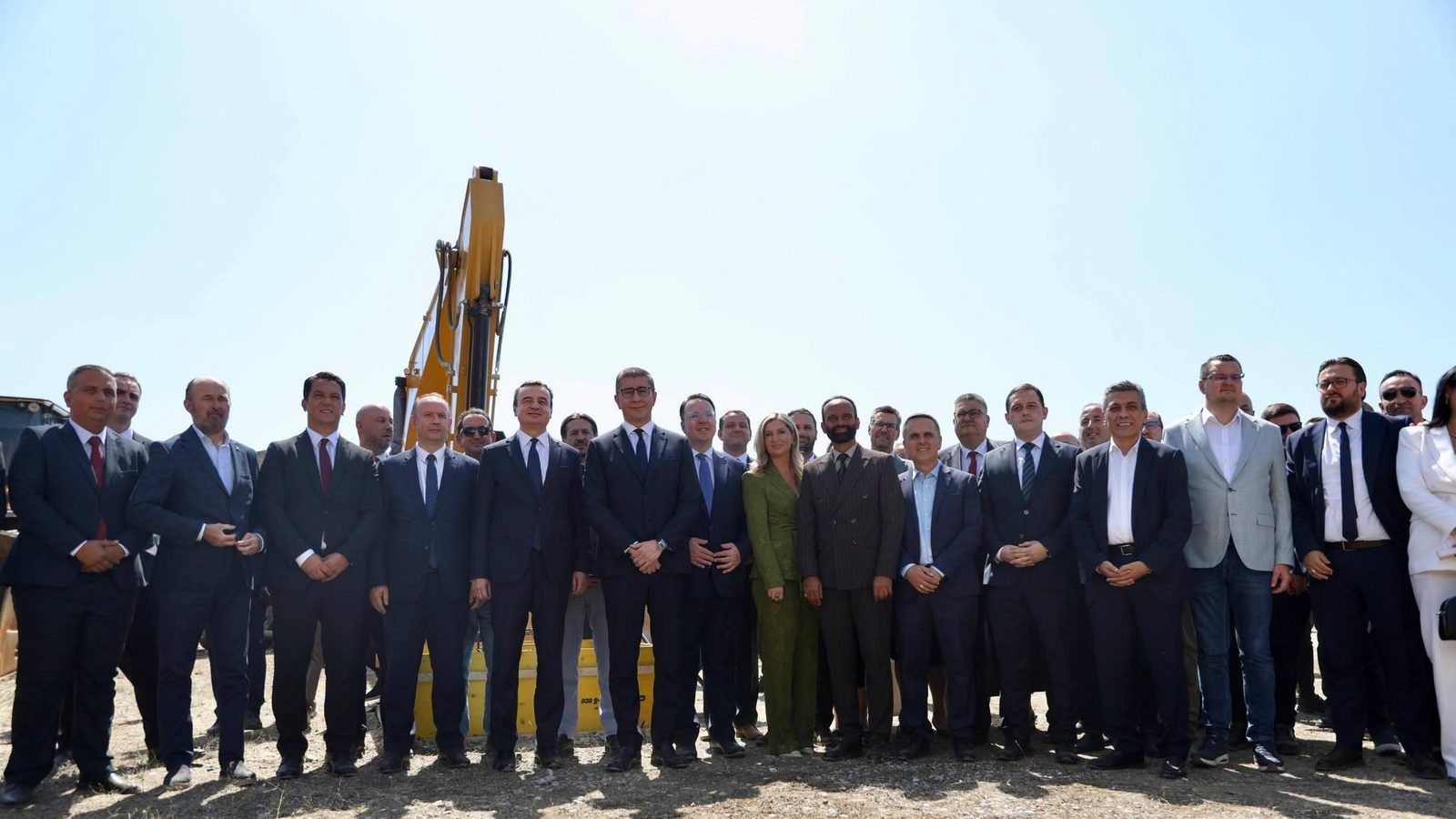
The start of construction works for the second phase of the Skopje–Blace highway gathered a large part of the state leadership at the scene: Prime Minister Hristijan Mickoski and a delegation he led were there, and also present was the Prime Minister of Kosovo, Albin Kurti, along with several ministers and officials.
Many government officials, few workers
Alongside Mickoski and Kurti, the ceremony was attended by the Speaker of the Assembly Afrim Gashi, deputy prime ministers, ministers, mayors and directors. The speakers were the two prime ministers, deputy prime ministers Aleksandar Nikolovski and Bekim Sali and Koce Trajanovski, director of the Public Enterprise for State Roads (PESR), which is the main implementer of the project.
The reception of Kurti caused visible pushing among the officials who wanted to shake his hand or at least get a smile from the Kosovo prime minister. After Mickoski and Kurti, the groundbreaking shovels were swung by Assembly Speaker Afrim Gashi, deputy prime ministers Aleksandar Nikolovski and Bekim Sali, Trajanovski, but also Izet Medzhiti and Bilal Kasami. It remained unclear in what capacity they were present — whether as co-presidents of Vredi or as mayors of Cair and Tetovo. The mayor of Struga, Mendi Kjura, was also present.
A dozen workers from the domestic company "Granit", which will build the highway, were a minority compared to the number of politicians in suits. The presence of ministers whose portfolios do not directly cover the project was also noted: Minister of Education Vesna Janevska, Minister of Culture Sedat Sulejmani, Minister of Justice Jeton Shasivari, Minister of Economy Besar Durmishi, Minister of Relations Between Communities Agon Ferati, Deputy Prime Minister Ljupcho Dimovski, Minister of Health Sasho Klekovski, Minister of Administration Goran Minchev, a deputy from the Ministry of Interior and MPs from VMRO‑DPMNE and from Vredi were present.
When asked why so many ministers and some mayors from Vredi attended and whether they had other obligations, the party responded with the following statement:
“This is a strategic infrastructure project of national and regional importance, which connects North Macedonia and Kosovo and has broad institutional support. Presence at the event is an expression of support for a project that is of interest to all citizens,” Vredi replied to us.
The Government, for its part, offered an explanation of why it considers the attendance justified:
“This is a project of great importance for the state and the citizens and we really see nothing controversial in representatives of institutions attending its official commencement. The Government is a team and when a project of importance for citizens is being implemented, the presence of Government members should not be viewed only through who is formally responsible for the project. All ministers are part of one Government that jointly adopts and implements policies and projects of interest to citizens. Also, we see nothing controversial in the presence of mayors and MPs. They are elected representatives of the citizens and it is perfectly natural for them to attend events that are important for their municipalities, for the region and for the state. The question whether the ministers did not have work in their portfolios that day is wrongly posed. The work of a minister does not mean just sitting in an office. The work implies coordination, attendance at important events and support for projects that have broader significance for the state. Much stranger was the practice when football was played in government offices, instead of institutions working and implementing projects,” the Government replied to us.
The Skopje–Blace highway for the second phase will be built over a length of 10.5 kilometres and is expected to be completed in four years. It will connect with the already built 1.5 km near the Blace border crossing. The route foresees five tunnels, eight bridges, 11 underpasses, four galleries and nine retaining walls.
Photo: Facebook