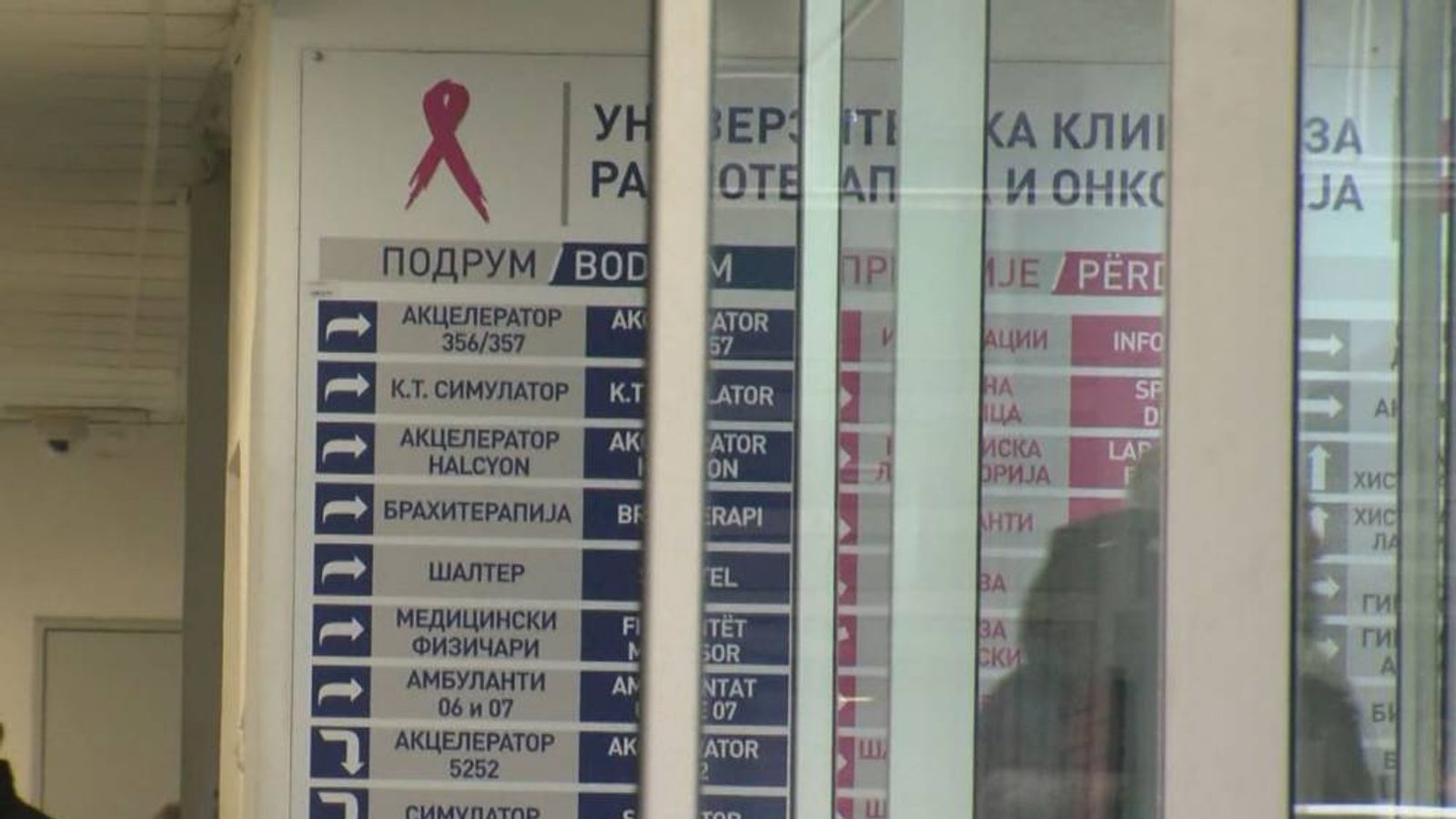
458 new breast cancer diagnoses and a screening system under strain
Patients and Hema‑Onko say long waits for tests and centralized services in Skopje weaken a screening programme that began in 2015.

One in 20 women worldwide will develop breast cancer in her lifetime, the International Agency for Research on Cancer (IARC) in Lyon, France warns — and locally the Clinic for Radiotherapy and Oncology recorded 458 newly diagnosed patients in the first six months of this year. Breast cancer remains the most frequently registered malignant tumor among women in the country.
Those numbers hide individual lives and family stories. Many patients tell of a parallel struggle against gaps in the health system: long waits for tests and treatments, centralized services in Skopje, and a screening program that looks better on paper than in practice.
Sixty-year-old Roza Trajchevska from Skopje is one of the women whose life this October — traditionally marked in pink to raise awareness — has been reshaped by cancer.
"So, I was not a disciplined patient in that regard. That's what the doctor told me and even wrote in the report that I was not disciplined because I didn't go for a mammogram for four years, for a reason I used to excuse myself — because my mother was ill with cancer from 2018 to 2021 when she died. And when I went to her check-ups I used to say, 'God willing no one will have to walk these halls.' But very quickly I went through it too. In 2023, before the holidays, I decided, 'let me have a check before the vacation.' I had a mammogram. The result after four days was given to me at the counter and it said that I could freely go and come for a check after two years. That everything is fine, that there is nothing, I was also given a CD," Trajchevska recounts.
On the insistence of a relative who works as a nurse in a private hospital, Trajchevska sought a second opinion. The planned Adriatic holiday was cancelled when follow-up imaging, ultrasound and core biopsy produced a different finding: she was advised to seek a surgeon quickly.
"Within about ten days I found a surgeon, I brought the results and was told that because of the position of the tumor in the breast the whole breast should be removed. It was possible that the lymph nodes would also have to be removed. Now I remember, I am more afraid than three years ago when I was told what would happen to me. I am more afraid of recurrences. Although I do regular checks I think I have far less strength now to go back three years than I did then, because I simply did not know what awaited me," she adds.
Trajchevska later underwent surgery followed by eight cycles of chemotherapy and 18 cycles of biological therapy. She has been taking adjuvant oral therapy for two years and faces further monitoring during the coming three-year period. Her husband and son were the strongest support through the hardest moments; she describes severe side effects that required infusion treatments lasting around ten days after each chemotherapy cycle.
Because of difficulties arranging consistent follow‑ups in public care, Trajchevska chose private controls despite the cost.
"But I decided not to experiment and moved to private care. Not everyone can afford it, because private is not cheap at all. I decided that I can pay once a year. Personally I can, not everyone can. To go privately once a year for a mammogram and every six months for a breast ultrasound… No, once a year for mammography and every six months an ultrasound. But I feel calmer. I go to the same doctor for the second time. The third time will be again in six months. At least I will not repeat the story. The story is already filed there, the doctor knows it, previous results are hers and my decision is such," she says.
Patient groups point to practical gaps in screening and services
The patient association Hema-Onko acts as a bridge between patients and institutions and receives frequent requests about missing therapies, a shortage of mammography appointments and, recently, limited access to PET‑CT scans.
"Most often they call because of lack of therapies, because of lack of appointments for mammographies, for PET‑CT in recent times, because that is a burning issue which truly requires a solid solution, because we have many patients who are waiting for PET‑CT scans. Then they ask about personal matters, about examinations they need to have when they cannot have them in our public health system, how much those would cost in other clinics, institutions, laboratories and so on. They also ask for psychological support, which is a very, very important point to mention. We try to do all that, at least with an initial conversation, and then refer them to a psychologist, because sometimes that is really needed," says Milica Kuzmanovska, vice‑president of Hema‑Onko.
Hema‑Onko also stresses that decentralizing oncology services would ease the burden: functioning centers in Bitola and Tetovo already exist and Štip could be activated to reduce travel costs and the need to take time off work for therapy.
Organized breast cancer screening in North Macedonia began in 2015 and targets women aged 40 to 69 with no symptoms who have not had a mammogram in the past two years. However, patients' experiences and a number of findings by the State Audit Office have raised concerns about how effectively the program operates in practice.
One striking example is the case of Maja Andjelkovik Veleska, who in the spring of 2023 received an invitation for screening at age 46. After attending the Polyclinic "Jane Sandanski" she had no direct contact with a doctor there; a radiology technician raised suspicions and she sought a second opinion in a private hospital. The private assessment and a subsequent biopsy showed cancer despite the Ministry's message that the screening result was normal. Stories like these underline patients' mistrust and call attention to the need for stronger, consistently implemented screening and more timely access to diagnostic scans and therapies.
Medical professionals and patient groups call this October not only a month of awareness but a reminder that screening programs must function in reality, not only on paper, if they are to save lives.
Photo: Rozev piknik pojadok vo Skopje/Hema-onko Edna od 20 zheni na