Vehicle confiscations vary after convictions for driving without a licence; Supreme Court to decide
Uneven practice by prosecutors and courts has led to permanent and temporary vehicle seizures; the Supreme Court will meet in December.
Courts and prosecutors in North Macedonia are reaching different outcomes over whether vehicles should be permanently confiscated when someone is convicted for driving without a valid licence, legal practitioners say — and the Supreme Court is due to take up the issue in mid-December.
Parliament amended the Criminal Code in February to introduce mandatory confiscation of motor vehicles for several offences, including driving with more than 1.5 g/kg blood alcohol, organising races and driving without having passed a driving test. Since the changes, police have been temporarily seizing vehicles on the spot when they detect such offences.
Three recent rulings show inconsistent practice
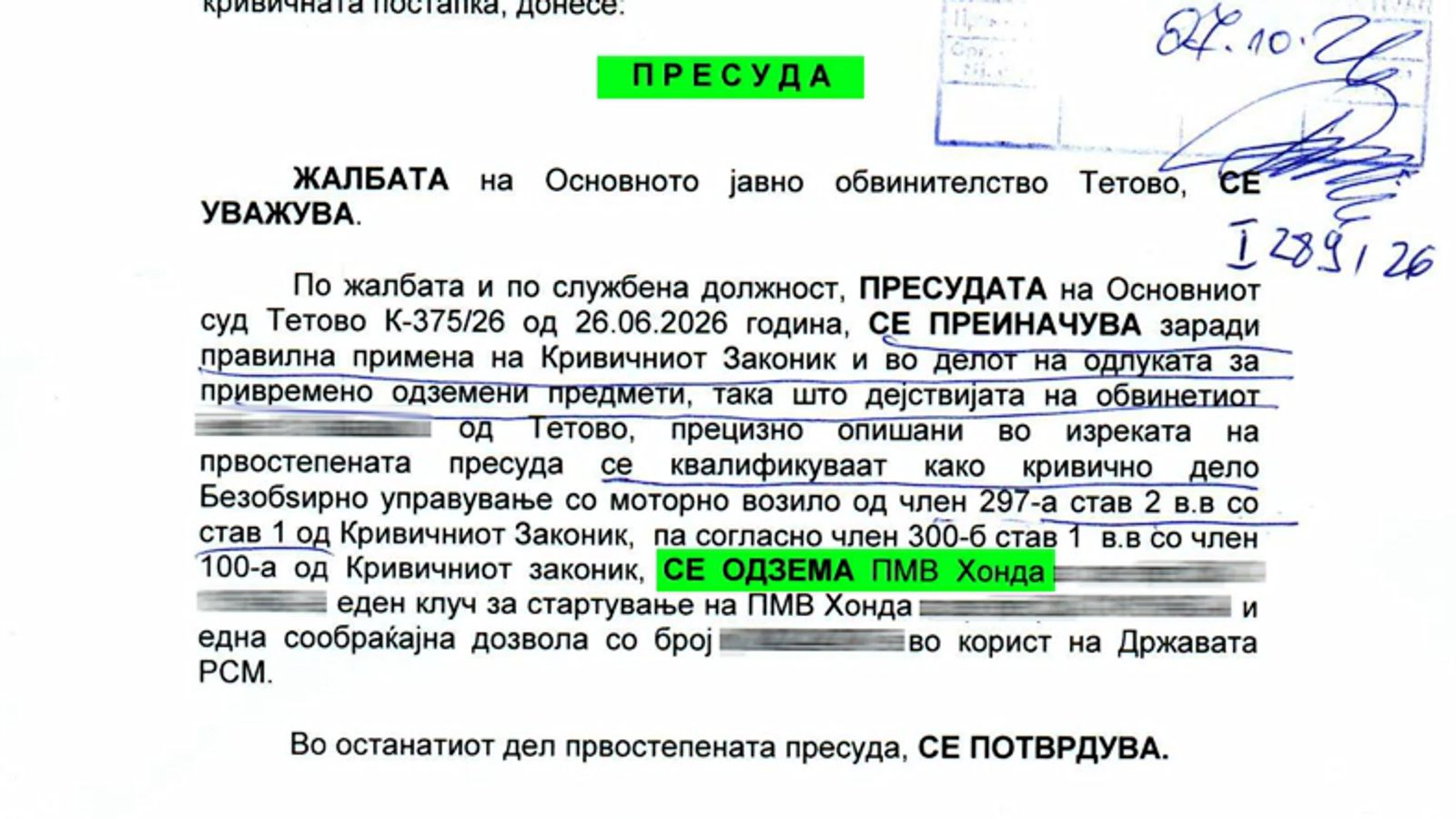
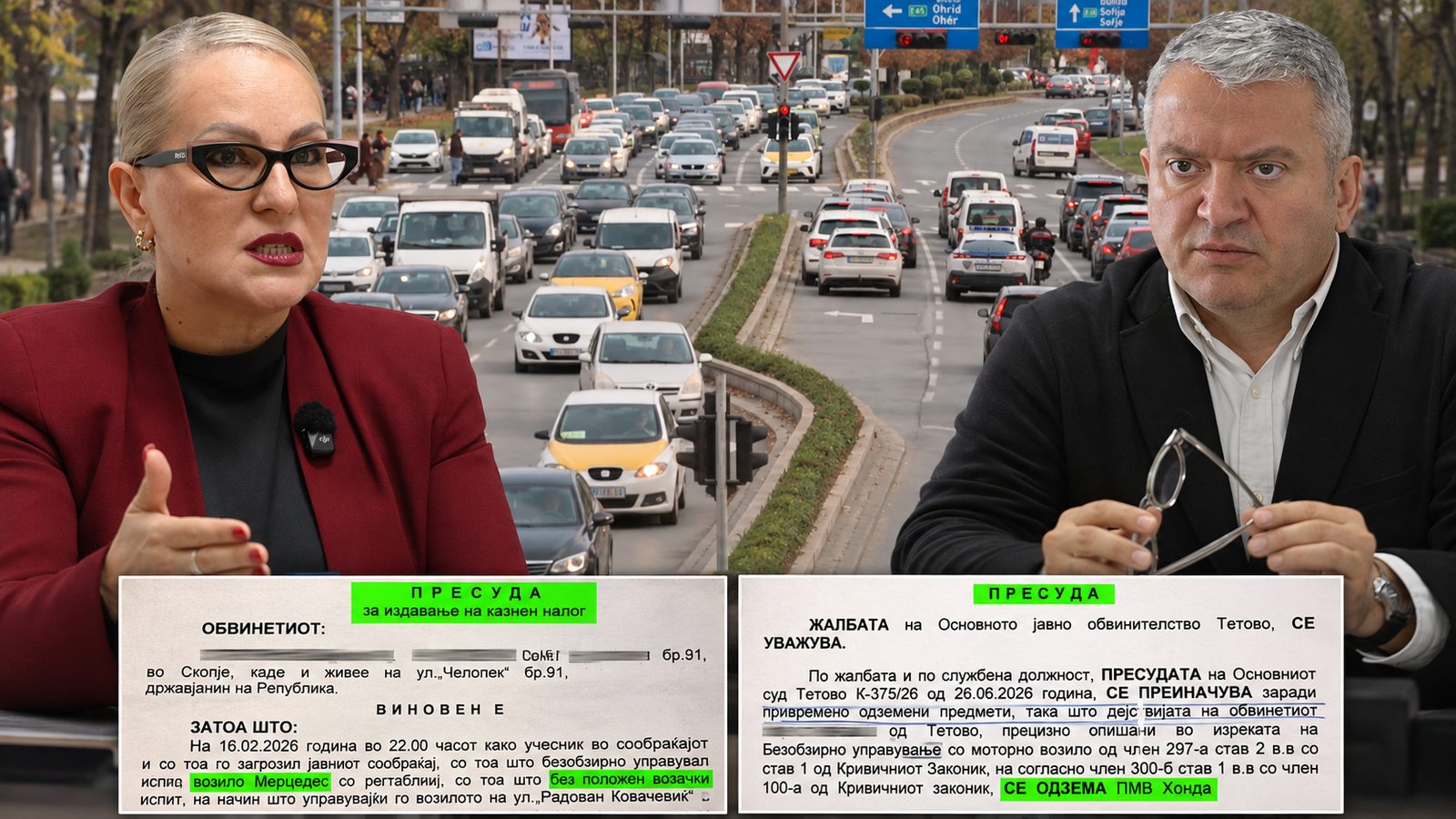
Appellate Court in Gostivar, on 23 September, issued a judgment ordering the confiscation of a Honda from its owner who had been driving without a licence. The court criticised the lower court's earlier refusal to order confiscation, stating: "The first-instance court acted incorrectly when it rejected the prosecution's proposal to confiscate the items which by law should be confiscated, because the provision of Article 300-b of the Criminal Code provides for mandatory confiscation..." The defendant also received a suspended three-month prison sentence, a fine of 20,000 denars, probation supervision and a six-month driving ban.
In September 2026 the Basic Court in Tetovo ordered the permanent confiscation of a Volkswagen Polo belonging to a woman from Skopje who had driven without a licence. She received a suspended three-month sentence (conditional on not committing a new crime within 12 months), a fine of EUR 500 and a six-month ban on obtaining a driving licence; that case is now on appeal to the Gostivar Appellate Court.
Also in September 2026 the Basic Criminal Court in Skopje accepted a prosecutor's proposal for a penal order against a driver who had driven a Mercedes AMG owned by his mother without having passed a driving test. In that case no one requested confiscation and the vehicle was not taken; the driver received a suspended sentence, a fine and a driving ban.
Lawyers and judges say these three rulings highlight uneven practice: prosecutors do not always request confiscation, lower courts sometimes refuse requests, and appellate courts reach differing conclusions. The Appellate Court in Gostivar noted its decision follows the law; the court quoted the Criminal Code provision (Article 300-b) as mandating confiscation in the relevant circumstances.
Appellate courts across the country have signalled the issue needs an authoritative answer from the Supreme Court. "Yes, we as the Appellate Court have a position on which criminal offenses motor vehicles are to be confiscated as a legal obligation of the court foreseen in Article 300-b in conjunction with Article 100-a of the Criminal Code, whereby the court pays attention to the principle of proportionality in accordance with the European Convention on Human Rights," the Appellate Court in Gostivar said. The Appellate Court in Shtip added: "We have reached the conclusion that the same must be treated on a case-by-case basis, especially taking into account ECtHR practice with regard to double punishment, disproportionate punishment, protection of property, etc., and this conclusion has been forwarded to the Supreme Court of the Republic of North Macedonia." Appellate Court Skopje judge and spokesperson Gabriela Gajdova announced that the Supreme Court will convene the four appellate courts in December to resolve the questions.
Defence lawyers point to practical problems long before a case reaches the courts. Attorney Aleksandar Tumanovski described how his client was stopped in the Skopje neighbourhood of Čento in February and the vehicle was taken away "by an oral order of the prosecutor" to a police station for storage. The prosecutor later issued a penal order in July and the court accepted it in September, but the client only recovered his car in November — nearly nine months after the temporary seizure. "I believe that vehicles should be stored in appropriate places, protected from weather conditions because any weather damage to the vehicle, for example, should be compensated by some of these institutions," Tumanovski said. He added that the problem is at the interface between police and prosecution: when items are not to be confiscated permanently the same prosecutor who ordered the temporary seizure must also order their return.
The Ministry of Internal Affairs told reporters that from 1 February to 30 October police officers temporarily seized 2,098 motor vehicles in connection with the criminal offence "reckless driving."
Photo: press material from the event