Government posts U.S. photos as two minimum wages fail to cover the basket: Where are the results and expense report?
SSM puts the September basket at 69,432 MKD; by 21 September the reviewed public sources contained no complete delegation roster or itemized cost, while the Government, as a counterargument, cites wage growth and lower annual food inflation.
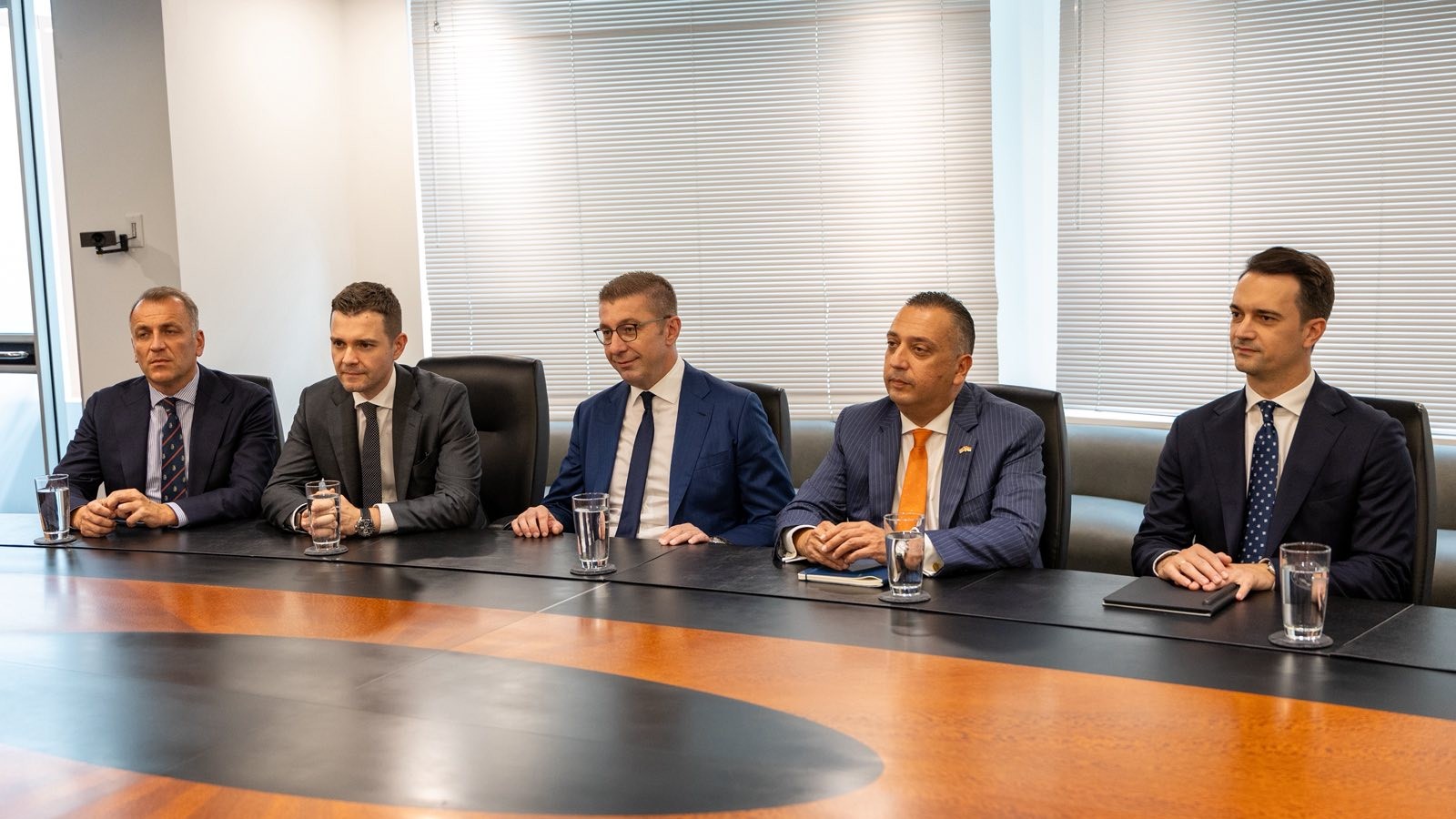
While the Government posts photographs, announcements and messages about strategic partnership from the United States, the domestic bill looks much more ordinary and much harsher: for September, SSM calculated a 69,432 MKD minimum union basket for a four-person household. There is no proven causal link between Prime Minister Hristijan Mickoski’s trip and prices in shops, and no such link should be imposed. The question is different, and politically essential: when the Government is seeking diplomatic and investment visibility in Washington and New York, why, by 21 September, can the public still not see a published complete delegation roster, an expense report and a clearly measurable material outcome?
This is not an argument over whether a prime minister should travel. States must speak with partners, seek capital, political support and better market access. But state communication must not replace state accountability. A photograph can show presence; it does not show price, obligation, deadline, signature or gain for citizens who are counting every bill at home.
What is actually documented in the United States
The Government announced a political and economic visit to the United States, first in Washington and then in New York around the 81st session of the United Nations General Assembly. For the Washington part, it reported meetings with Caroline Vik, a representative of the U.S. International Development Finance Corporation, DFC, as well as with members of Congress Keith Self and Claudia Tenney. The most firmly independently documented point is Mickoski’s public conversation at the Atlantic Council in Washington on 17 September, a think-tank event with a publicly available recording of about 57 minutes.
For New York, the Government reported that Mickoski spoke with U.S. Secretary of State Marco Rubio and had contacts with senior State Department officials, including Christopher Landau, Brendan Hanrahan and Daniel Lawton. In the reviewed public U.S. schedules and announcements by the cutoff, no corresponding U.S. readout was located for the contacts with North Macedonia. That does not prove the contacts did not take place. But it shows that the public record on their format, duration, agenda and possible conclusions so far comes mainly from Government announcements.
A photograph is not a result: what is still missing
The Government has the right to say that talks open opportunities. But in the public interest, a distinction must be made between an opportunity and an approved project, between a meeting and an agreement, between institutional capacity and money actually promised to North Macedonia. The Government described DFC through a capacity of 205 billion dollars. That is not an amount approved for the country. In the reviewed sources by 21 September, no signed September DFC loan, grant, project or announced investment amount for North Macedonia was found.
The trade framework with the United States also cannot be presented as an outcome of this mission if the public record shows it was announced in February, before the September visit. Mickoski may politically argue that formalization or next steps are being pursued, but that is not the same as a newly signed result from the trip.
The most important gap is even simpler: by 21 September, the reviewed public sources contained no complete roster or headcount of the delegation, nor any total and itemized cost of the trip. That does not mean the documents do not exist or that the costs will not be published later. But it does mean that, at this moment, the public cannot assess how much the mission cost, who exactly traveled, who paid and what was measurably obtained.
The union basket: a figure that must be read accurately
SSM announced that the September minimum union basket amounts to 69,432 MKD for an assumed four-person household. Of that amount, food and drinks account for 25,259 MKD, or 36.4%. In SSM’s scenario with a rented 60 m² apartment, the total basket is 84,807 MKD. This figure is not rent by itself and is not a national average market rent; it is SSM’s full tenant model, which includes the broader item for housing, water, electricity and heating.
The SSM basket is not a state poverty line and is not official statistics on the cost of every family. It is a union model and must be named as such. But as a public monthly series, it is a relevant signal of pressure on workers’ budgets. In September 2024, SSM’s base basket was 61,306 MKD. Today’s 69,432 MKD means an increase of 8,126 MKD, or 13.3% over two years, according to the same union comparison.
Two minimum wages: simple arithmetic, a hard signal
The statutory minimum for 2026 is 38,507 MKD gross, while the publicly reported net equivalent is 26,046 MKD. Two such net minimum wages equal 52,092 MKD. By simple editorial arithmetic, that is 17,340 MKD below SSM’s base September basket and 32,715 MKD below the rented-household scenario of 84,807 MKD.
This calculation does not claim that every household has exactly two minimum wages, no other income, that everyone pays rent, or that every family spends according to the SSM model. But it shows the problem the Government must not cover with protocol photographs: for households close to the minimum wage, even two employed people can remain below the union-calculated basic needs. The average wage does not solve that fact, because the average is not the median and does not describe the position of a worker living on the minimum wage.
The Government’s context must not be erased
For a fair picture, the Government’s counter-argument must also be included. It can verifiably point to minimum-wage indexation, growth in the average net wage and moderate annual food inflation in August. According to official statistics, the average net wage in June 2026 was 48,381 MKD, 6.4% higher nominally and 2.9% higher in real terms compared with June 2025. In August, annual inflation was 2.6%; food and non-alcoholic beverages rose 1.0%, while housing, water, electricity, gas and other fuels rose 3.8%.
These data are important, but they are not a final answer. The consumer price index is not the same as the union basket. The average net wage is not the wage of a minimum-wage worker. And annual food inflation of 1.0% in August does not cancel the two-year change in the union basket, nor the cost for a tenant paying the whole package of housing and utilities.
The Government can also refer to the 2026 Budget, which plans 116.8 billion MKD for pensions, 52.6 billion for wages and 12 billion for social protection. These are planned public funds, not proof that a specific household already has greater purchasing power. There are also rules for guaranteed minimum assistance and an energy allowance, but the public has the right to know how many households are covered, how many are rejected and whether the amounts are sufficient.
The Government previously claimed that measures limiting margins and publishing prices produced results and helped reduce the food component of the union basket during a certain period of 2025. That is the Government’s causal assessment. In the reviewed materials, no independent evaluation was located that, with full data on coverage, inspections, fines and market effects, would show that those measures themselves caused the decline. If the Government claims it has a different basket of 101 basic products and that it is lower than the union basket, then it should publish the methodology: items, quantities, stores, cities, price collection dates, assumed household and treatment of rent and utilities.
Questions the Government should answer
Strong criticism of the Mickoski Government does not need to rely on speculation. The missing documents and the arithmetic every household understands are enough. From what was publicly available by 21 September, neither the financial scope of the U.S. mission nor its final material results can be independently assessed. That is not proof that the visit failed, but it is a serious accountability problem.
The Government, the Ministry of Foreign Affairs and the Prime Minister’s Office should publicly answer the following:
- What is the complete list of people who traveled as part of the delegation, with their functions, who approved the travel and what is the source of funding for each person?
- What is the planned and realized cost for airfare or flights, accommodation, per diems, local transport, security, protocol, communication services and other items?
- For each meeting with DFC, Congress and the State Department: who confirmed it, who attended, what was agreed in writing and what is the deadline for the next step?
- Is there a signed document, credit line, grant, investment memorandum, term sheet or project agreement as a result of this visit; if there is, what is the value, what are the terms and what are the deadlines?
- When will the methodology for the Government’s alternative basket of 101 products be published, and how exactly was the difference from the SSM basket calculated?
- What independent analysis exists on the effect of the margin measures, with data on coverage, inspections, violations, fines and price movements?
Until those answers are published, the Government can produce visibility, but not verifiable accountability. And in a country where two net minimum wages mechanically do not reach the union basket, public money and public results must not remain behind the curtain of protocol.
Photo: Government of North Macedonia / press material