“Seize the present if you want to influence the future,” Siljanovska‑Davkova told young people
At a youth forum in Ohrid the president warned that slogans about the future must not sideline the present and called for a systemic, cultural approach to prevent peer violence.
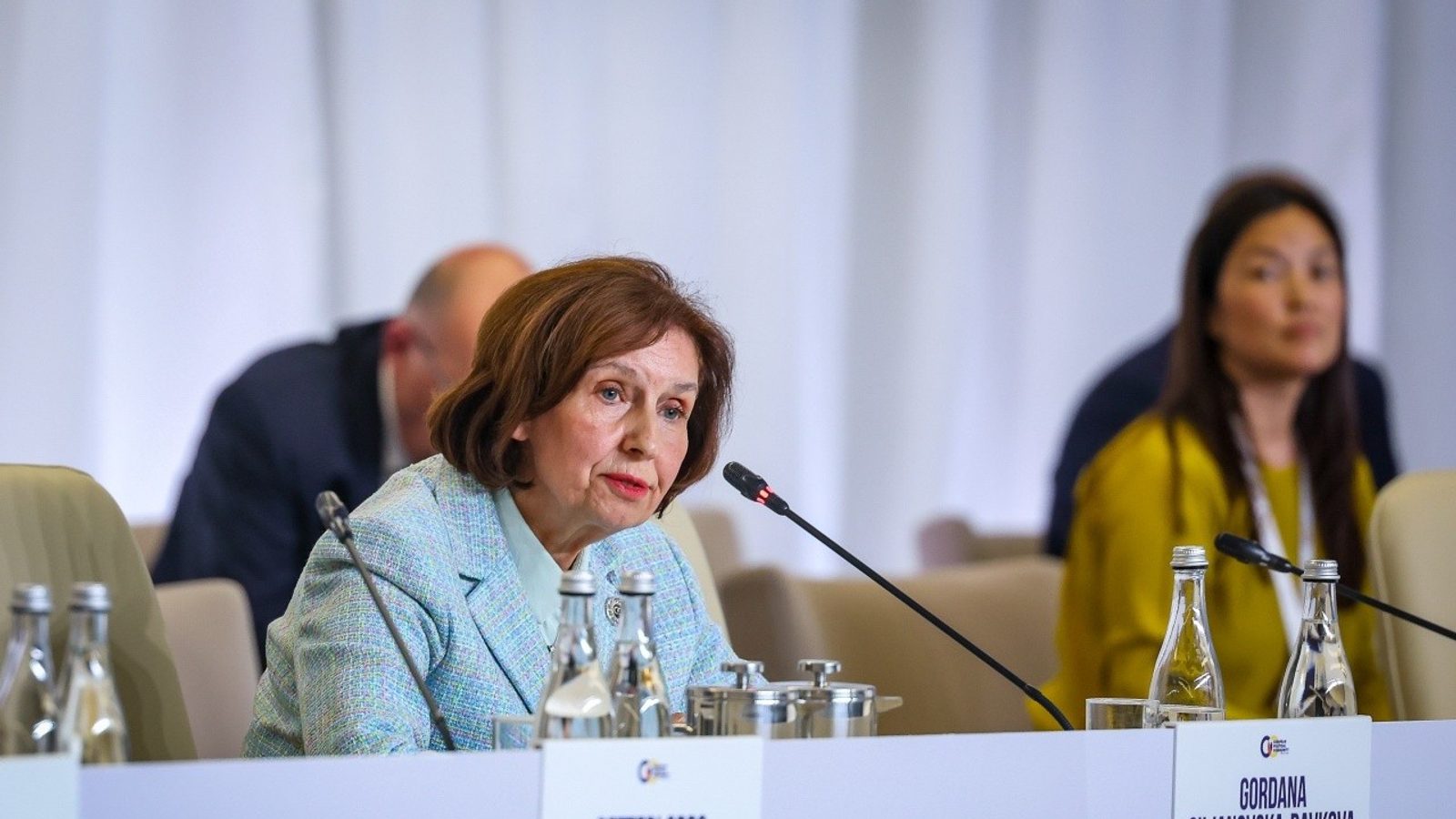
President Gordana Siljanovska-Davkova urged young people to take an active role in decision-making and public life if they want to affect the future, speaking today at a discussion titled "Peer violence and vandalism: Youth, schools and the digital space" held at the presidential villa Biljana in Ohrid.
Siljanovska-Davkova: the future cannot be an excuse to ignore the present
Siljanovska-Davkova warned that the common slogan that "the future belongs to young people" must not be used as a reason to sideline their present needs and agency. "I sometimes say that perhaps we adults, only because of that phrase 'the future belongs to young people', impoverish the present. Take the present if you want to influence the future. Therefore, the inclusion of young people in the decision-making process, not only in the Assembly, at all levels, in schools, is important," she said.
She stressed that efforts to combat violence cannot be reduced to statistics because behind every case there is an individual with feelings, desires and dignity. In that context Siljanovska-Davkova emphasized the importance of personal encounters and human contact, especially at a time when a large part of young people's communication takes place in the digital sphere.
Addressing verbal aggression and the effect of language on young people, the president warned against insults, belittling and intolerance, which are often underestimated forms of violence. She called for teaching young people values of love, respect and non-violent behavior rather than normalizing violence as a way to communicate or resolve conflicts.
Siljanovska-Davkova also proposed a broad cultural and systemic approach to prevention: "We must create a system.... All of us must become active in order to build a culture of understanding, a culture of peace, instead of a culture of fear... Sport, music, culture, activity — there are no more important means for engagement and, if you will, for the demilitarization of the thoughts present on the networks or, if you will, for peacemaking," she said.
Culture Minister Vesna Janevska told the meeting that aggression among young people appears more brutal than before and that what is especially worrying is that incidents are frequently filmed and posted on social networks. "I have the impression that aggression has increased a lot, maybe it is only more visible and more reported, but I think it has become more brutal. In the past children would fight, there was pushing and scuffles and so on, but now we have cigarettes being stubbed out on bodies, stabbings with knives, humiliations in the crudest form that can exist toward a human being. And what is most terrifying, and equally terrifying, is apathetic watching, even filming on the phone and posting on the networks," Janevska said.
Janevska added that family background is an important factor for aggressive behavior, but media and the digital environment also have an influence. She said the Ministry of Education and Science, together with the Chamber of Psychologists, is running trainings for teachers to recognize early signs of aggression and family problems, covering 30 municipalities so far. As measures she named school prevention programmes, more teacher presence in corridors and yards, manuals for dealing with peer violence, anti-cyberbullying activities, and announced planned legislation that would introduce penalties for parents of children who commit violent acts.
"Changing mentality is not something that happens overnight; it is a process that takes time and cannot be done by the family alone or the school alone — it is done by the whole society. It is not a platitude when we say 'the future is with the young.' That is reality. If we jointly use the present, we will create a better future," Janevska said.
Photo: Gordana Siljanovska-Davkova / Fejsbuk