Stefan Andonovski: North Macedonia up 16 places in UN e‑government index, now 68th
Minister Stefan Andonovski says the country entered the “very high” e‑government category and reported higher scores across all index pillars.
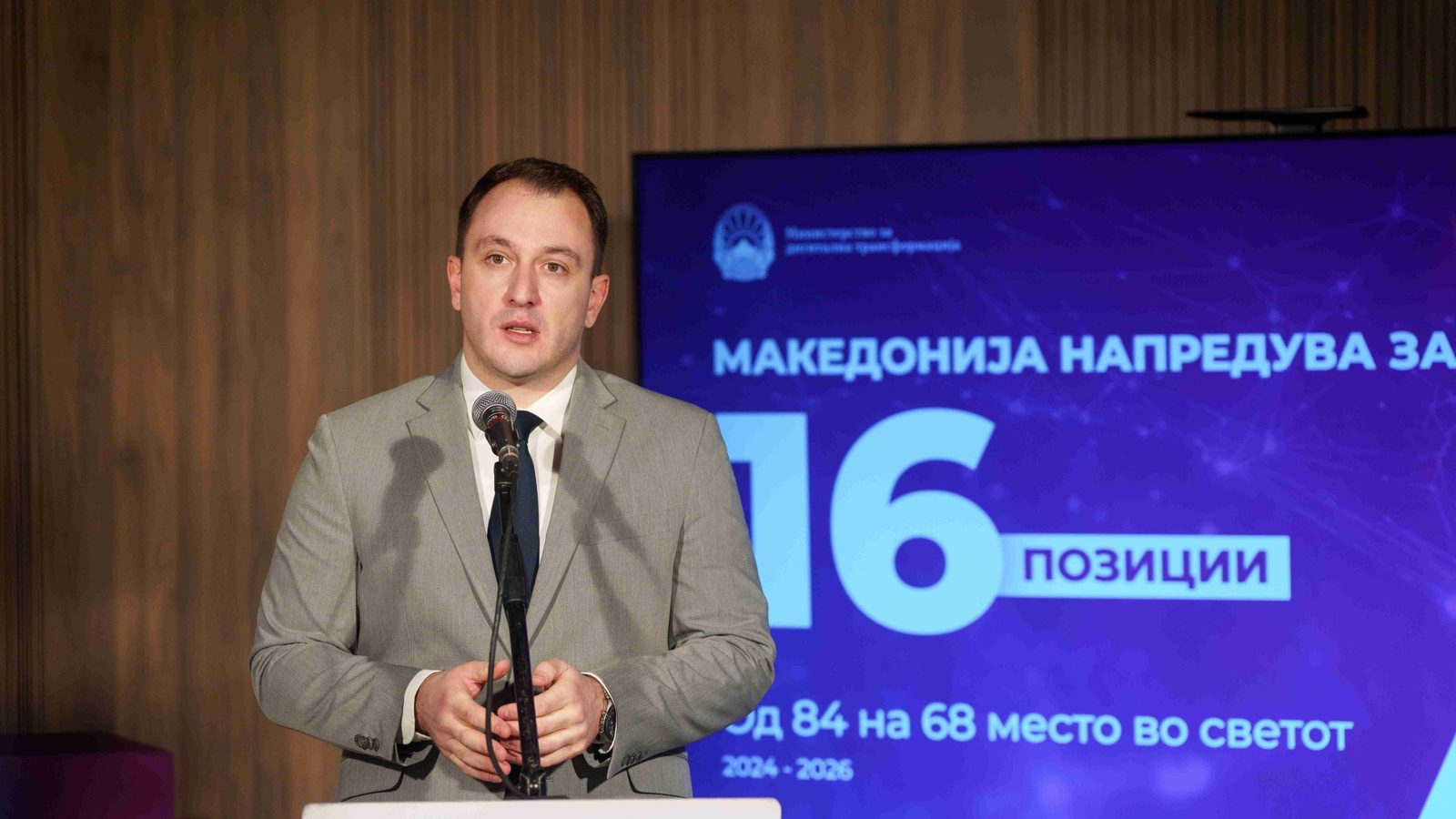
North Macedonia rose 16 places to 68th in the United Nations E‑Government Development Index for 2026, the country’s Minister of Digital Transformation, Stefan Andonovski, announced at a press briefing. The new position marks the first time the country has entered the "very high" e‑government group in the index.
According to Andonovski, the 68th position improves on the 84th place recorded in the 2024 cycle and is the country’s best result since 2010, when it ranked 52nd.
Andonovski said: "Compared with ten years ago, 2016, when we were on 69th place, the position of Macedonia all these 10 years recorded extremely poor results. So with this year's result we not only improve the ranking from two years ago, but we surpass the best result in the last 16 years."
Scores and pillars behind the jump
The minister outlined the index scores that underlie the improvement: North Macedonia’s overall score rose from 70 index points in 2024 to 78.4 in 2026. Sub‑scores increased as follows: online services from 66 to 74; telecommunication infrastructure from 75 to 81; human capital from 70 to 79. The e‑participation indicator climbed from 57 to 65 (all values are on a 0–100 scale).
Andonovski highlighted stronger institutional arrangements and technology functionality inside the online services pillar: the institutional framework score rose from 88 to 96, while technological functionalities increased from 68 to 100. He also noted that further work is required on end‑to‑end service delivery so citizens and businesses can complete more procedures fully online.
The UN index evaluates digital government development in 194 countries every two years using a common methodology that measures three foundations—online services, telecommunication infrastructure and human capital—and an additional e‑participation indicator. Andonovski said he expects North Macedonia to advance another 20–30 places by the 2028 ranking, driven by better digital connectivity, infrastructure, citizen skills and uptake of new digital services.
On service availability, the minister reported that the national portal uslugi.gov.mk currently lists 350 services, some fully electronic and others informational. He announced that roughly ten services from the Ministry of Interior and about thirty from the Health Insurance Fund (FZO) are planned for publication in the coming period, and that citizens will be able to propose which services should be digitized via the portal starting next year.
Photo: Ministerstvo za digitalna transformacija