Association: pension funds delivered returns, but the system needs painful reforms
ADPF presents 20-year returns, supports multifund changes and asks for open expert debate on higher contributions, retirement age and indexation.
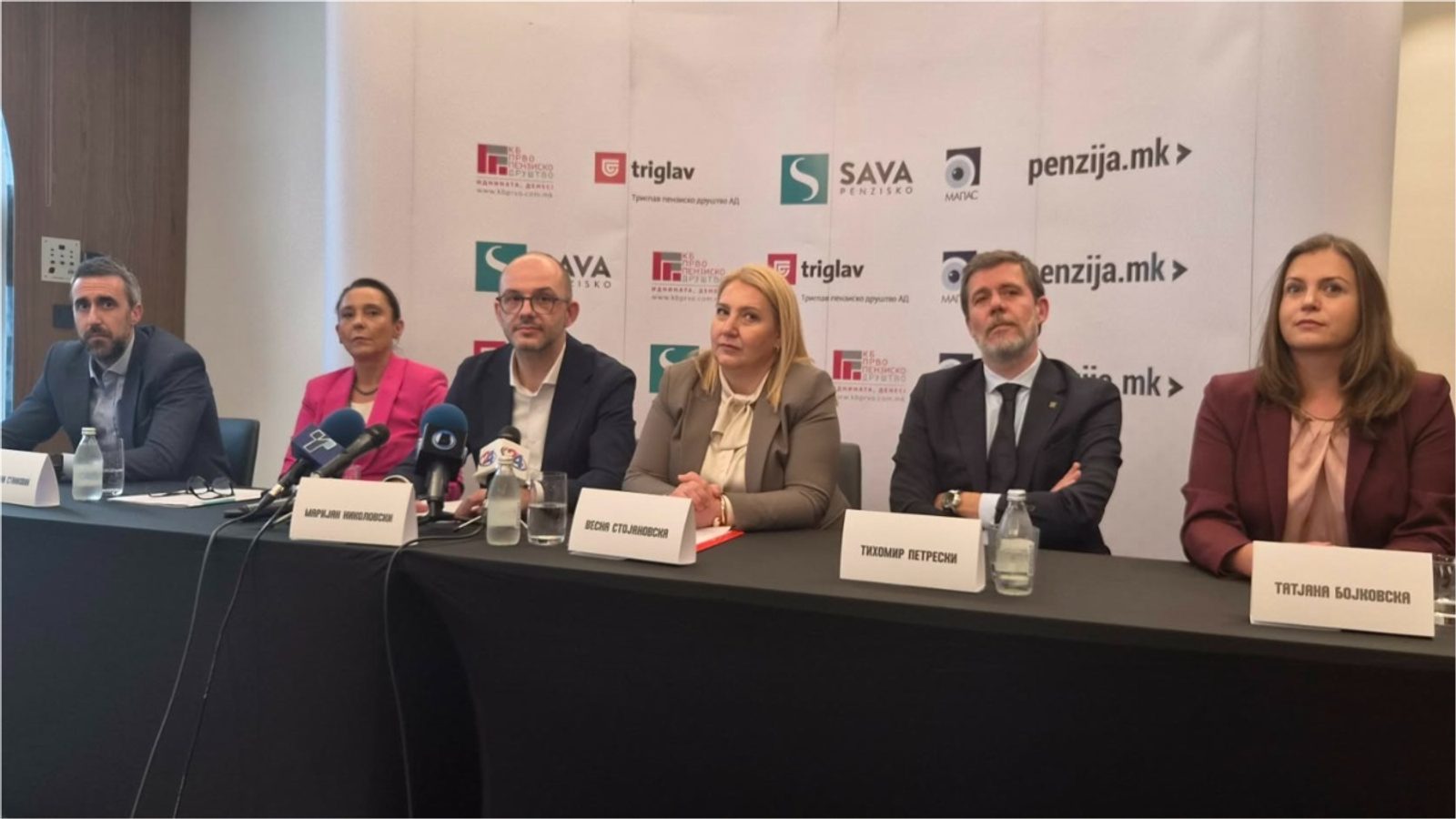
The Association of Pension Fund Management Companies of North Macedonia (ADPF) defended the performance of private pension funds on Tuesday, saying they have increased the purchasing power of members' savings over two decades but warning that structural reforms are still necessary to secure the system's long-term sustainability.
Association calls for open expert debate and gradual reforms
At a press conference following a technical roundtable with academics, actuaries and regulator representatives, ADPF vice-president Vesna Stojanovska presented twenty-year performance figures for the funded pension pillar. "Exact returns for the last 20 years since the pension system in the Republic of Macedonia exists are — nominal return of 5.5% and real return of 2.3%. More crucial is how much pension funds have increased the real value of contribution money. In numbers or in percentages today it looks like this: if someone in 2006 made a payment into the mandatory pension fund, today the nominal value of the money has increased threefold, and the real value of the money has increased by 58%," she said.
Stojanovska argued that future returns will depend on the investment framework, strategy and risk taken. She singled out a planned law on multifunds and changes to investment limits that, according to ADPF analyses, could lift returns by "1.5 to 2 percentage points." She also quantified past gains: "At the moment which means 5.5% — to repeat: 1 billion and 250 million euros of returns or amount of realized return for 20 years, distributed to the individual accounts of our members, i.e. future pensioners," she said.
ADPF representatives stressed that the capital-funded pillar is not an experiment but a reform in operation for twenty years, that savings are personal and inheritable, and that members can at any time check their contributions and investment results on their accounts. At the same time the association insisted that fairness must be assessed.
"Fairness is important especially lately when we increasingly hear that a large number of pensioners receive the minimum pension. The minimum pension means social protection. It is time to clearly define the social and pension components in their scope, to determine their criteria so we can build a long-term sustainable pension system. The pension system is part of each state's social system and therefore the social factor must not be neglected. But, to be properly tested and treated, it must be defined in its scope," ADPF expert Snezana Stankovic said.
ADPF president Marjan Nikolovski added that reform is not a question of if but of how quickly painful measures should be introduced. "The analysis showed that since the establishment of the reformed pension system about twenty years ago until today, the life expectancy of people on average has extended by 3 years, and in the meantime we have not had a single month change in the retirement age. In translation this means that an average pensioner today would use the pension three years longer compared to what it was about twenty years ago. There were no concrete proposals on how much that age should increase. The concrete recommendation was from the aspect of system transparency for future generations, that it would be good that such change does not happen overnight and catch insured persons who are literally close to retirement, but that it should be a gradually implemented reform where, for example, from today over the next 10, 15 or 20 years it would be known that the retirement age will gradually increase, calculated in months or quarters. So, if the current maximum limit is 64 years, gradually to go to 64 years and 3 months, or to 64 years and 6 months and so on," he said.
The association proposed concrete reform measures that emerged from the expert discussion: lifting the contribution rate (from 18% to 21.2% of gross salary), a staged increase of the statutory retirement age, separating the strictly social recipients of pensions from contributory pensions, and a revision of the mechanism for periodic pension indexation.
ADPF also responded to recent criticism from Prime Minister Hristijan Mickoski, who has called pension funds poor managers and said returns are lower than expected. In response the association pointed to public data: "The only relevant source of data for achieved returns of mandatory and voluntary pension funds in nominal and real terms is the website of the Agency for Supervision MAPAS. So, whenever we communicate our results to the public, we communicate data that are publicly published and available so they can be verified. The purchasing power of pension savings has really increased over the years," Nikolovski said.
ADPF urged that every policy proposal affecting the pension system be discussed in an open professional debate and evaluated for its impact on members and on the system's long-term sustainability.
Photo: ADPF