Austrian ambassador: Competent civil servants, not only money, are needed for social reforms
During a visit to the Gnezdo day centre in Skopje, the Austrian ambassador stressed that administration capacity and qualified staff are essential for durable social services.
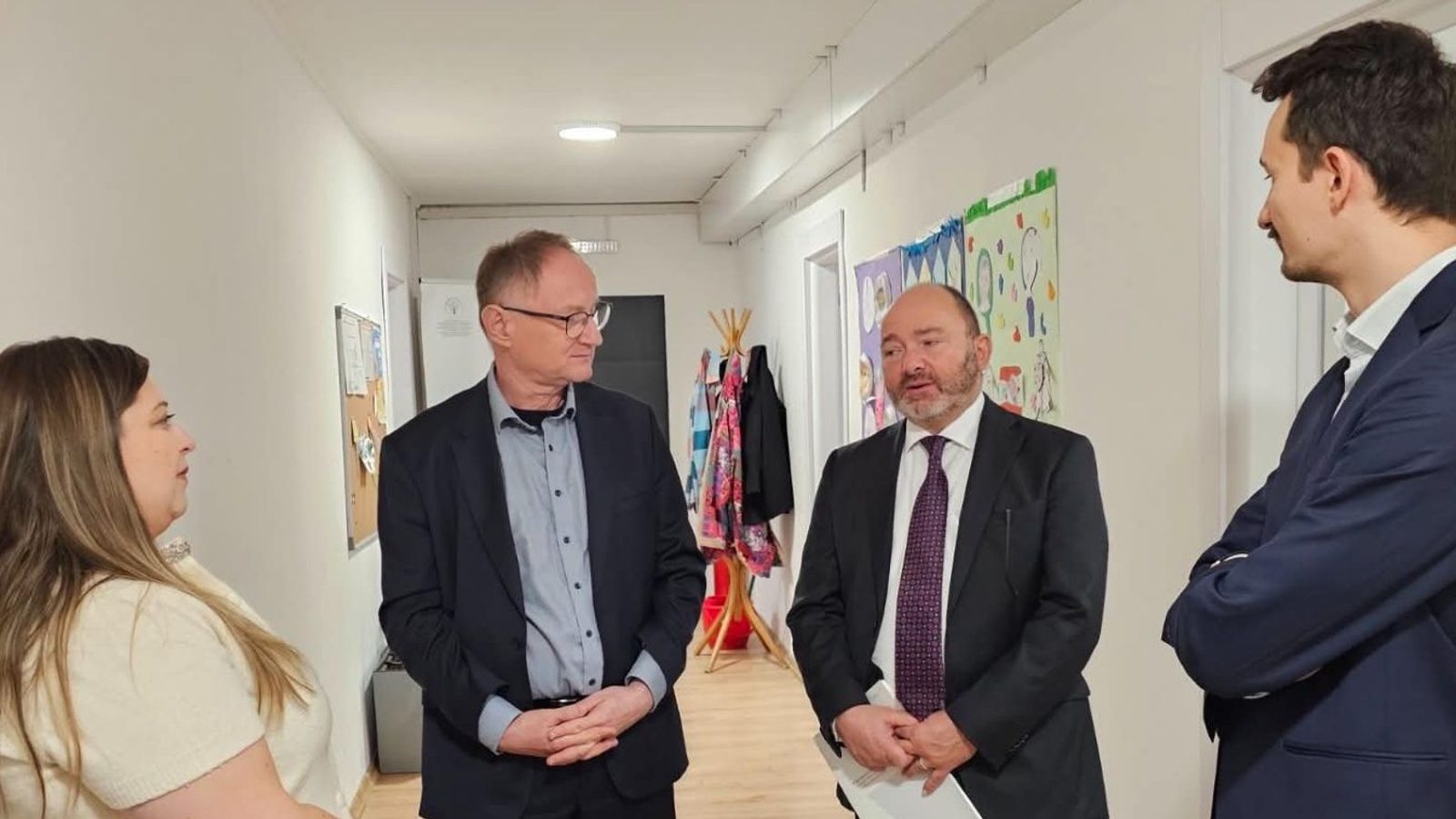
Austrian Ambassador Martin Pamer said that strengthening public administration capacity is as important as funding for delivering lasting social reforms, after visiting the Gnezdo day centre for children at social risk in Skopje.
The centre, opened in May last year by the NGO Journalists for Human Rights with support from the Austrian Federal Ministry of Labour, Social Affairs, Health, Care and Consumer Protection and in cooperation with ECPAT Austria, is the first of its kind in North Macedonia. Natasha Dokovska from the association told visitors the centre operates weekdays from 9:00 to 17:00, has 106 children registered and about 35 who attend regularly; children there receive breakfast and lunch.
Harald Breza-Fuger, the social affairs, health and consumer protection attaché at the Austrian Embassy, warned that sustainable funding and enough qualified staff remain key obstacles.
"Also, the staff in the field of child protection at the centres for social work are far from sufficient, especially in municipalities like Shuto Orizari and other areas. We know that a reform of the Centres for Social Work is currently underway supported by UNICEF, and they are working on a concept to improve the situation, the working conditions, but also the salaries of the employees in the Centres for Social Work. Nevertheless, I would say that the challenges remain large. Especially regarding the Roma community, a lot of effort is needed. I consider that this 'Gnezdo' project and other projects funded by the Austrian Ministry for Social Policy are examples of good practice that show that inclusion is possible, that reducing poverty is possible, but this needs to be done in a more systematic way, and also adequate funding is one of the most important issues."
Funding, bilateral projects and administrative capacity
Pamer noted that Austria supports a range of concrete citizen-level projects in North Macedonia — in social affairs, health, labour, tourism, infrastructure, fire protection and education — and that the bilateral cooperation also helps North Macedonia on its path toward EU integration. He said €15,000 were allocated specifically to the Gnezdo project and that total Austrian support for current projects is around €1.1 million.
He added: "The problem is not so much a lack of financial resources, although that is present too. North Macedonia potentially has access to significant financial resources and support in many different areas. However, among all these issues the question arises of how to manage the processes, that is the problem with the public administration. It is, in a certain sense, at the same time too big and insufficiently equipped, in the sense that there is not an adequate number of competent people, who are appropriately paid, dedicated to their work and capable of organising the state. That is a model that in Austria has been functioning successfully for a longer period. Of course, our situation is different, because we had much shorter transition periods and similar. One of the main issues in the implementation of concrete projects is securing financial means, and then turning them into concrete activities through the people who should implement them. At first glance, that looks very simple, but when you start to implement, things are no longer so simple. Essentially, what happens is that even within my function, I often have to make sure daily or weekly that people are actually carrying out their work tasks."
The Macedonian Platform Against Poverty published data on 17 October, International Day for the Eradication of Poverty, stating that nearly 22 percent of citizens live below the poverty line. Their figures show 29.5 percent of children live in poverty, while 38 percent of children are in multidimensional poverty and face conditions risky to health, education, safety and development.
Photo: Centar