Na Tochak warns BRT must not push pedestrians and cyclists off Skopje boulevards
The initiative calls for integrated design, published analyses and starts-from-the-tightest-sections planning to protect walking and cycling.
The civic initiative Na Tochak warned that introducing a Bus Rapid Transit (BRT) network in Skopje must not come at the expense of pedestrians and cyclists, and that smaller walking and cycling corridors cannot be treated as interchangeable with BRT lanes.
"Introducing BRT can be an important step for Skopje, but it must not become an isolated project of bus lanes — it needs to be part of an integrated system with rail, the rest of the bus network, walking and cycling. BRT will not merely convert two car lanes into two bus lanes; it will change the overall traffic solution on sections of the main boulevards," the initiative said.
Space, safety and design choices matter
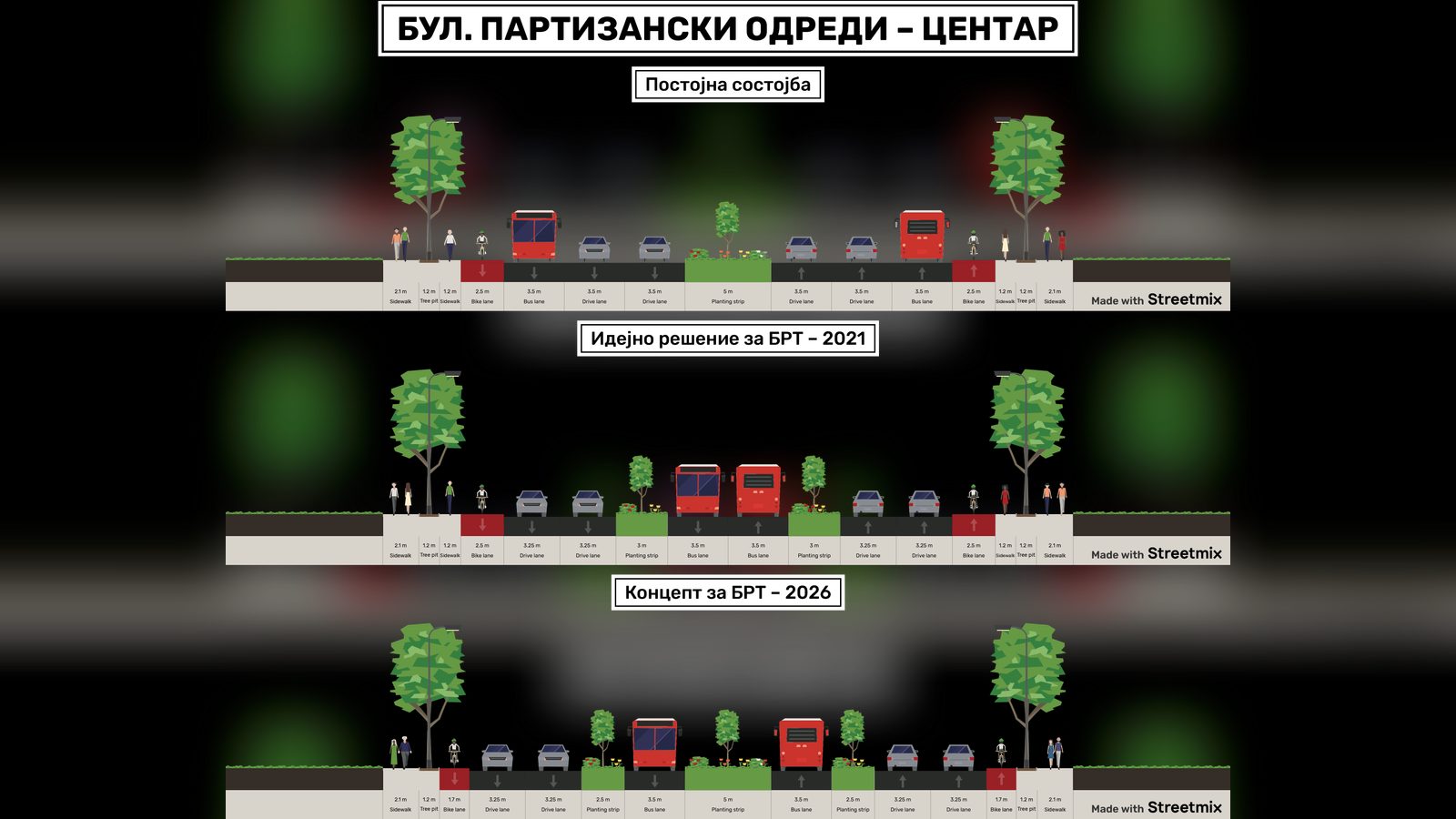
Na Tochak singled out the risk that limited carriageway width on many boulevards could push pedestrians and cyclists into conflicts or reduce their space. The group contrasted wider sections such as Bulevar Jane Sandanski, which at about 60 metres can accommodate various layouts, with narrower arteries like Partizanski Odredi, Kliment Ohridski, Kocho Racin, 11 Oktomvri and Kuzman Josifovski‑Pitu, whose cross-sections are commonly 30, 40 or at most 50 metres.
"Bulevar Jane Sandanski, with a profile of about 60 metres, allows for different solutions. But Partizanski Odredi, Kliment Ohridski, Kocho Racin, 11 Oktomvri and Kuzman Josifovski‑Pitu are significantly narrower, 30, 40, maximum 50 metres, and do not have the same comfort. The concept should start from the weakest points — the segments where space is most constrained — so that a solution is chosen with the least harm to the rest of the transport system," Na Tochak said.
The NGO also pointed to the stretch around Bunjakovec and the Faculty of Architecture as particularly sensitive, saying sidewalks and cycle facilities there are already used to capacity and close to the limit of functionality. They warned that shaving pavement to make room for a BRT alignment could force pedestrians and cyclists into direct competition for scarce space.
Na Tochak raised technical questions that influence both costs and spatial design: whether BRT vehicles will board from the kerb or from central island platforms, the side of vehicle doors and whether buses would run in the far left lane. They argued that selecting right‑hand doors with BRT running in the leftmost lane could raise construction costs because of additional space interventions, while options with central platforms and left or double doors might increase vehicle cost but allow better use of space and cheaper infrastructure.
"Which solution is better should not be decided only by the principle ‘what is better for existing buses’, but on the basis of concrete data on travel times, costs and the consequences for the whole traffic system, especially the pedestrian and cycling infrastructure," the initiative said.
Na Tochak urged that the BRT design be planned from the outset to allow future conversion or upgrade to tram operation, that BRT vehicles get signal priority, and that stations and crossings be safe and accessible. They also want station surroundings designed as quality public spaces with greenery, shade, seating and secure cycle facilities.
The group’s main demand remains full transparency and a public debate before final decisions: publish the full design, cross‑section profiles, analyses, alternatives and the data on which the preferred option will be chosen. They stressed they are not against BRT but want it to develop as an integrated, accessible and sustainable transport system that advances rather than degrades walking and cycling infrastructure.
The municipality has published a pre‑qualification tender for the BRT project, the mayor Gjorgievski announced.
Photo: press material from the event