Civic groups: red and yellow dominate traffic‑light monitoring of mayors’ one‑year pledges
Civic groups monitoring 14 municipalities say red and yellow dominate their ‘traffic‑light’ evaluation; examples from Čair, Centar, Delchevo and Gostivar.
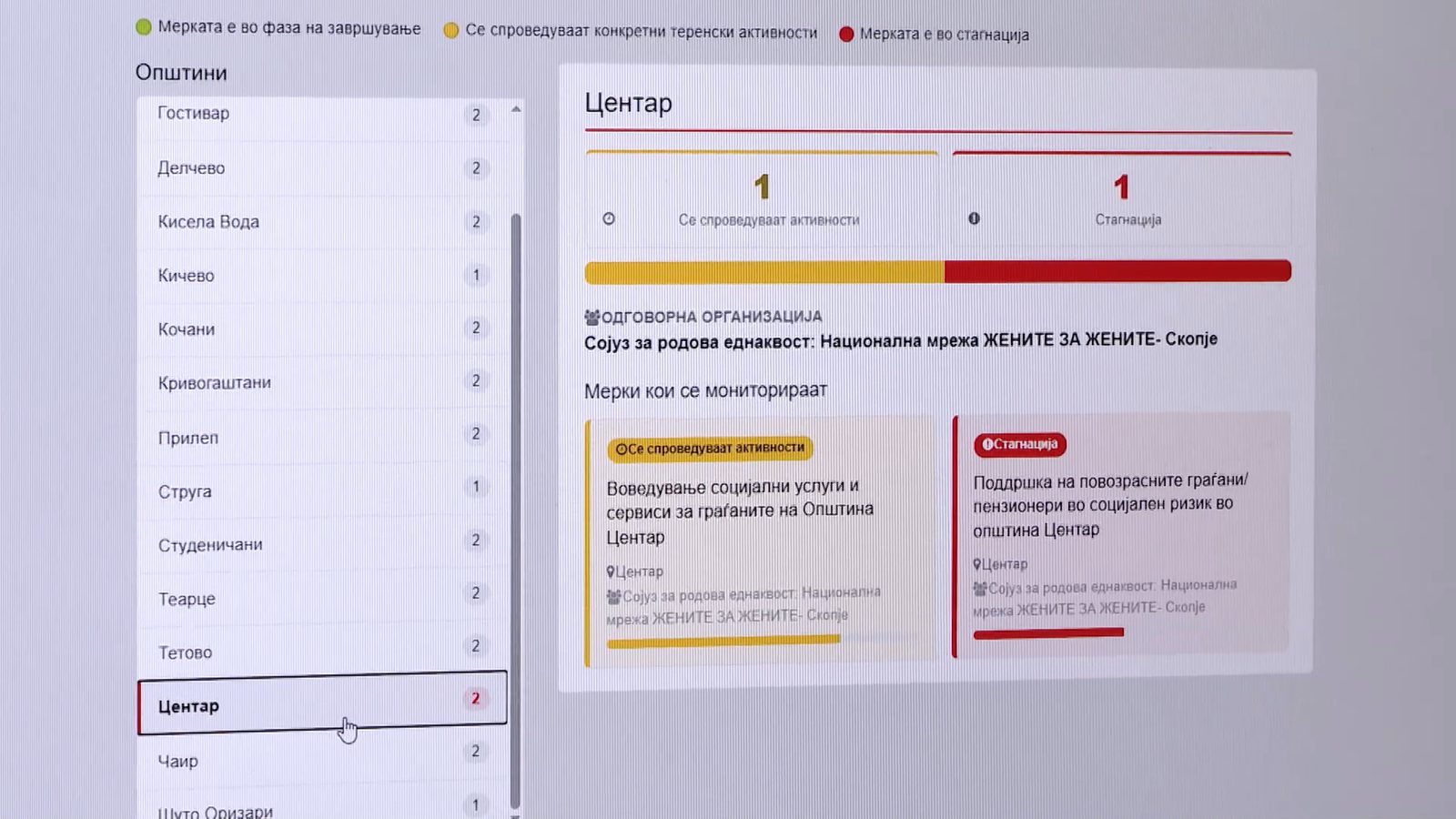
Civic groups tracking a limited set of pre-election pledges say most promises remain either unfulfilled or only partially advanced after one year in office, and their monitoring 'traffic light' is dominated by red and yellow indicators.
The monitoring covers 14 municipalities and focuses on one or two pledges per local authority. Activists say the information available to the public is often incomplete; when journalists asked several monitored municipalities for updates, two did not respond and two mayors told reporters the situation will change soon.
Examples from Skopje, Delchevo and Gostivar
In the Čair municipality, residents still struggle to find parking. Local and national politicians previously promised new parking spaces and an underground garage at Skanderbeg Square; the pledge was repeated in a televised statement by Vice Prime Minister Izet Medžiti.
Izet Medžiti said: "I believe that the tender procedure will be opened soon and that construction will begin at the beginning of 2025..." When asked for details about the timeline and start of work, Čair Municipality did not answer.
The non‑governmental Assistive Center, which monitors that municipality, reports that parking measures appear in municipal programmes and budgets but lack visible, on‑the‑ground implementation. "At this stage, according to the monitoring, there is programme planning, but the public does not have sufficiently regular, detailed and easily accessible information about which phase each project is in, which procedures have been started, which funds are secured, what the deadlines are and when citizens can expect concrete implementation. Therefore our assessment is that the situation is in a preparatory and planning phase, but with the need for greater transparency and clearer implementation dynamics," the organization says.
In Centar, the national network Women for Women follows two continuous social measures delivered through contracted operators: community services and care for elderly people at social risk. "These are the measures, that is, services to citizens carried out by engaging operators, that is, non‑governmental organizations, and the second is care for older persons, that is, pensioners at social risk. And both measures that we monitor are regular, that is, continuous; they exist in the municipality every year and were part of previous electoral programmes and continue," said Olivera Eftimovska, who follows the monitoring there.
Eftimovska added a call for clearer procurement practice: "Transparency. So the procedures themselves can be improved in relation to... there is no public procurement, it goes with a public announcement; it could be more transparent, meaning to have public procurement in relation to the measures." On the monitoring site, Centar shows yellow for social services and red for the pensioner support pledge.
Mayor Goran Gerasimovski rejects the claim that the measures are stalled and says payments follow an established schedule. "In the past it was 2,500 denars, which I introduced for the first time as mayor in my first term, and the promise in the campaign for the second term was that it would be doubled, that is from 2,500 denars to 5,000 denars. And usually in recent years it... was paid in November or December. That will be the case this year too and that red that lights on their tables will be green in a few months," he said.
Gerasimovski also pointed to ongoing elderly‑care work: "We have 'Care for older people', an excellent project where we visit 90 households of elderly residents and our services, together with 'Humanost', an NGO that in cooperation with the municipality implements the project, provide improvements to everyday living needs of our elderly residents by buying some food products, paying bills, physical therapy services, etc."
Further east, activists in Delchevo report that one monitored pledge — opening a youth centre — is essentially fulfilled. "The youth centre is open, basic equipment exists, there is a room where activities take place. It has been assigned... The youth centre has been assigned to a non‑governmental organization that will run it and there is also a coordinator. With that, all prerequisites have been created for the Youth Centre to function," said Bikovski.
The other Delchevo pledge concerns creating serviced plots for young families through urbanisation of the Taušan‑sko Maalo area. Mayor Ivan Gocevski said the municipality is working on the promise but must complete key administrative steps first. "We plan to repurpose it for A1, i.e., for family housing with privileged utilities so that our new married couples can buy a plot with pre‑defined urbanisation, with carried out urbanisation, with privileged utilities. That is, utilities that will be previously set by a tariff list of the Council and will be much, much lower than those that now realistically exist as an option and according to the tariff of Delchevo Municipality," he said. He added: "We immediately started the implementation of this project and we already in Delchevo have a Youth Centre which is part of the old municipal assembly, in a room that is the property of Delchevo Municipality. For the sake of truth, we signed a memorandum with one NGO here in Delchevo and we have excellent cooperation, for which we are grateful."
In the west, observers give Gostivar red scores for two monitored pledges: free mammography screenings and financial support for women who are victims of domestic violence. Eftimovska explained the delays: "At the moment they are not implemented because the first measure has problems with the devices that should be used for the examinations, so we were told by the municipality that it will be delayed a bit, however the measure will have to be implemented. Regarding the programme, also the payments are somewhat out of sequence... I mean, they are not paid on time as they should be."
She added that many citizens are unaware of the available help: "So they do not even know what the measure means and we believe that here work must really be done to raise awareness about gender equality. And I think that here there should really be a budget on its own to reach citizens."
The monitoring of pledges in Gostivar, Delchevo, Centar, Čair and ten other municipalities continues as part of the Programme for Support of Elections, a Swiss government project implemented by the International Foundation for Electoral Systems (IFES). Activists note that mayors are in the first year of their current mandates and still have time to turn the traffic‑light indicators green — but "time flies," the monitoring warns.
Photo: press material from the event