French police under scrutiny over alleged excessive force during protests
Videos of alleged beatings and serious injuries have fuelled fresh criticism of French crowd‑control tactics during nationwide protests.
By Madeleine Pitt — 23 October 2026.
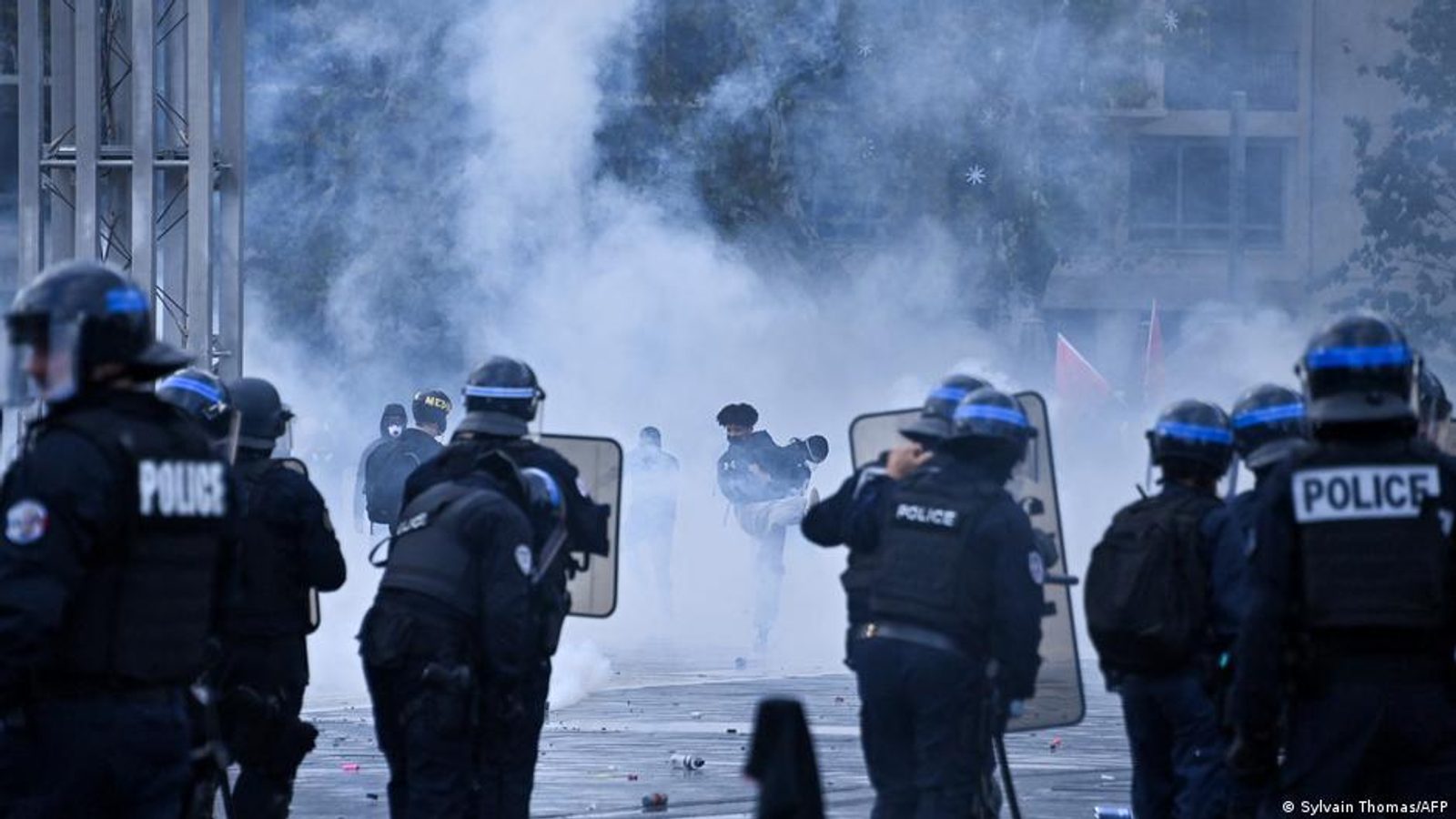
French police have come under intense scrutiny after new allegations of heavy-handed tactics during a fresh wave of protests that swept the country. Videos circulating on social media show officers striking and dragging people, wrestling a young man by the neck and forcing a woman to the ground; the clips could not be independently verified. Human-rights groups and medical reports point to a string of serious injuries linked to crowd-control weapons.
More than half a million people marched across France on Saturday, mostly to protest cuts in public services, rising living costs and demands from pupils for better school conditions. Demonstrations that began with high-school students blocking campuses were followed by episodes of arson, looting and confrontations with police, prompting authorities to say they will deploy military forces for coming weekends.
Arsenal, tactics and severe injuries
Authorities and experts highlight that French police possess a wider array of crowd-control equipment than many of their European counterparts. In particular, the LBD-40—an impact launcher used to fire rubber projectiles—has been repeatedly implicated in serious harm. Medical accounts from recent weeks say several teenagers suffered life-altering injuries: one reportedly had an arm blown off, another was left blind in one eye, and a third sustained a broken jaw.
“It is not only a French specificity. But there are rules. A certain distance must be respected,” said Anastasia Tsukala, an associate professor of criminology at Paris-Sud University. She added: “Even if you try to follow the rules, people can move and suddenly lose an eye. That is why this is extremely dangerous.” Officials also regularly deploy tear gas; international treaties ban such agents in armed conflict, although they are used by many police forces.
“These grenades contain a high level of explosive substances. From that perspective France is a unique case,” Tsukala said, referring to stun or concussion grenades widely used by French units. Interior Minister Laurent Nunez has insisted the equipment is “non-lethal,” while pointing out that some items are classified as military material in France’s internal security code.
Researcher Sebastian Rosh of the French National Centre for Scientific Research, who compares European policing, argued that if police brutality is measured by deaths or cases of permanent disfigurement among protesters and crowds, “then the French police are the most brutal in the entire European Union.” He added that political decisions shape which equipment is used: “Political authorities freely decide on police gear. When the LBD was introduced into the French police it was intended for units fighting organised crime. Today the same weapon is used for crowd control. That shows how the way French politicians think about responding to political protest has changed.”
Critics also point to differences in tactics. German police, for example, typically prioritise de‑escalation; operations in locations such as Litzeraat in 2023 used restraint compared with more aggressive deployments elsewhere. Amnesty International described the French response as “disproportionate,” and the French branch of the League for Human Rights denounced what it called “violent repression.”
France lacks an independent national oversight body for policing comparable to schemes in the United Kingdom or Denmark. Instead, internal investigations are handled by the IGPN (General Inspectorate of the National Police), which said it has opened at least 40 files since the start of the latest protest wave. Minister Nunez defended officers’ actions in Marseille: “It was very difficult to control all the different groups,” he said. “The police did an excellent job and thanks to their dedication many crimes were prevented.”
Photo: press material from the event