Frckoski: Serbian-Russian influence 'kidnapped' MOC-OA's path to a Constantinople tomos
In the podcast "The Betrayal in the Church", the professor opens the most sensitive church-political dilemma: whether the rapid tomos from Belgrade redirected the process that started at the Ecumenical Patriarchate. Documents confirm a dramatic turn in 2022, but not evidence of a coordinated internal operation.
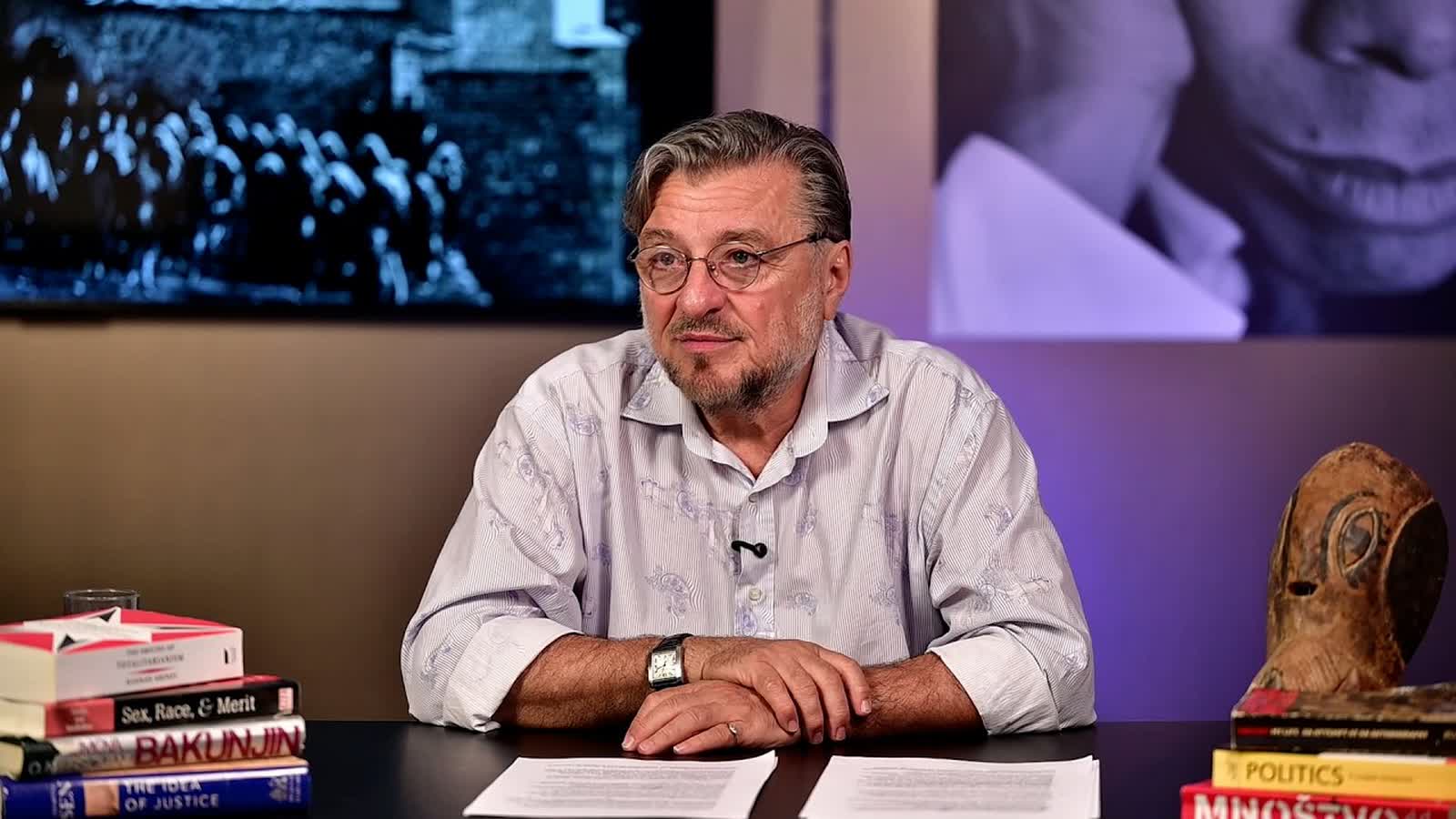
The path of the Macedonian Orthodox Church–Ohrid Archbishopric (MOC–OA) toward full and broadly accepted recognition was redirected at the moment when the Ecumenical Patriarchate opened the door, and Belgrade and Moscow felt they were losing control over the process. This is the central thesis that professor and former diplomat Ljubomir Frckoski puts forward in the podcast "The Betrayal in the Church", speaking of, as he says, "a blockade from within" and Serbian-Russian influence in parts of the Macedonian church structure.
His assessment is serious and politically explosive. It must not be presented as an already proven fact. But it must not be dismissed without debate either, because it opens the essential dilemma that remained after the historic 2022: whether the MOC–OA received completed autocephaly or a document that brought it significant recognition but left unresolved the path to a universal Orthodox consensus and a tomos from the Ecumenical Patriarchate.
"How does that national betrayal, a blockade of this process, happen? A blockade of this process happens from within the Church... We have a Russian-Serbian installation in our Church, that must be acknowledged," says Frckoski in the conversation.
The date that changed church history
It is undisputed that the turning point began with the Ecumenical Patriarchate. On 9 May 2022 the Holy Synod of the Ecumenical Patriarchate received into eucharistic communion the hierarchy, clergy and faithful led by Archbishop Stefan. In the official communiqué it is said that the wound of the schism had been healed, and administrative matters between the churches were left to the Serbian Orthodox Church. The Ecumenical Patriarchate accepted the name "Ohrid", but not the adjective "Macedonian" in its official usage.
That act was historic, but it was not a tomos of autocephaly. Only a few days later the Serbian Orthodox Church renewed liturgical and canonical unity with the MOC–OA, and on 5 June 2022 Patriarch Porfirije in Belgrade handed a tomos to Archbishop Stefan. On 12 June Stefan and Ecumenical Patriarch Bartholomew celebrated the first joint patriarchal and synodal liturgy in Istanbul.
It is precisely in the speed between those dates that Frckoski sees a geopolitical operation. According to him, the appeal to the Ecumenical Patriarchate extracted the Macedonian church cause from the long-standing Serbian blockade. When the Ecumenical Patriarchate activated the process, he argues, panic arose in Belgrade and Moscow that the MOC–OA would completely leave their sphere of influence. Therefore the Serbian tomos was brought with unusual speed – not only as a church gesture, but also as an attempt to reattach the process to Belgrade.
"This speed is tied to them not losing us completely from control and trying to bring us back under control," says Frckoski.
"Pseudo-tomos" or full autocephaly?
Frckoski calls the Serbian document a "pseudo-tomos". His reasoning is that bilateral recognition by one church is not the same as universal Orthodox recognition. In his interpretation, the Ecumenical Patriarchate is the institution that should complete the process with a tomos that would place the MOC–OA into a broader and undisputed canonical order.
The official position of the MOC–OA is different. On its website the Church describes the Serbian document as recognition of full autocephaly without restrictive clauses regarding the name, jurisdiction and care for the diaspora. The Serbian tomos's own text states that the Serbian Orthodox Church is not the only factor and that acceptance by other local Orthodox churches is required.
The facts show that recognition did not remain only in Belgrade and Moscow. After the Serbian act, steps of recognition or acceptance were taken by the Russian Orthodox Church, the Polish, Bulgarian and Romanian churches, the Church of the Czech Lands and Slovakia, as well as other church jurisdictions. The Romanian church, however, simultaneously assessed that a final tomos from the Ecumenical Patriarchate expressing pan-Orthodox consensus should follow. That shows that the dispute is not about whether the schism has been overcome – it has been overcome – but about the manner in which autocephaly should finally and universally be confirmed.
Moscow, Belgrade and the struggle for influence
The heaviest thesis of Frckoski is that within the MOC–OA itself there exists a group that acts in accordance with Serbian-Russian interests. For such an organized "installation" no publicly disclosed evidence has been published that would show command, financing or a coordinated secret structure. Therefore this must remain clearly marked as his accusation.
However, the broader debate about Russian church influence is not led only by Frckoski. The journalist and editor of "Religija", Marjan Nikolovski, in an interview for Vistinomer argued that pro-Russian church actors imposed fears that the Ecumenical Patriarchate would take away the diaspora or erase the Macedonian identity. That too is an analytical assessment, not a court-established fact, but it shows that the question long ago exceeded the framework of a single podcast.
In the background is also the large rift in the Orthodox world between the Ecumenical Patriarchate and Moscow, especially after the Ukrainian church issue. For small churches, that conflict means canonical formulas easily become instruments of external policy. The Macedonian case therefore is not only a dispute over signatures and church titles; it is a test of whether the MOC–OA will be able to build its place independently without becoming a bargaining chip between larger centers of power.
The unresolved question
The strongest part of Frckoski's thesis is not the word "betrayal", but the warning that the historic success of 2022 must not turn into complacency. The MOC–OA emerged from isolation, received a Serbian tomos and established relations with multiple Orthodox churches. But the Ecumenical Patriarchate still has not issued a final tomos of autocephaly.
Therefore the real question is not whether the achieved should be denied, but whether Macedonian church diplomacy will complete the path to the broadest possible recognition. If Belgrade and Moscow truly redirected the process, as Frckoski claims, the answer should be in documents, transparency and an independent strategy – not in new dependence. And if his thesis is exaggerated, then church institutions have the obligation to publicly explain exactly what was obtained, what still is missing and what the plan is for the final relationship with the Ecumenical Patriarchate.
Photo: frame from the podcast "The Betrayal in the Church" / Talk the Talk