Waiting-room installation in Skopje highlights corruption in public healthcare
A mock clinic waiting area and satirical sculptures were set up between Partizanski Odredi Boulevard and Leninova Street to spotlight informal payments and other abuses.
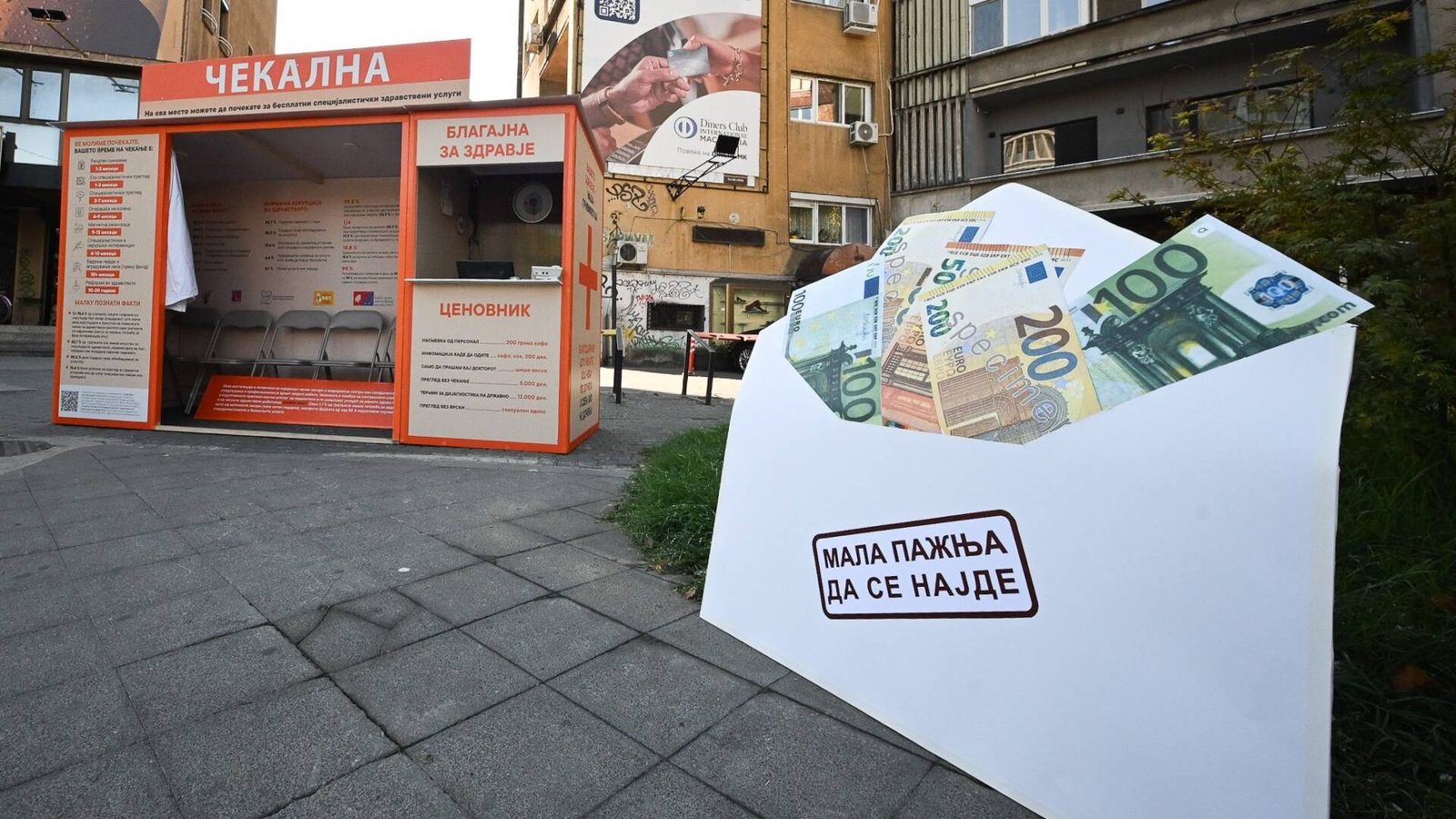
An improvised hospital waiting room was installed this morning on the square between Partizanski Odredi Boulevard and Leninova Street in Skopje as a visual protest against corrupt practices in the public health system.
The pop-up installation, set up by the Association for Emancipation, Solidarity and Equality of Women (ESE), recreated a clinic waiting area complete with a service counter and chairs. Passersby stopped to read satirical messages painted on the walls and some even sat down to "wait" for medical help as a way to confront how informal payments and favors shape access to care.
Darko Antic of ESE framed the action as a challenge to both citizens and institutions: "The aim of this activity is to attract public and institutional attention in a creative and unusual way to a problem deeply rooted in Macedonian healthcare and with which thousands of citizens face daily. Corruption in healthcare violates basic human rights, creates unequal treatment of patients and undermines the foundations of public health. We hope the messages written on this waiting room for better healthcare will encourage citizens, but also health workers, to report corruption, and at the same time will spur authorities to tackle this serious problem more decisively."
Visual metaphors and survey findings
Next to the mock waiting room the organisers placed two large sculptural pieces that represent common forms of corruption: an oversized envelope spilling banknotes to symbolise cash bribes, and a giant coffee package branded "Kafe Vrska" that satirically points to small gifts and favours exchanged in everyday medical encounters.
Those elements echo the NGO's recent survey, titled "Getting by or Corruption? Informal payments, connections and gifts in the health system," which found that giving money or gifts is the most frequent form of corruption in North Macedonia's public healthcare. In most cases payments were reported to secure a hospital bed, an operation without waiting, or a faster appointment with a specialist.
Jasminka Frishcic, ESE's executive director, highlighted a gender dimension in the data: "Our research showed that women, especially those from vulnerable groups, are more exposed to corruption in healthcare. One of the figures that confirms this is that one quarter of the female respondents said they had experienced corruption when using gynaecological–obstetric services."
The NGO stresses the action is not aimed at frontline healthcare workers but at systemic shortcomings and corrupt practices that harm the reputation of the profession. The installation is part of the project "Stronger System for Fairer Care: Reducing Corruption in Healthcare," implemented by ESE with financial support from Expertise France through Agence française de développement.
Photo: press material from the event