OSCE: North Macedonia prosecutors show positive practices in organised‑crime and corruption cases
OSCE observation in Budva praises transparency and courtroom work by Macedonian prosecutors but points to shortages of staff and funds that limit progress.
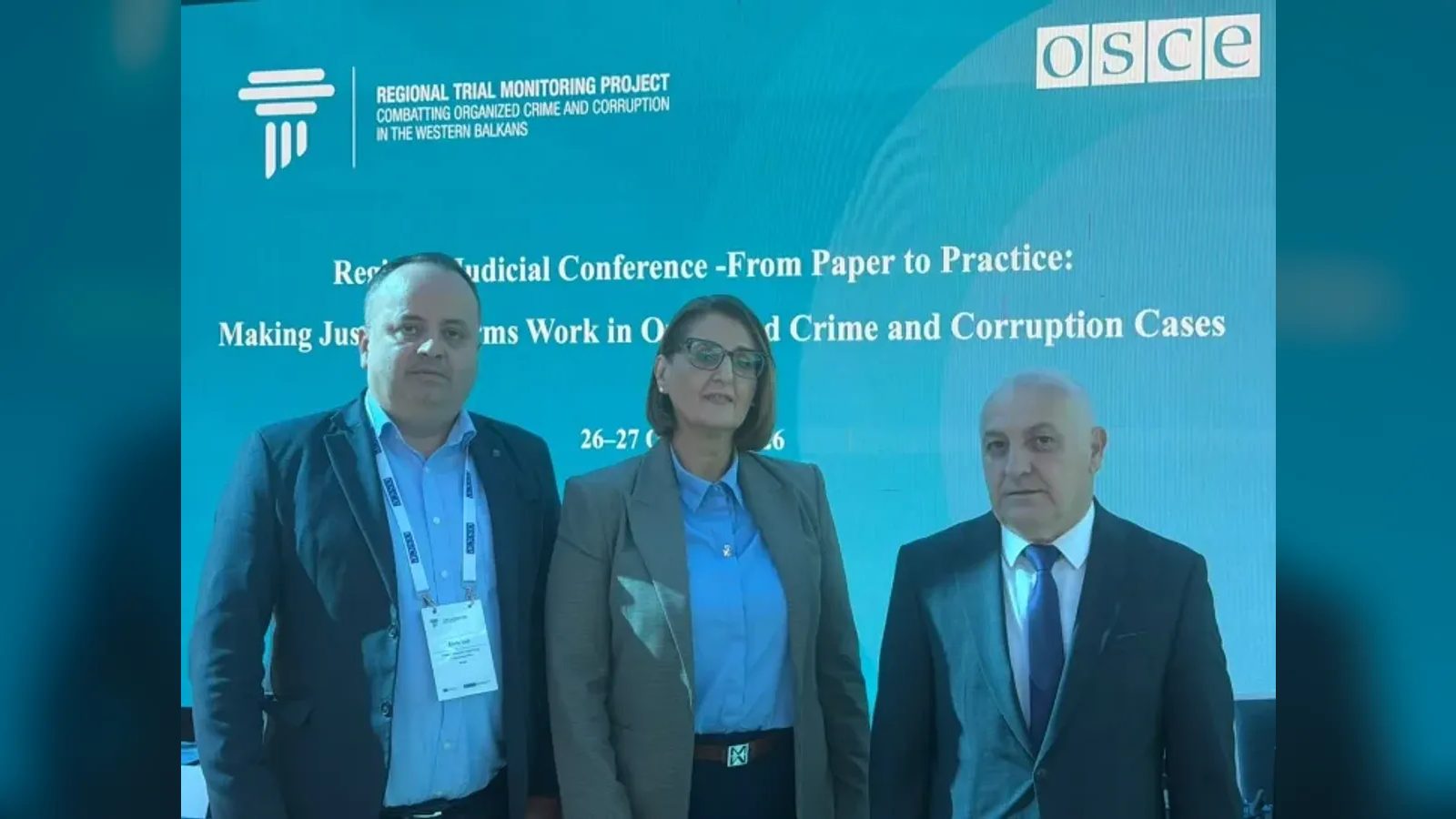
Representatives of the Public Prosecutor's Office of the Republic of North Macedonia — Public Prosecutor Elvin Veli, Bashkim Besimi, president of the Council of Public Prosecutors, and prosecutor Natasha Pop Trajkova from the Basic Public Prosecutor's Office for the Prosecution of Organized Crime and Corruption (OJOGOKK) — took part in a regional OSCE conference in Budva, Montenegro, where an observation report on court proceedings across the Western Balkans was presented.
OSCE highlights strengths and remaining capacity gaps
The report gives the Macedonian prosecution relatively high marks for transparency in high‑public‑interest cases compared with other countries in the region, and it emphasizes a visible commitment to establishing strategic frameworks aimed at greater openness and accountability. Adoption of a communication strategy is singled out as an important step for rebuilding public trust and for more proactive, professional engagement with the media and citizens.
"From the prosecution's perspective, certain positive practices appeared regarding the effective presentation of evidence and conduct before the court. In several cases, public prosecutors actively participated in planning the trials, proposed realistic schedules for presenting evidence and took responsibility for calling their own witnesses," the report notes, recommending that such positive steps continue to be applied consistently.
OSCE also highlights work done through the Association of Public Prosecutors in cooperation with the U.S. Embassy in Skopje to improve the quality of indictments. The report adds that the State Public Prosecution supported these initiatives, focusing on better presentation of evidence at trial and on strengthening prosecutors’ effectiveness in court.
"The State Public Prosecution also supported these initiatives, with particular attention to improving the presentation of evidence in court and strengthening the effectiveness of public prosecutors during trials," the report says.
As another positive development, the report notes progress on drafting new regulations to oversee the work of public prosecution offices and evaluate prosecutors’ performance. That initiative is supported by an EU‑funded Rule of Law project intended to align internal rules and establish clearer supervision and professional assessment mechanisms.
At the same time, the report flags insufficient human and financial resources as a key constraint on further gains in efficiency. "It seems that this is one of the most critical issues that requires a parallel approach: continuous efforts by the prosecution to improve efficiency, combined with appropriate institutional support and provision of resources. Resolving both aspects is necessary to break the circle in which improvement of efficiency is expected before additional resources are provided, while public prosecutors consider that additional resources are necessary to achieve greater efficiency," the OSCE report states.
Within the regional project, North Macedonia had the largest number of monitored cases in the region — 16 organized‑crime cases and 56 corruption cases. The project measures justice system effectiveness through three linked dimensions: capacities (quality, consistency and support conditions), fairness (guarantees for fair trial, equality before the law and reasoned judicial decisions) and efficiency (management of complexity, time and resources without compromising fairness or quality). The Public Prosecutor's Office has also stepped up regular public communication by publishing statements, case summaries and holding briefings for the cases included in the OSCE regional observation project, which is financed by the European Union.
Photo: press material from the event