First Toškovski’s brother-in-law, now his police chief’s wife: the best student of his generation is again “not good enough”
Two years ago he lost out to the Interior Minister’s brother-in-law; now he has lost out to the wife of the head of the Ohrid Sector for Internal Affairs, whom Toškovski appointed. According to the review committees, a doctor of science with a 10.0 average and a Geneva master’s degree is not good enough even to be a teaching assistant. The committee says the procedure was lawful.
If you want to become an assistant professor at the Faculty of Security in Macedonia, a 10.0 average and a degree from Geneva are not enough. What matters more is who you are related to and which party you belong to. That is the conclusion suggested by the new case reported by Sloboden Pečat: the candidate who was passed over two years ago in favour of Interior Minister Panče Toškovski’s brother-in-law has now been passed over again – this time in favour of the wife of an Interior Ministry police chief appointed by decision of the same minister.
He is a former best student of his generation, a doctor of science in the field of security with a 10.0 average and many years of experience in the Interior Ministry and the National Security Agency. In two new competitions at the Faculty of Security – Skopje, part of St. Kliment Ohridski University – Bitola, he was proposed neither for assistant professor nor for teaching assistant in criminalistic sciences.
From the brother-in-law to the police chief’s wife
In 2024, Stevčo Jolakoski, Toškovski’s brother-in-law and an employee of the Ministry of Transport and Communications, was elected “assistant professor in the scientific field of police sciences”. According to the objection filed at the time, Jolakoski graduated from law school with an average of 8.02, completed a master’s degree in civil law with an average of 8.10 on the topic “Lease-purchase agreement”, and obtained his doctorate at the Faculty of Security under the old programme, without taking exams. His rival was a criminalistics graduate with an average of 9.85 and the best student of his generation. Levica then asked the State Education Inspectorate and the State Commission for Prevention of Corruption to open a case. An extraordinary inspection found that the selection formally complied with the law, and the procedure was halted.
Two years later, in the competition for assistant professor of criminalistic sciences, the review committee proposed Biljana Bogdanova-Smilevska. She is the wife of Igor Smilevski, the current head of the Ohrid Sector for Internal Affairs, who was appointed by decision of Minister Toškovski. According to Sloboden Pečat, Bogdanova-Smilevska openly supports VMRO-DPMNE on her Facebook profile, ran for the Ohrid municipal council in 2021 and is an active member of the VMRO-DPMNE Women’s Union. In 2024 she also competed against Jolakoski, but did not file an objection and waited two years to apply again.
The same names on the committees
Professor Svetlana Nikoloska sits on both review committees. She supervised the doctoral dissertation of former Interior Minister Gordana Jankuloska, and she also chaired the committee that selected Bojan Hristovski, today the director of the National Security Agency, as a teaching assistant at the same faculty. Initially, both committees also included Professor Boris Murgoski, who supervises Minister Toškovski’s doctorate. Since December 2025 the minister himself has been a doctoral student at the Faculty of Security. Murgoski withdrew, and his place was taken by Professor Ice Ilijevski of the Faculty of Law in Kičevo.
A 10.0 average counts for nothing, a “professional paper” counts
The candidate who objected earned a master’s degree in criminalistics with an average of 9.57 and a doctorate in security with an average of 10.0 at the state faculty, and then a second master’s degree at the Global Studies Institute of the University of Geneva, which ranks 55th on the Shanghai list. According to Sloboden Pečat, the committee’s reasoning implies that the master’s degree Bogdanova-Smilevska obtained at the private European University is worth more than both of his master’s degrees.
In his objection he disputes seven of her publications, which the publishers categorised as “professional” rather than scientific papers, and which, in his view, cannot automatically count towards the mandatory minimum for an assistant professor. He also questions whether it has been proven that four publications from 2026 were published on time, and disputes the recognition of three more scientific papers. Some of her papers are in the field of family and inheritance law. One was published at a conference in Struga organised by the university of former Struga mayor Ramiz Merko, and two in a journal of the European University, where the candidate held the title of titular assistant professor.
He believes that his experience in the Interior Ministry and the National Security Agency was not properly valued either, even though that very criterion was decisive in 2024 when Bojan Hristovski beat his rivals. “In particular, I contest the way my candidacy was evaluated, given that I am a graduate criminalist, a master of criminalistics, a doctor of science in the field of security and a master of advanced studies in international security from the University of Geneva,” the objection reads. He is not asking to be elected; he is asking for the objection to be upheld, for a new review committee to be formed and for all candidates to be evaluated again, fully and with reasons.
Kukušev: “not in the field” in 2024, the best in 2026
The same logic applies to the teaching assistant post. In 2024 Angela Kukušev was Hristovski’s rival, and the committee then assessed that her positively evaluated activities were “not in the field of criminalistic sciences”. Now, although nothing has changed in the meantime, the committee has judged her the best candidate for teaching assistant in precisely that field. Kukušev is enrolled in doctoral studies in political science at Ss. Cyril and Methodius University. If she completes her doctorate there, according to Sloboden Pečat, she could not legally be elected assistant professor of criminalistic sciences. This time the decisive factor was her 10.0 master’s average – the same average that, in her rival’s doctoral studies, meant nothing to the committee. Both of the candidate’s objections were rejected, as was the objection of another candidate against the selection of Kukušev.
What the committee says
The review committee maintains that Bogdanova-Smilevska meets the legal requirements, including the number of scientific papers published in reference publications over the past five years. In its view, even if 10 of the 14 submitted publications are disputed, the candidate still has the legal minimum of four papers. The committee considers the topics of her master’s and doctoral theses more closely related to criminalistic sciences, while her rival’s research mainly concerns international relations, geopolitics and broader security studies.
As Bogdanova-Smilevska’s key advantage, the committee cites six years of teaching experience at the private European University, membership of committees for the defence of eight master’s theses and eight teaching criteria met, against three for her rival. At the same time, the committee admits that he has the advantage in professional and applied experience – nine criteria met against eight. The remarks about the registration of papers and about the composition and impartiality of the committee were rejected, with the assessment that the procedure was lawful.
The minister who wants “the best of the generation”
The case is all the more awkward for Toškovski because of his own words. On 1 October 2026, at the start of the academic year at the same faculty, the minister told the students: “That means you have additional motivation to be the best in your class, the best in your generation.” He also announced that the best students would be able to join the Interior Ministry “without a public vacancy notice”. Yet when the best of his generation, a man with experience in the Interior Ministry and the National Security Agency, applies to the faculty, the advantage goes to the minister’s brother-in-law and the wife of his police chief.
Toškovski has so far claimed that academic processes are separate from the ministry. “Academic processes are clearly regulated and institutionally separate from the competences of the Interior Ministry,” he told Radio Free Europe in December 2025, when he enrolled in doctoral studies at the Faculty of Security. The faculty, for its part, at the time answered questions about conflicts of interest only by referring to its publicly posted rules.
The questions Toškovski must answer
No court has established that the minister personally influenced the selections, and the 2024 inspection found no formal breach of the law. But the questions remain: is it a coincidence that at the Faculty of Security, where the minister is a doctoral student, people from his family and from his party and police circle once again get the advantage? Why is a doctor of science with a 10.0 average and experience in the Interior Ministry and the National Security Agency not good enough even to be a teaching assistant? And what message do the thousands of students receive when the minister tells them to be “the best in your generation”?
By the time this article was published, neither Minister Toškovski nor the Faculty of Security had publicly responded to the new allegations. If the answer is once again that everything is “in line with the law”, then the problem is not just one committee – it is a system in which a party card and family ties are worth more than knowledge.
Sources: Sloboden Pečat (the 2026 competitions), Infomax (the 2024 selection), A1on (Levica’s request), Radio Free Europe (Toškovski’s doctorate), Interior Ministry (1 October 2026), Interior Ministry (24 December 2025).
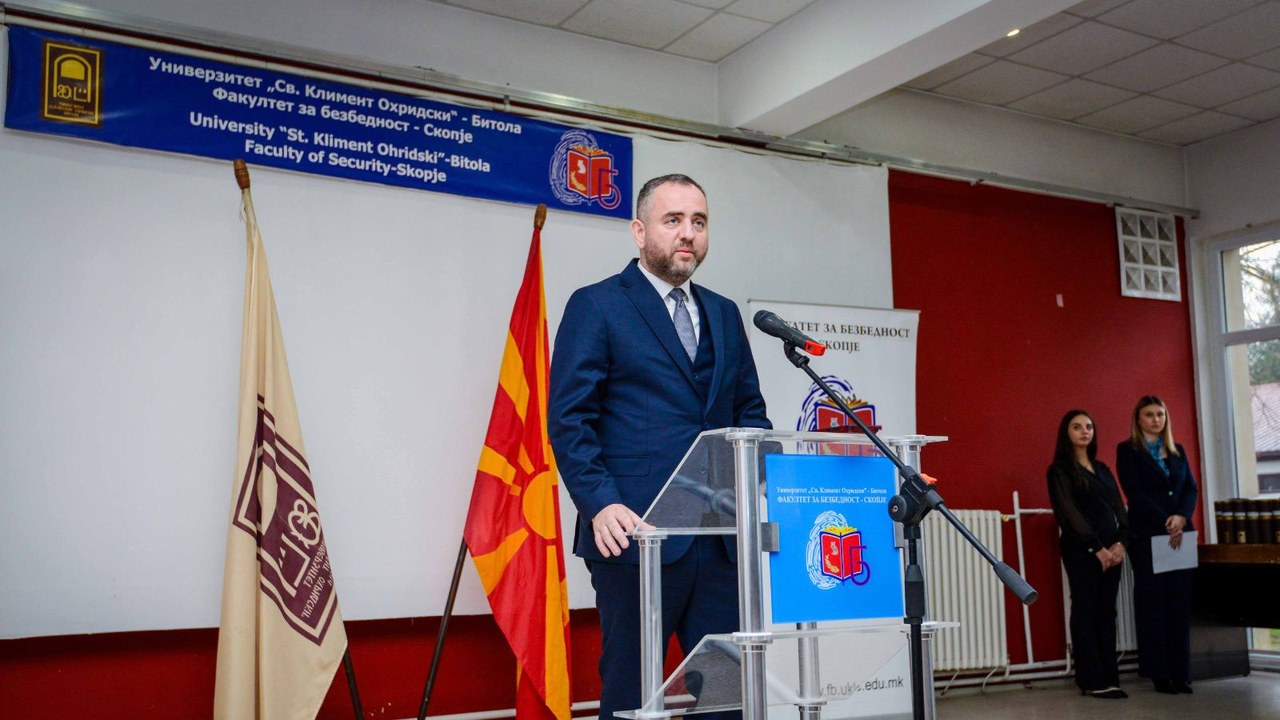
Photo: Interior Ministry (archive, Faculty of Security, December 2025)