Audit: Health Insurance Fund has systemic weaknesses, German hospital seeks €433,771
The State Audit Office points to a lack of controls, open advances for treatment abroad and a number of court claims, including from a German hospital.
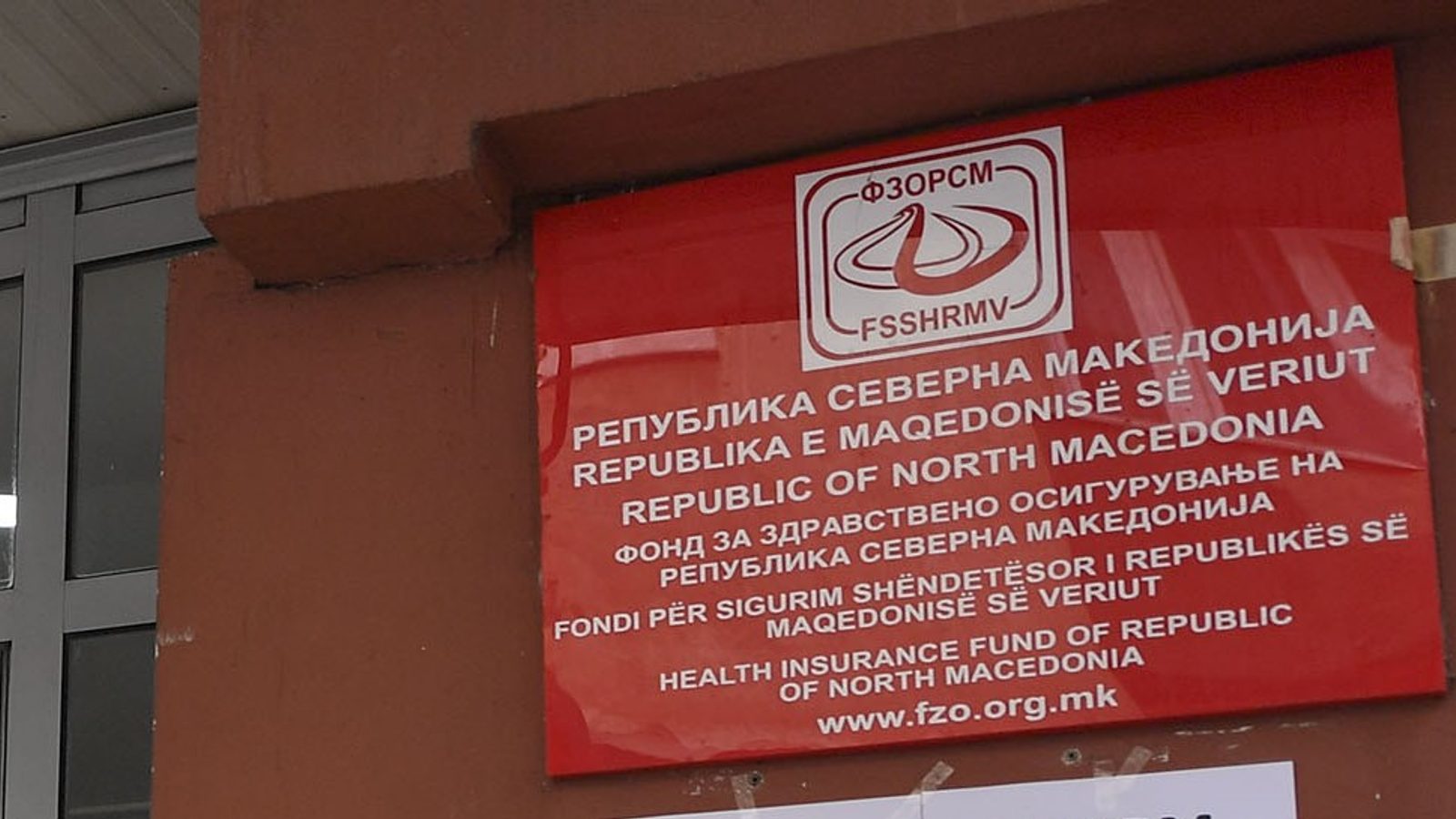
The State Audit Office, in its report on the operations of the Health Insurance Fund (HIF) for 2024, notes systemic weaknesses in financing, control procedures and the information system, with concrete legal and budgetary consequences. The audit points to delays in the introduction of the electronic prescription, inconsistencies in the monitoring of treatment abroad, weaknesses in the financing and procurement from public health institutions and outdated reference prices and drug lists.
The report also lists changes in the Fund’s leadership: Magdalena Filipovska-Graškoska was director from April 2022 to July 2024; from July 2024 until 13 July 2026 the director was Sasho Klekovski, who then became Minister of Health; and from 13 July 2026 the new director of the HIF is former minister Zlatko Perinski.
The auditors state literally: “In 2024 a total of 44 inspections were carried out in institutions that provide hospital health care (HHC), which is 16% fewer than the previous year. Of these, 13 inspections were carried out in private health institutions (PHIs) and the remaining 31 in public health institutions (PHIs), while irregularities were found in 45% of the inspections. Despite the fact that, due to the method of financing, inspections at public health institutions do not have a significant impact on the amount of compensation paid by the Fund, the majority of inspections continuously focus on them. On the other hand, at private health institutions the compensation is directly conditioned by the invoiced type and volume of services, which means that the absence of regular and comprehensive control creates a risk of incorrect invoicing and payment. The amount of compensation paid to private health institutions for hospital health care in 2024 amounts to 1,036,685 thousand denars.”
Open advances and court disputes
The audit points to the growing balance of open advances for treatment abroad and the portfolio of court disputes the outcome of which is uncertain. The auditors say that despite letters to foreign hospitals requesting final invoices or the return of unused advances, these measures have not reduced the balance; approximately half of the open advances relate to the period 2014–2023 for which final invoices have not been received or refunds have not been made.
The report also provides detailed figures for court proceedings. According to the audit, the Fund appears as the defendant in 21 court proceedings in the country with a total value of claims of 286,603 thousand denars, of which 67% are cases by private health institutions for payment of services above the contracted compensation; during 2024 the Fund paid 94,209 thousand denars to two claimants pursuant to final court judgments. Additionally, it states: “In addition, the Fund appears as the defendant in 12 court proceedings initiated by a German hospital, with a claim for collection of partially unpaid invoices for treatment of insured persons, in a total amount of 433,771 euros, i.e. 25,484 thousand denars. In the previous period, based on performed expert appraisal and a legal opinion obtained from a law firm, several pieces of information were submitted to the Government and communication with the hospital was established. As of the date of the audit, no new activities have been undertaken nor have significant changes in the status of the proceedings been recorded. To date, 9 claims from the hospital have been upheld by the German court, and for 4 of them the Fund has filed an appeal.”
On the other hand, the Fund is the claimant in 8 proceedings with a total value of 57,115 thousand denars, of which 97% are for receivables, and in 2025 it filed 6 proceedings with a total value of 580 thousand denars for compensation of damage for treatment costs.
The audit also points to financial strain: as of February 2026, the unpaid contribution by the Fund to pension and disability insurance amounts to 8,415,865 thousand denars (approximately 137 million euros), and unpaid funds from the Ministry of Health on account of the contribution for uninsured persons at the end of 2024 amount to 2,136,300 thousand denars (approximately 35 million euros). The report also indicates problems in the IT infrastructure and integration, as well as delays in the introduction of the electronic prescription; the procured module for receipt and control of invoices for foreign insurance, although delivered and formally accepted, has not been put into operation because it does not meet the needs.
The auditors also point out weaknesses in the financing model for public health institutions: “A key audit issue is that the current model of financing public health institutions does not ensure full application of the principle of payment according to the health services actually performed. Namely, the Fund, instead of reimbursing the real health services performed, has a legal obligation to provide funds for the full functioning of all public health institutions, whereby the majority of them have realized a significantly smaller volume of services compared to the contracted compensation.”
As a concluding assessment, the audit finds that despite actions taken on previous recommendations, serious weaknesses and the need for systemic improvements still remain. The report states: “Recommendations have been given aimed at further improving the work of the Fund.”
Photo: SDK.MK)