Siljanovska‑Davkova in Salzburg: Enlargement is a test of the EU’s strategic capacity
At the 22nd European Summit she called delays and bilateral disputes a threat to the enlargement process and outlined three reforms to protect merit and prevent a two‑tier Europe.
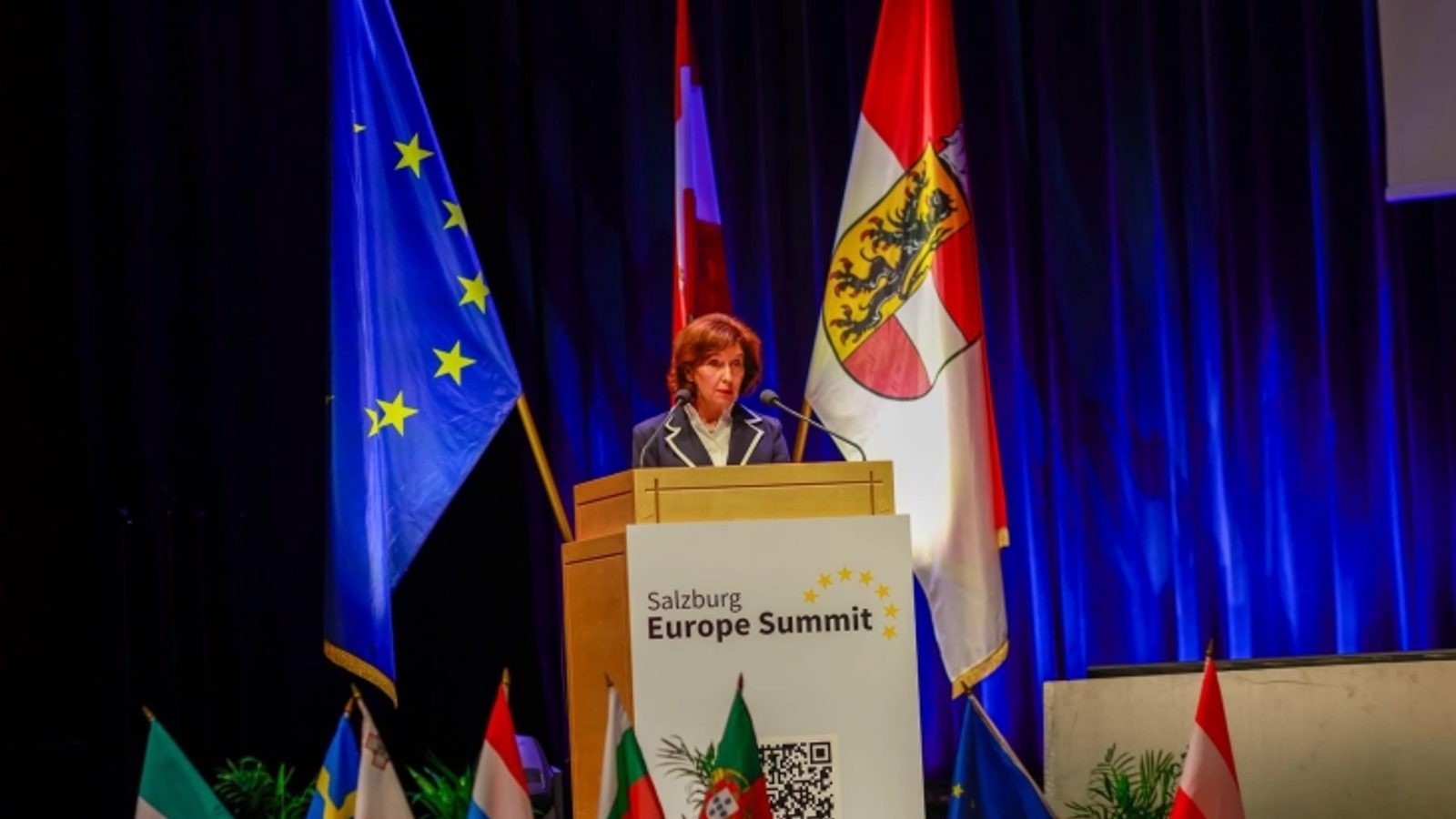
President Gordana Siljanovska‑Davkova told participants at the 22nd European Summit in Salzburg that EU enlargement is not only a policy toward candidate countries but a measure of the Union’s strategic capacity. Speaking on a panel titled "Is Europe (still) a global player?", she warned that delays and bilateral disputes undermine both the credibility of the enlargement process and Europe’s geopolitical weight.
Siljanovska‑Davkova recalled North Macedonia’s decades‑long path toward the EU: "No European state on its integration path has borne a heavier burden than us: we changed our national flag, our constitutional name and adopted 36 constitutional amendments, most dictated from abroad," she said, highlighting the country’s sacrifices and reforms.
She noted concrete indicators of progress: of 35 years of independence, North Macedonia has been a candidate for EU membership for 21 years, received 17 positive reports for opening negotiations, achieved a high degree of alignment with EU law and maintains 100 percent compliance with the Common Foreign and Security Policy. She described the country as among the most successful in carrying out European reforms and in implementing the Western Balkans growth plan.
Three reforms to rescue enlargement’s credibility
At Salzburg Siljanovska‑Davkova proposed three structural changes to restore momentum. First, she argued that a merit‑based system must be protected: "If a country meets objective criteria, no other country should be able to halt its technical progress over an issue that is not part of the European criteria."
Second, she warned against creating first‑ and second‑class membership: protective tools can be legitimate but must be objective, proportionate and time‑limited, not instruments to enshrine permanent hierarchies among members. Third, she said, staged integration can deliver real benefits before full membership—but only if it is a route that leads to membership, not a permanent substitute.
Siljanovska‑Davkova also invoked legal and political principles when she argued that forcing a state to change its internal constitutional structure to settle a historical dispute raises questions about European consistency. "Article 4(2) of the Treaty on European Union obliges the Union to respect the equality of Member States and their national identities embedded in their fundamental political and constitutional structures," she said, calling the case a test of democratic capacity.
Warning that blurred accession prospects can fuel backsliding in the Western Balkans, she said the only force capable of calming tensions and moving the region forward is a credible EU membership perspective. "While associational offers to overseas partners signal global ambition, by postponing its own enlargement the Union effectively demonstrates impotence," she added.
Photo: press material from the event