Supreme Court to review permanent vehicle confiscations after February Criminal Code changes
Judges and prosecutors have reached differing decisions on permanent seizure of vehicles after February's Criminal Code amendments; a December meeting aims to unify practice.
The Supreme Court will review questions over permanent confiscation of motor vehicles after the February amendments to the Criminal Code at a joint meeting with the four Courts of Appeal scheduled for December. The discussion aims to harmonize judicial practice that courts and prosecutors have applied inconsistently in recent months.
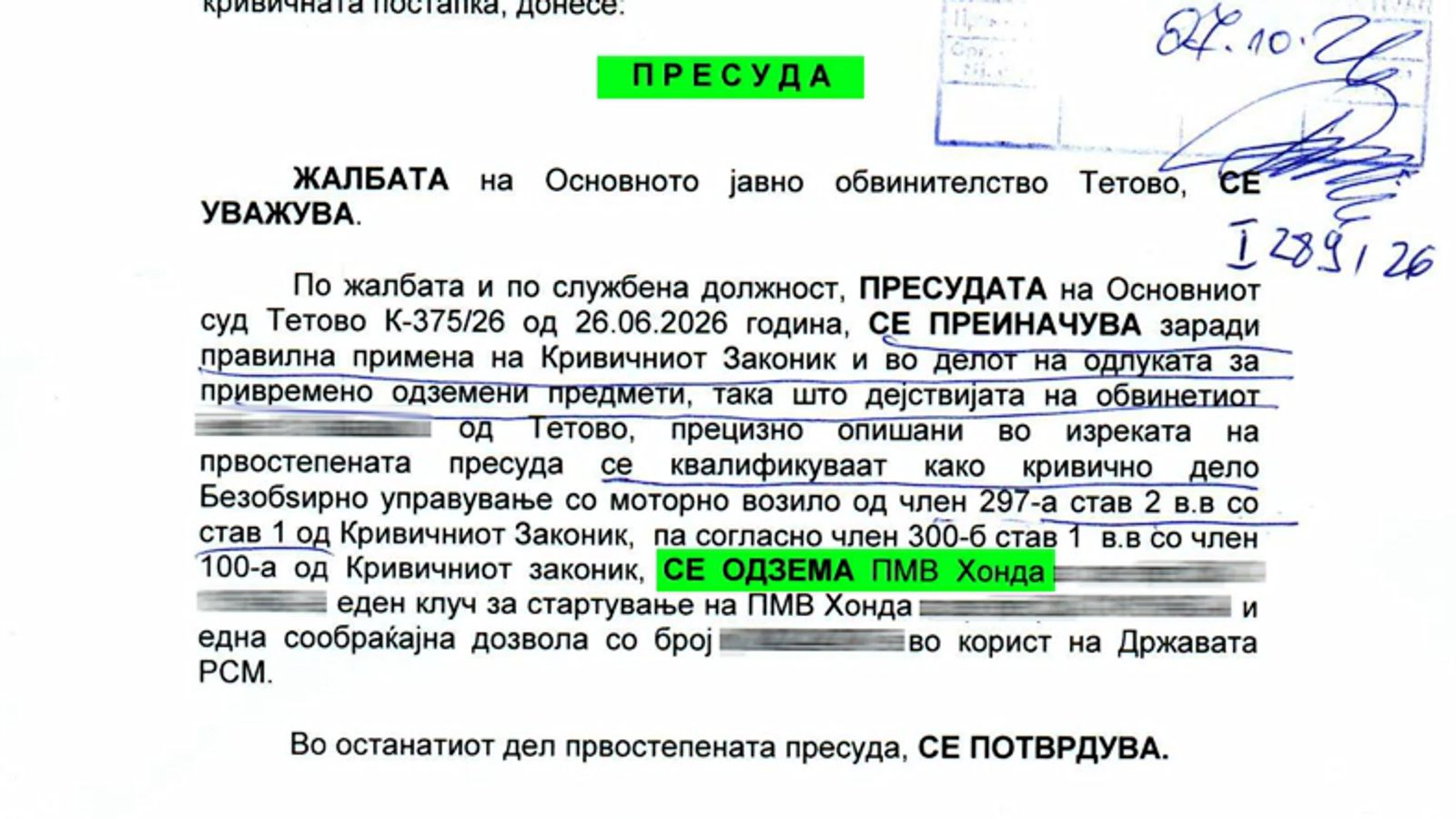
Judicial decisions obtained by newsroom reviewers show divergent approaches even in cases with similar facts — chiefly for driving without a valid licence. A Basic Court in Tetovo ordered confiscation in one such case but declined it in another. The Appellate Court in Gostivar overturned the latter decision and permanently seized the vehicle, arguing the lower court had erred.
According to the Gostivar ruling: "The first-instance court acted incorrectly when it rejected the prosecutor's motion to confiscate items that, according to law, should be confiscated, because the provision of Article 300-b of the Criminal Code provides for mandatory confiscation," the appellate court wrote.
Differences between prosecutors and courts
Other tribunals reached different outcomes. The Criminal Court in Skopje did not order a seizure after a penal order proposal from the Skopje prosecutor's office. Appellate judges say the central question is respect for the proportionality principle under the European Convention on Human Rights, which requires case-by-case assessment.
Gabriela Gajdova, judge and spokeswoman of the Appellate Court Skopje, said the meeting is intended to resolve those doubts. She told reporters: "Given that the Supreme Court is the sole authority to adopt legal principles and legal opinions, and that in our practice it has been established that all four appellate courts gather to discuss contentious issues, we have raised this as a contentious matter and such a meeting will now take place in December when we expect these dilemmas to be resolved," said Gajdova.
Appellate judges from Shtip argued the assessment must be individual, "especially taking into account the practice of the European Court of Human Rights, with regard to double punishment, disproportionate punishment and protection of property." Judges stress that personal circumstances and the gravity of the offence must be weighed "so that by confiscating the motor vehicle an excessive burden is not placed on the accused."
On the ground, the Ministry of Interior temporarily seized 2,098 vehicles in nine months. Meanwhile, the Parliament has already adopted further amendments to the Criminal Code that will prevent vehicles from being confiscated solely for driving without a licence in future cases.
Photo: press material from the event