Kicevo–Ohrid motorway: stabilisation works continue after 12 years
Stabilisation with deep reinforced piles, 250 engineering measures and fresh geo-surveys; environmental groups warn about impacts on the Treska river.
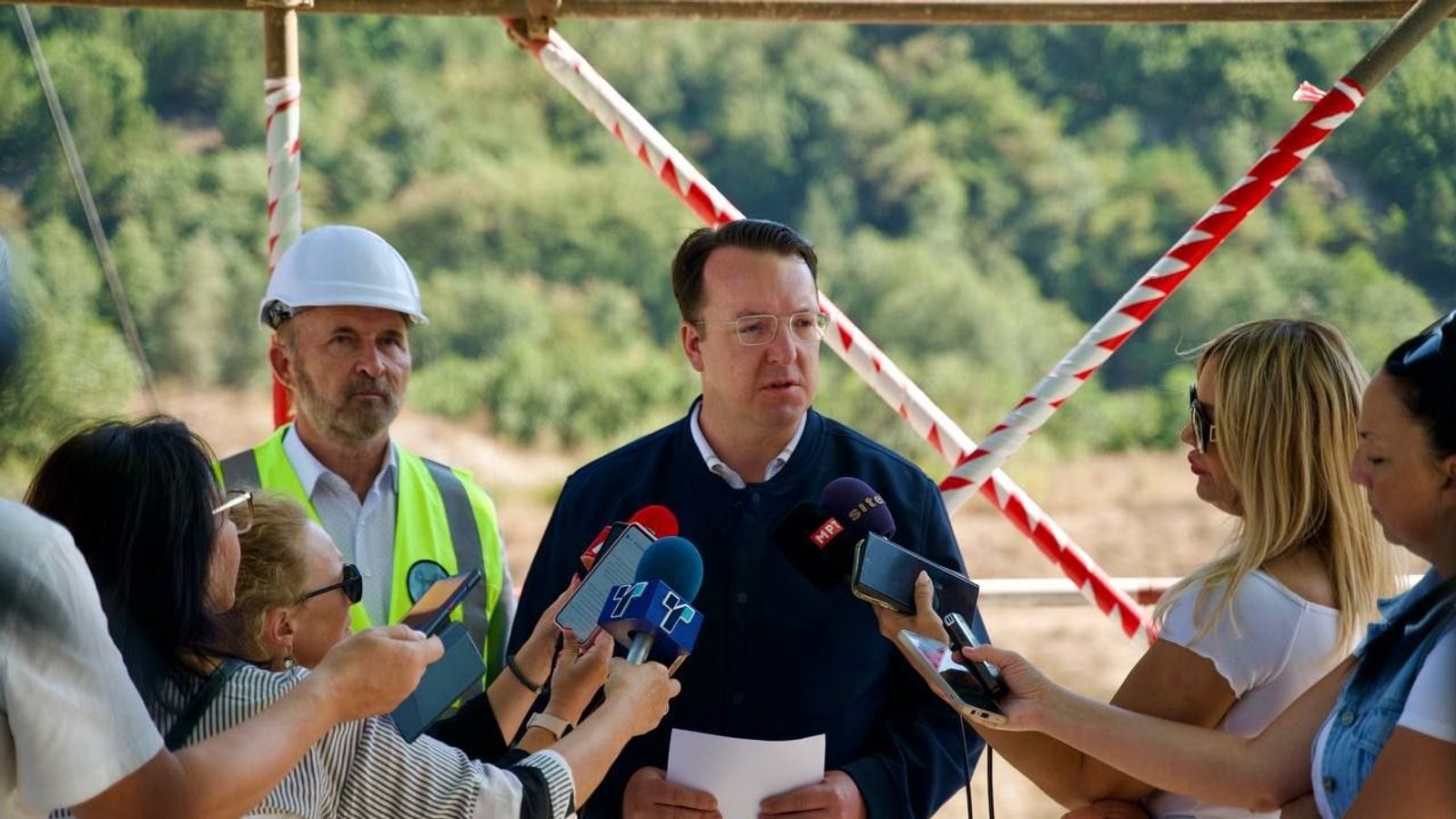
Construction of the Kicevo–Ohrid motorway has entered its 13th year, and engineers are still wrestling with unstable ground and landslides along the route. Work around the village of Botun now focuses on slope stabilisation: reinforced-concrete piles are being driven deep beneath the planned carriageway to secure the subsoil.
Complex ground, heavy reinforcement
As the Transport and Communications Minister Aleksandar Nikoloski described, operators are "going into the 'dragon' 7 to 11 floors down. Reinforcement cages are lowered — each reinforcement cage weighs 30 tonnes of steel — and they are then poured with concrete," a technique repeated across critical sections where the foundation is weak.
Officials say a total of around 250 such engineering solutions will be implemented along the 57-kilometre alignment after fresh geo-investigations. "Additional geo-investigations were carried out over a length of 7 kilometres at roughly 400 to 500 sites with varying depths, to determine the composition of the ground in the lower section and decide which technology will be used for stabilisation," said Koce Trajanov, director of the public enterprise in charge of the project.
Environmental concerns have also been raised. Activist Milan Aleksoski warns that inadequate planning and missing documentation for interventions along the route are affecting the Treska river catchment and its biodiversity.
"The disruption of the geodiversity of Bistra, Stogovo and Ilinska Mountain along the route of the new motorway has a strong negative impact on the biodiversity of the Treska River and all its springs and tributaries. The die-off of the Macedonian native trout should be a red alarm to prevent the catastrophic consequences that still await us," Aleksoski wrote on Facebook.
Minister Nikoloski rejects a link between the motorway works and the reported fish die-off: "That is not connected to the construction of the motorway. In no way is it connected to the construction of the motorway. The motorway is not at all connected to the springs of the Treska," he said.
Budget figures underline the scale and controversy: the project that was initially budgeted at €411 million for 57 kilometres has grown to €744 million — roughly €13 million per kilometre. So far 37 kilometres have been completed, and authorities maintain they aim to open the entire route in the first half of 2027.
Photo: press material from the event