“Who did you make the deal with to let Alta Bank in?” Filipče corners Mickoski: he gives the orders, Latas carries them out
The SDSM leader put to the prime minister the question he keeps avoiding: who was the deal with for Alta Bank’s entry? Mickoski answered with “there is no deal” and insults, while Filipče listed the ordered texts, the Guetta money, Prespa and the debt.
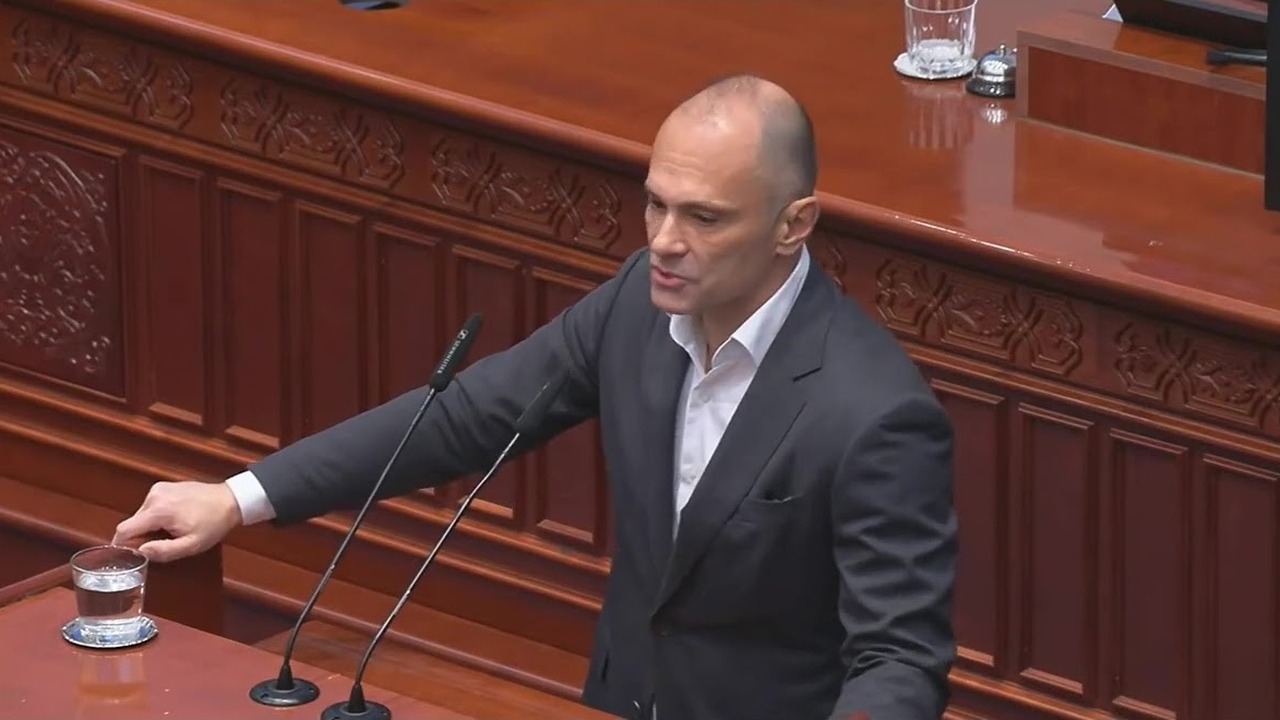
“Hristijan, who did you make the deal with to let Alta Bank into the country?” SDSM leader Venko Filipče put that question to Prime Minister Hristijan Mickoski on 26 November, from the parliamentary podium, at the session of parliamentary questions. The reply, as reported by Telma and Lokalno, was short: “There is no deal for Alta Bank.” Most of the rest of it was insults – “traitor”, “criminals” – and an argument about the economic figures.
The address lasted about five minutes, and Filipče opened it with an identity card. “My professors Jovkovski, Ugrinovski and Saveski say everyone makes their own identity card,” he told Mickoski. “You chose to rule demagogically and in a Machiavellian way, that is, you chose to lie and to control everything.” Then he presented the bill: ordered texts, lies about Guetta, lies about identity, debt, Alta Bank and – at the very end – “the comrades from Serbia”.
“He shamelessly admitted that you order texts”
Filipče returned to the statement the prime minister made on 23 November on Telma’s “Top Topic” programme. Commenting on the Financial Times pieces about Serbia’s Alta Group and its owner Davor Macura, Mickoski said: “We can order a text wherever you want, in whatever portal you want, and whatever it says… If we want to.” When the journalist remarked that this was not good, the answer was: “We can, I don’t know what is not good here… I am speaking hypothetically. A text can be ordered in any medium and in any way, I am not saying it will happen, to compromise someone.”
“A few days ago, in an interview on Telma, you shamelessly admitted that you order texts,” Filipče told him in Parliament. “You can order a text wherever you want, whenever you want, in any medium. We know that. You have now admitted before the entire Macedonian public that you are the inspirer, the creator, that you carry out all the media lynchings, black campaigns, fake news… campaigns with which you pollute the spirit of the citizens, because from that huge number of fake news items they no longer know what is true and what is a lie. But that is your goal, so that you can fish in troubled waters afterwards.” He then named the person who, in his words, does the job: “You are the one who obviously gives the orders. Latas is the one who carries them out. But we saw in Serbia how those campaigns end.”
Reactions to the original statement came at once. The Association of Journalists of Macedonia (ZNM) and the Independent Trade Union of Journalists and Media Workers (SSNM) reminded the public that ordered content may be published only as clearly marked paid advertising, and that any hidden influence on editorial policy runs against professional and ethical standards. Journalist Vasko Magleshov judged that the prime minister reduces the media to ordered pieces and the public space to a market for buying narratives. SDSM said the statement confirms its long-standing warnings, and at its press conference on 24 November Filipče stressed that the Financial Times is not “Alfa television”.
Mickoski later explained that he was speaking hypothetically and that the statement was taken out of context. On 25 November, at the opening of a facility in Butel, he said: “Let one of your colleagues come forward and say whether I have ordered a text,” but added that the Government will keep “ordering articles and authored texts” as part of campaigns of the “Invest in Macedonia” type. The Financial Times, for its part, stood by its position that the text on Alta Group is credible and that no money was taken for it. No evidence is publicly known that any specific text was actually ordered – and Filipče presented none in his speech. But the question remains: why does a prime minister, on camera, describe ordering a text as something that “can” be done?
“He said zero denars of taxpayers’ money” – and then five million euros came out
“He lied about David Guetta. He said zero denars of taxpayers’ money. The next day it came out that it was 5 million euros of taxpayers’ money for a party, amid all this poverty and crisis… Another shameless and brazen lie,” Filipče said.
This is the documented version. On 10 September, two days after Guetta’s concert in Skopje, the Government, the State Lottery and the organiser “Avalon” announced at a joint press conference that the celebration of 35 years of independence cost more than 300 million denars, or five million euros. Government spokeswoman Marija Miteva said: “No budget funds were spent on the realisation of any of the events of the celebration. The cost of these events is not borne by the citizens, and that can easily be checked.” The money, she said, came from the State Lottery – 300 million denars from its undistributed profit for 2024 – while another 40 million denars came from socially responsible companies.
The director of the State Lottery, Aleksandar Klimovski, explained: “The State Lottery as a company is a separate legal entity, distinct from the Government, which is the founder of the company. So that money is not budget money. It becomes budget money when that undistributed profit is paid into the treasury account.” The whole dispute fits in one sentence: the Lottery is a state company founded by the Government, and its profit – in the words of its own director – becomes budget money as soon as it is paid into the treasury. Filipče calls it “taxpayers’ money”; the Government says it is not state money. The public call, which lasted five days, drew a single bid – from Stardust DOOEL, the entity through which Avalon International Booking operates. How much Guetta and the other performers were paid was not disclosed.
“He lied about identity”
Filipče reminded citizens of the advertisements from the time before Mickoski came to power, in which bowed figures walk down the street, while Mickoski claimed that identity had been sold off through the Prespa Agreement. “Now you yourself admit that the Prespa Agreement protected the identity, and that our language is already recognised at the United Nations. You are the one saying it,” he said.
“President von der Leyen came here too and told you directly, openly, to your face: we are waiting for you in Europe with your identity and language,” Filipče went on, adding that instead of progress towards the European Union, citizens are being sold “free roaming” as a success. “Citizens want to move freely across Europe, to travel, not to wait for hours at the border. They want to be part of the free market of 500 million people – not to talk on the phone without paying extra. They want a quality life.”
“We are at the bottom in GDP per capita”
“We were supposedly the third economy in Europe. What third economy? We are at the bottom in gross domestic product per capita. People feel that every day,” Filipče said. That matches the ranking based on the International Monetary Fund’s October projections, which places Macedonia 41st among 48 European economies, with projected GDP per capita of $11,762 for 2026.
According to Filipče, prices have risen by “30 to 40 per cent” in two years for basic products and fuel, and total state debt has grown by 50 per cent, “from eight to almost 12 billion euros” – for current spending, without a single major capital project except those started under SDSM governments, “which you then criticised as the most corrupt”. The latest published figures, reported by DW, show public debt of €10.73 billion, or 58.8 per cent of GDP, at the end of the second quarter; Filipče speaks of a figure close to 12 billion.
Mickoski defends the economy with growth: 3.8 per cent in both 2024 and 2025 and 3.7 per cent this year, while, he said, we are comparing against “a very low base thanks to your Government”. On fuel, he claims that abroad people ask him how his diesel manages to be “30 to 50 euro cents per litre” cheaper than theirs. He called the Bechtel and Enka contract for Corridors 8 and 10, begun under the previous Government, “criminal” and urged the Public Prosecutor’s Office to investigate it: “The worst project for Macedonia, but we have to finish it, what can we do!?” That is precisely Filipče’s point: the projects they criticised as “the most corrupt” are now the only ones driving the economy.
The Alta Bank question: who was the deal with?
Here Filipče brought the speech to its peak: “From such murky water you are bringing in Alta Bank here, the most criminal bank in Europe, the bank in which Vučić laundered money, which had money from smuggled drugs, Russian money banned everywhere in Europe… You once stopped Davor Macura through one company, and then you let him come in here through the bank. And then you say the problem was imported. Well, yes, you imported that problem. You endangered the money of citizens and of companies. My direct question: who did you make the deal with for Alta Bank’s entry into the country?”
What is documented, and what is a political assessment? The Financial Times reported that the European Central Bank had contested Alta Group’s attempt to acquire a stake in an Austrian bank and that Alta played a significant role in money transfers for Russian citizens and companies after Russia’s invasion of Ukraine in 2022. Serbia’s Prosecutor’s Office for Organised Crime suspects Macura of taking around 45 billion dinars – almost €383 million – out of the vault of Alta Bank in Belgrade. On 1 November the National Bank placed Alta Bank AD Bitola under temporary administration, and clients were limited to 15,000 denars a week by card. There is, however, no court ruling that the bank is a “money-laundering machine”, and no publicly presented evidence of any deal for its entry – that is the political assessment of Filipče and SDSM. In his speech Filipče did not name the company through which Macura was supposedly “stopped”, nor did he show a document.
SDSM, after the criminal complaints it had already filed, on 24 November also submitted an interpellation of Governor Trajko Slaveski, demanding political accountability, and Filipče asked President Gordana Siljanovska-Davkova whether she had been under pressure to nominate Slaveski as governor. VMRO-DPMNE hit back that “SDS is running from responsibility because it, together with DUI, was opening the door for Alta Bank”. The answer to the question itself – who the deal was with – came down, in media reports, to one thing: “no deal”.
The message to the “comrades from Serbia”
At the very end Filipče told Mickoski: “Tell the comrades with whom you are now preparing a fuel oil import not to threaten me, the comrades from Serbia, because I am not afraid of you. I am on the side of Macedonia. You are on the side of crime.”
Filipče did not say who is threatening him, or what the fuel oil deal is, and there is no public confirmation of either; in the reported reply the prime minister did not address that part. Those are his claims and should be read as such. But when the leader of the largest opposition party says from the parliamentary podium that “comrades from Serbia” have threatened him, and the authorities answer neither yes nor no, the question does not disappear on its own.
“I know you are deal-oriented” – Mickoski’s answer
Mickoski answered with personal labels. “Yes, I think you are a traitor and I have not changed my opinion, but I will defend you in Brussels. I will never inform on you abroad. I know you are ‘deal-oriented’, but this government is different. There is no deal for Alta Bank,” he said. According to Telma, Filipče had earlier called him a hypocrite and a liar who says one thing abroad and another at home, and the prime minister shot back that, unlike him, he does not make deals and is not an informer.
So, before the eyes of the public, this is the record: the prime minister calls the leader of the largest opposition party a traitor and a criminal; he calls one contract “criminal” while saying it must be completed; and to a question about a bank he answers that there is “no deal”. Every citizen can judge for themselves which of the two answered what they were asked.
The questions that remain
Filipče’s claims about “the most criminal bank”, about laundered money and about the “comrades from Serbia” are political accusations by the opposition: no court has confirmed any of it, and Mickoski and the Government reject them. But the questions stay on the table: who let Alta Bank onto the Macedonian market, by what procedure, and what did the Government and the National Bank know beforehand; why a prime minister in an interview sees ordering a text as something that “can” be done; how large the real debt is and where the borrowing went; whose money paid for the five-million-euro concert and why the public call drew only one bid; and who the “comrades” are that threatened the opposition leader. Until they are answered, “no deal” remains just a sentence.
Sources: Telma (the exchange in Parliament), Lokalno (Filipče’s question), Lokalno (Mickoski’s reply), Lokalno (“Top Topic”), Lokalno (Mickoski’s clarification), DW (the ZNM and SSNM reactions), SDSM (the 24 November press conference), SDSM (the interpellation), SDSM (the question to Siljanovska-Davkova), TIME.mk (VMRO-DPMNE’s reply), Sakam da kazam (the independence celebration), DW (the GDP ranking), DW (public debt), Blic (the suspicion against Macura), Telma (the Alta Bank limits).
Photo: frame from the SDSM video of the parliamentary session, 26 November 2026