Tractors in the centre of Strumica: 25 denars for the ajvar pepper, and the minister did not come to the protest
Forty denars last year, 25 this year — while not one cost has fallen by a single denar. A third day of blockades, an ultimatum for Tuesday and the threat of blocking the road to Bulgaria.
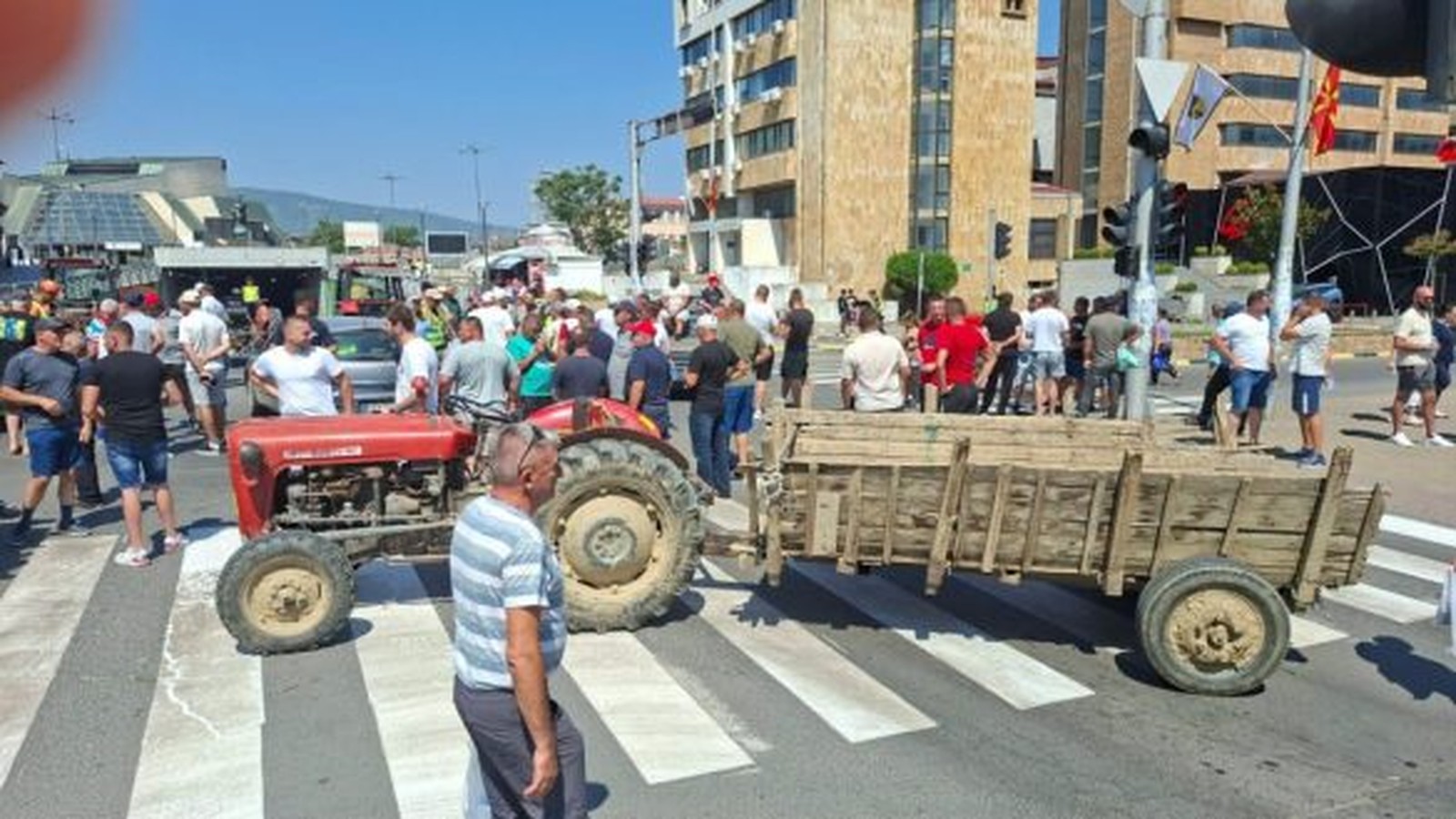
The tractors are back on the asphalt. For the third consecutive day, farmers from the Strumica region have taken to the streets, and in the latest protest they blocked the very centre of Strumica with tractors and heavy agricultural machinery. The reason is a single number: 25 denars per kilogram of red pepper — the kurtovska kapija variety, popularly known as ajvarka, which processing plants are buying at a price producers call humiliating.
Last year the same pepper was bought at 40 denars per kilogram, and mixed first and second class at 35 to 40 denars. This year the price fell to 25. That is a drop of roughly one fifth in a single year, at a time when not one production cost has fallen by even a denar. Picking alone costs five denars per kilogram, and on top of that come inputs, fertiliser, feed, plastic sheeting and water.
A double blow in a single season
This season was a series of blows for the ajvar pepper growers. First the spring floods destroyed part of their crop, then the strong July winds tore apart their greenhouses, which they had to rebuild out of their own pockets. Inside those same greenhouses they work at temperatures of 50 to 60 degrees Celsius.
"Everyone says construction workers suffered the most from the heat. No, it is us, the farmers, who suffer, working in greenhouses at 50 to 60 degrees. The state should stand behind the farmers, and the factories and buyers should ask themselves whether we will plant the same quantity of peppers next year at these humiliating prices. We will not plant. Production will fall," the producers say.
At one of the protests, a banner in the hands of a Strumica farmer reduced the entire economic calculation to a single sentence: "I gave you 50 tonnes of red pepper, and my children are eating dry bread — and they do not even have enough of that."
What the farmers are actually asking for
Their demands are neither a subsidy by decree nor a guaranteed price by regulation. The producers are asking for order in the purchasing process and for predictability:
- First class — 50 denars per kilogram, first-to-second class — 40 denars, second class — 20 denars.
- Prices to hold for the entire purchasing season, with no unilateral reduction or change of terms during the buy-up.
- Payment for delivered produce within a maximum of three months from the day of delivery.
- Timely and immediate payment of subsidies per kilogram of pepper delivered, followed immediately by subsidies per planted area.
In other words, they are asking for a contract with known rules before they hand over the goods, rather than a price they learn only after the truck has been unloaded.
The minister who did not come to the protest
The farmers invited the Minister of Agriculture, Forestry and Water Economy, Borche Serafimovski, to come out and face them at the blockade near the junction for the village of Robovo, on the road between Dabile and Bosilovo. More than a hundred producers with tractors and freight vehicles waited for him for two hours. The minister did not come to the protest. On the same day he held separate meetings with producers and with registered buyers and traders in Strumica.
His message was that the state does not dictate the market price, but that it has an obligation to ensure a lawful, transparent and predictable purchasing process. The Ministry announced that talks would continue the following week with the owners of the processing plants, and that the State Agricultural Inspectorate would continue its daily checks at purchase points — verifying purchasing conditions, the public display of prices, product classification, the accuracy of measuring instruments and the state of documentation.
And here lies the heart of the problem. The farmers did not ask the minister to set a price for them — they asked him to seat the buyers and processors at the same table and to mediate. Instead they received a promise of a meeting a week later, and inspections that check whether the price is displayed, not whether it is sustainable. Checking the scales does not solve the fact that the measurement shows a loss.
An ultimatum for Tuesday
After three days of blockades, the protest representatives are unequivocal. Aleksandar Grozdanov of the "Mladi Murtino" association conveyed the producers' decision:
"Yesterday the minister promised us he would secure a higher purchase price, but if we do not get a price that is acceptable and that genuinely covers our production costs, from Tuesday we are back on the streets with even larger protests and radical blockades."
The next step on the table is a blockade of the Strumica–Novo Selo border crossing route, the road towards Bulgaria. It is the last resort of people who have no other way of being heard.
Why this is not local news
The Strumica region is the country's market-gardening heart. If production there stops paying, peppers will not disappear from the market — they will come from imports, at a price the consumer pays and the farmer never sees. When producers say "we will not plant next year", that is not a threat, it is arithmetic.
The question is no longer whether the blockade is justified. The question is why every year the same conversation begins only once the tractor is on the asphalt — and why the state, which has institutions for purchase points, an inspectorate and a ministry, always arrives after the bill has already been written on the farmer's back.
Photo: Navalica