Women dominate sciences but are underrepresented in technology — panel at FINKI
Panel at FINKI in Skopje highlighted statistics, barriers and initiatives to encourage girls and women into STEM careers.
Women make up roughly 70 percent of graduates in natural sciences and mathematics in North Macedonia and account for more than half of researchers, yet their presence in technology remains much smaller: about 33 percent of graduates in information and communication technologies are women, and they represent less than a quarter of the IT workforce.
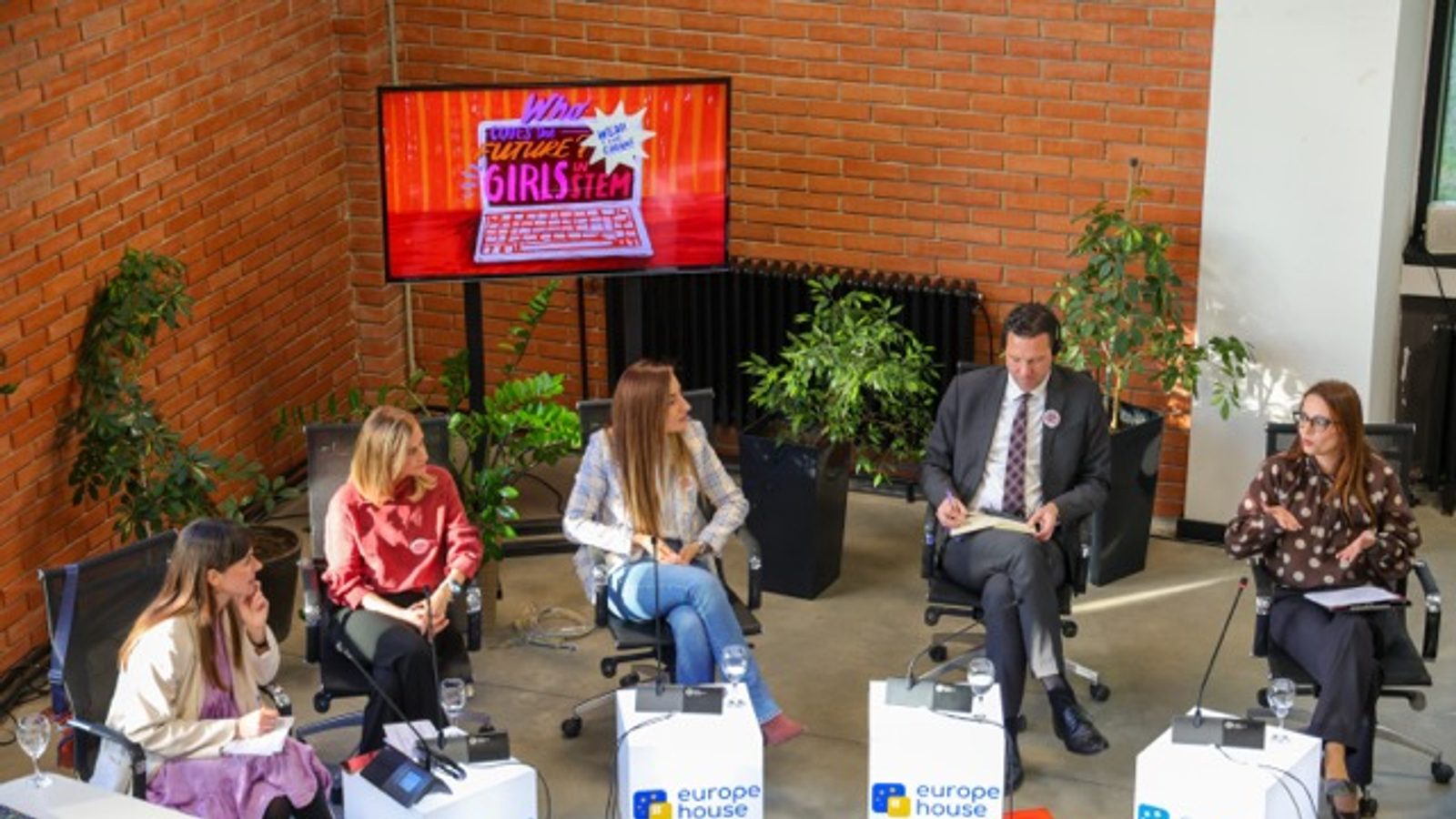
These disparities were the focus of yesterday's panel discussion “Who codes the future? – girls in STEM,” held on the FINKI campus in Skopje. The event was part of the Wear the Change campaign and a national caravan organised by Europe House and the Delegation of the European Union.
Panelists examined structural and institutional barriers, stereotypes and inequalities that affect girls' and women's access to and participation in STEM. Speakers emphasised that limited support, a sense of not belonging and the lack of visible female role models often shape educational and career choices.
The panel included Ambassador Ola Sulstrem; Marijana Ilovska Zlatanovski, executive director for digital innovations at Intertec.io and director for partnerships at Women in Tech North Macedonia; Prof. Dr. Ana Poceva Panovska from the Faculty of Pharmacy at Ss. Cyril and Methodius University in Skopje (UKIM); and Prof. Dr. Nevenka Kiteva Rogleva from the Faculty of Electrical Engineering and Information Technologies (FEIT) at UKIM. The discussion was moderated by Andrea Ugrinoska of Tiit! Inc. – Skopje.
Voices from the panel
Prof. Dr. Ana Poceva Panovska highlighted long-term shifts in pharmacy education and the results when barriers are removed. "More than a hundred years ago, pharmacy was a profession dominated by men. Today, more than 90 percent of students at our faculty are women. This change shows what happens when opportunities for education and professional development are opened to women," she said.
Marijana Ilovska Zlatanovski stressed that while the number of women in technology has grown, questions remain about advancement to leadership posts. "Over the years the number of women in technology has grown dramatically, but then a new question appeared: what do we do with women in leadership positions in the world of technology? I am glad that today we work on overcoming those barriers and encouraging girls to take greater initiative. There is definitely progress, but there is still much to be done," she said.
Ambassador Ola Sulstrem pointed to the need for long-term investment in education, research and innovation and support for young people. "I believe the future of this country, the region and the world largely depends on the young woman who today is 20 years old, who wonders what comes next and decides which path to take," he said.
Prof. Dr. Nevenka Kiteva Rogleva described her path from the traditionally male-dominated energy sector and underlined the importance of interest, knowledge and strong education. "I come from the field of energy, which is traditionally considered a male profession. But my professional path shows that interest, knowledge and a good educational foundation are far more important than gender stereotypes. Support from family and teachers is especially important for young girls to be encouraged to follow their interest in science and technologyE," she said.
The session ended with a public question-and-answer segment. Panelists warned that when girls and women do not have equal conditions to develop their potential, society loses opportunities for innovation, diverse perspectives and more effective solutions.
Photo: press material from the event